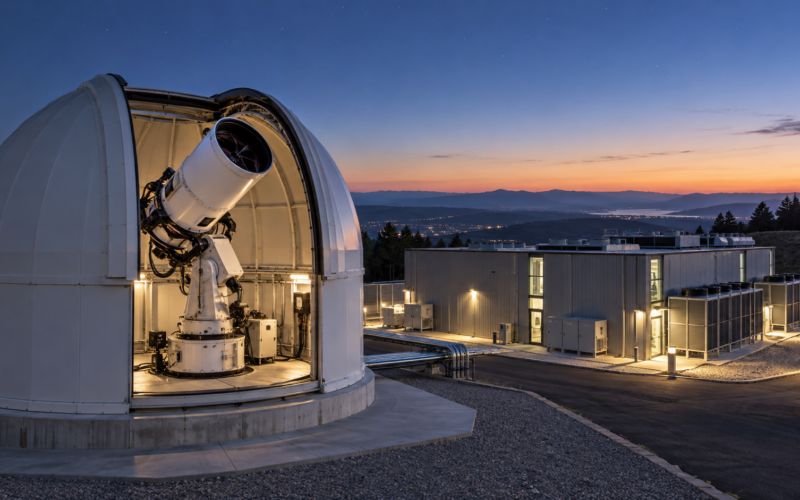
NTT, Inc. (TSE: 9432) has signed a memorandum of understanding with French photonics company Cailabs to develop next-generation optical ground stations capable of connecting satellite networks more directly with terrestrial data infrastructure. The companies will investigate integrating NTT’s digital coherent communications and network-control technologies into Cailabs ground stations, then linking selected stations to nearby NTT data centres through the All-Photonics Network that sits at the centre of NTT’s Innovative Optical and Wireless Network strategy. The collaboration begins with demonstrations and basic communication capabilities before potentially progressing toward higher-capacity coherent optical links, meaning it remains a development programme rather than a commercial deployment contract with disclosed revenue. Its strategic significance lies in creating an end-to-end architecture spanning satellites, ground stations, terrestrial optical networks and data centres instead of treating the satellite downlink as a separate communications system.
Satellite constellations are generating increasing quantities of Earth observation, communications and scientific data, while conventional radio-frequency links face spectrum and throughput constraints as the number of spacecraft grows. Optical communications can transmit large quantities of information through laser links and potentially provide higher data rates than conventional radio systems, although they introduce their own challenges around atmospheric conditions, pointing accuracy and ground-station availability. NTT and Cailabs are therefore focusing not only on the laser terminal but also on network orchestration, including the ability to route traffic around optical ground stations affected by weather and move data through terrestrial optical infrastructure after it reaches Earth.
Why does linking optical ground stations directly to data centres change satellite network economics?
Satellite communications traditionally involve several stages between receiving a signal and making the resulting data available to a customer. A ground station receives information, terrestrial networks transport it onward, and processing or storage infrastructure then handles the workload. Integrating those layers more tightly can reduce operational complexity and potentially shorten the path between orbital data collection and computational processing.
NTT wants selected Cailabs ground stations connected directly to nearby data centres through its All-Photonics Network. APN is designed to provide end-to-end optical wavelength paths with high capacity, low latency and lower power consumption by keeping data in the optical domain across more of the network instead of repeatedly converting signals between optical and electrical formats.
That architecture could become particularly useful as satellites generate workloads intended for artificial intelligence analysis. Earth observation imagery, weather information and defence-related sensor data increasingly need rapid processing rather than simple archival storage. Moving information from orbit into a nearby data centre through high-capacity optical infrastructure could allow customers to process satellite data faster and reduce some of the networking bottlenecks between collection and computation.
The commercial value will depend on whether NTT and Cailabs can make the architecture reliable enough for operational services. Optical satellite links can be disrupted by clouds and atmospheric conditions, so a scalable network needs multiple geographically distributed ground stations and intelligent routing capable of switching between them automatically.
How is NTT trying to solve the weather problem that complicates optical satellite links?
NTT’s network-control technology is designed to detect when a ground station becomes unavailable and reroute communications through another station and the All-Photonics Network. Cailabs brings the physical optical ground-station technology, while NTT contributes terrestrial optical transport and orchestration capabilities.
This is important because clouds can block optical links even when the satellite itself and the ground equipment are functioning correctly. A single optical station can therefore have lower practical availability than a conventional radio link unless operators can redirect traffic rapidly between sites with different weather conditions.
A distributed network changes the reliability equation. If several optical ground stations are connected through a low-latency terrestrial backbone, the satellite network can select whichever location currently offers a usable optical path and then transport the data through the terrestrial network to the destination.
The concept resembles geographic redundancy in conventional data-centre infrastructure. Reliability emerges not because every individual component remains available at all times, but because workloads can move among several available locations.
Why does digital coherent technology matter to the capacity NTT and Cailabs ultimately want?
Digital coherent communications encode information using several characteristics of a light wave rather than only its intensity. The technique is already central to high-capacity terrestrial optical networks because it allows much more information to travel through a fibre while sophisticated signal processing compensates for transmission imperfections.
NTT and Cailabs plan to assess whether similar coherent techniques can increase the capacity of future satellite-to-ground optical links. The programme will begin with simpler demonstrations before moving toward more advanced coherent communication if early phases perform as expected.
This staged approach is technically important. Free-space optical communications face challenges that ordinary fibre networks do not, including atmospheric turbulence and movement between the satellite and receiver. Technologies proven inside glass fibre therefore cannot simply be transferred unchanged into a satellite link.
If those engineering problems can be managed, coherent optical communications could materially increase the amount of information delivered from future constellations. That matters as satellite operators deploy higher-resolution cameras, synthetic aperture radar and other sensors that generate far larger datasets than traditional telemetry.
How does the Cailabs collaboration fit NTT’s wider NTT C89 space strategy?
NTT is positioning the work inside NTT C89, its broader space-business initiative. The company says the Cailabs programme could eventually expand into a wider network of optical ground stations connected to NTT data centres, creating an infrastructure platform that combines satellite connectivity, terrestrial networking and computing resources.
That would extend NTT beyond its traditional telecommunications role. Instead of simply selling terrestrial connectivity, the company could participate in the infrastructure used to bring data from orbit into cloud and enterprise environments.
Cailabs gains a similarly useful route into the terrestrial network. The French company can manufacture optical ground stations, but satellite connectivity becomes more valuable when the received data can immediately move through a reliable global network toward storage and processing infrastructure.
The arrangement therefore reflects a broader convergence between telecom networks, cloud computing and space infrastructure. Satellites are becoming another source and destination of data attached to global computing networks rather than an isolated communications market.
What remains commercially unproven in the NTT-Cailabs agreement?
The most important missing element is financial scale. Neither company disclosed investment, contract value, customer commitments, planned numbers of ground stations or a firm date for commercial service. The agreement is explicitly exploratory and uses a phased technical programme beginning with demonstrations.
The companies also have to prove reliability across weather conditions and geographies before the architecture can support mission-critical satellite services. Building several ground stations improves availability but adds capital expenditure, land requirements and operating complexity.
Competition is another consideration. Space laser communications are attracting investment from satellite manufacturers, defence contractors, telecom operators and optical technology specialists, while radio systems remain entrenched and continue improving.
The investment case for NTT therefore rests less on one memorandum and more on whether IOWN becomes useful outside terrestrial telecom. If Cailabs ground stations can eventually connect satellites directly into NTT data centres at scale, the project would demonstrate that NTT’s optical-network strategy has applications stretching from cloud infrastructure all the way into orbit.
What does NTT’s share price indicate as the optical-space strategy develops?
NTT shares closed September 18 at ¥177.30, down 1.5% for the session. The stock was about 0.9% above its September 11 close of ¥175.70 and approximately 10.5% above the August 18 close of ¥160.40, while its latest 52-week range stood at ¥142.60 to ¥180.10.
The September 18 decline should not be attributed specifically to the Cailabs agreement because the programme does not yet contain financial commitments large enough to alter near-term group forecasts. The more relevant observation is that NTT shares were trading very close to their 52-week high while the company continues broadening the commercial applications of IOWN.
Optical ground stations will not materially change NTT’s earnings immediately. They could, however, demonstrate whether the company’s photonics strategy can create revenue pools outside ordinary fixed and mobile communications.
Discover more from Business-News-Today.com
Subscribe to get the latest posts sent to your email.