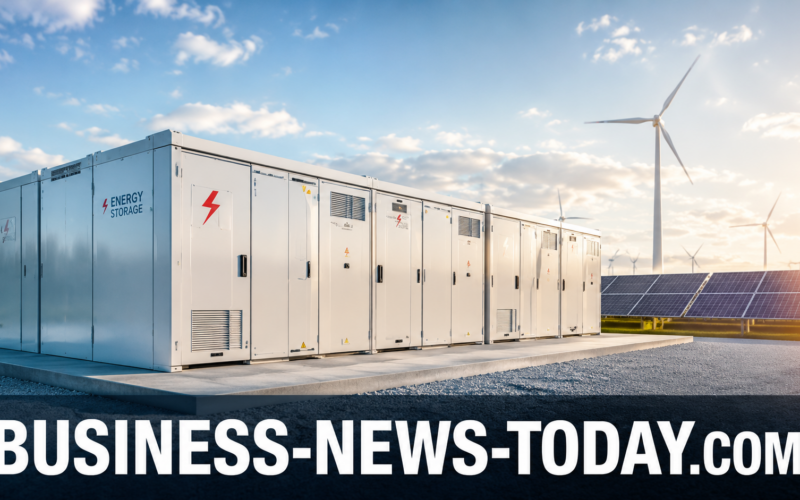
Northland Power Inc. (TSX: NPI) has closed approximately PLN500 million, or C$185 million, of project financing for the Mieczysławów and Kamionka battery energy storage projects in Poland, completing the funding structure for a combined 300 MW/1.2 GWh portfolio already under construction. Mieczysławów is designed at 200 MW/800 MWh and Kamionka at 100 MW/400 MWh, giving both projects a four-hour storage duration at rated power.
The financing sits alongside approximately PLN280 million, or C$105 million, of grants from Poland’s National Fund for Environmental Protection and Water Management, while Northland says its equity contribution has already been funded from corporate cash and available liquidity. Total capital cost for the two projects is estimated at approximately PLN1 billion, or around C$400 million.
How is Northland funding PLN1bn of Polish battery construction?
The financing structure gives an unusually clear view into the capital stack. Approximately PLN500 million of project debt represents about half of the stated PLN1 billion total capital cost, while PLN280 million of grants represents roughly another 28%.
Together, debt and grants therefore cover approximately 78% of the stated project cost on a simple comparison. The remaining portion is broadly consistent with Northland’s statement that its equity commitment has already been fulfilled, although the company did not disclose an exact final equity amount and all headline figures are approximate.
This is why grant support can materially change storage economics. Batteries require heavy upfront expenditure while revenue is earned over years from capacity contracts, grid services and energy-market trading. Reducing the amount of equity and debt required lowers the financial burden that operating revenues must eventually recover.
The structure also shows why capital cost cannot be compared only with battery MW. These projects include cells, power-conversion systems, transformers, grid connection, controls, land, civil works and other infrastructure required to operate at utility scale.
What does 300 MW/1.2 GWh tell us about how the batteries will operate?
Dividing 1.2 GWh of energy capacity by 300 MW of power capacity produces a four-hour duration.
That places Mieczysławów and Kamionka in a different category from one-hour or two-hour batteries focused primarily on very short system-balancing events. Four-hour systems can shift materially larger blocks of electricity between parts of the day, making them useful for absorbing renewable generation and supplying electricity through evening or other constrained periods.
The projects can still participate in ancillary-service markets where response speed matters, but their larger energy reservoirs create additional commercial options.
Northland has not suggested that the batteries will discharge at full output for four hours during every cycle. Actual dispatch will depend on market prices, grid-service obligations, state of charge, degradation management and operating strategy.
Why do 17-year inflation-indexed auction agreements matter if batteries can also trade in power markets?
Northland says a portion of project revenues is contracted through 17-year inflation-indexed auction agreements, while the assets will also have opportunities in energy arbitrage and ancillary-services markets.
That revenue mix can be valuable because contracted payments create a predictable base that supports project debt, while merchant activities preserve upside from volatile electricity markets.
Purely merchant batteries can earn exceptional returns during periods of large price spreads but face revenue uncertainty as competition grows. Fully contracted assets offer greater certainty but can surrender some market upside.
Northland’s model attempts to combine both. The inflation linkage also provides some protection against long-term cost increases, although the exact proportion of revenue under contract versus merchant exposure was not disclosed.
Can PLN1bn of batteries really produce C$40m–C$50m of annual adjusted EBITDA?
Northland expects the two projects to contribute approximately C$40 million to C$50 million of combined annual adjusted EBITDA once fully operational. That is management guidance rather than a guaranteed outcome.
Compared with the roughly C$400 million estimated capital cost, the expected EBITDA represents a simple annual ratio of approximately 10%–12.5% before interest, tax, depreciation, maintenance capital and other factors. That ratio should not be interpreted as project return on equity or internal rate of return because the financing structure includes grants and debt and because adjusted EBITDA is not free cash flow.
The calculation is still useful because it shows why the projects can be financially meaningful for Northland once operating. Storage assets capable of combining contracted revenues with merchant optimisation can generate recurring cash flow without consuming fuel.
The risk is that merchant revenues underperform management assumptions or battery degradation requires higher-than-expected augmentation expenditure.
Why is Poland becoming a major storage market?
Poland’s electricity system has historically relied heavily on coal while rapidly adding wind and solar. As variable renewable generation expands, the grid needs more flexible resources capable of moving electricity across time and responding rapidly to system imbalances.
Standalone batteries can provide that flexibility without requiring fuel supply or long construction timelines associated with conventional power stations.
Northland acquired Kamionka and Mieczysławów as late-stage pre-construction projects in November 2025 and has since secured grants, project debt and started construction. Commercial operations are expected in early 2028 for Kamionka and mid-2028 for Mieczysławów.
If those schedules are achieved, the facilities are expected to be among Poland’s early utility-scale standalone battery projects, giving Northland operating experience in a market likely to require substantially more storage as renewable penetration rises.
How does the Poland BESS portfolio fit with Northland Power’s wider strategy?
Northland owns interests in approximately 3.6 GW of operating generation, has another 2.4 GW under construction and maintains a development pipeline of about 8 GW across offshore wind, onshore renewables, storage and natural gas generation.
The Polish batteries therefore diversify a company historically known more strongly for wind generation. Storage has a different revenue and operating model, but it can complement renewable assets by providing flexibility when generation and demand do not align.
Poland is already one of Northland’s core growth markets through the Baltic Power offshore wind development. Adding battery infrastructure deepens its exposure to the same national electricity system through a technology with shorter construction cycles and different cash-flow drivers.
The financing milestone removes a major development risk, but the remaining challenge is execution. Northland now has debt, grants and equity in place; it still has to complete 1.2 GWh of battery infrastructure, reach commercial operation and deliver the C$40 million–C$50 million annual adjusted EBITDA management currently expects.
Discover more from Business-News-Today.com
Subscribe to get the latest posts sent to your email.