The Northern Lights CCS Project is strategically important because it is one of the first commercial attempts to turn carbon capture and storage into a shared European infrastructure service. Located in western Norway, the project receives liquefied carbon dioxide from industrial emitters, stores it temporarily at an onshore terminal in Øygarden, transports it through an offshore pipeline and injects it into a geological reservoir beneath the North Sea seabed.
Northern Lights matters in 2026 because it has moved beyond policy ambition and construction into real operation. The project successfully transported and stored its first carbon dioxide volumes in August 2025, marking the operational start of Phase 1. In 2026, the project is no longer just proving that the technical chain can work. It is expanding capacity, enlarging its dedicated CO₂ shipping fleet and preparing to serve more industrial emitters across Europe.
The project is designed around an open-access model. Instead of each cement plant, waste-to-energy facility, fertiliser producer or refinery building its own offshore storage site, Northern Lights offers transport and permanent geological storage as a service. That model is important for hard-to-abate industries that can capture carbon dioxide but do not have local storage reservoirs, offshore operating capabilities or transport infrastructure.
The 2026 expansion phase is the real scale test. Phase 1 has transport and storage capacity of 1.5 million tonnes of CO₂ per year. Phase 2 is planned to raise that to more than 5 million tonnes per year by 2028. The expansion includes new onshore storage tanks and pumps, a new jetty, two new offshore injection wells, an extended subsea pipeline system and additional purpose-built CO₂ transport vessels.
Where is the Northern Lights CCS Project located and what infrastructure does it include?
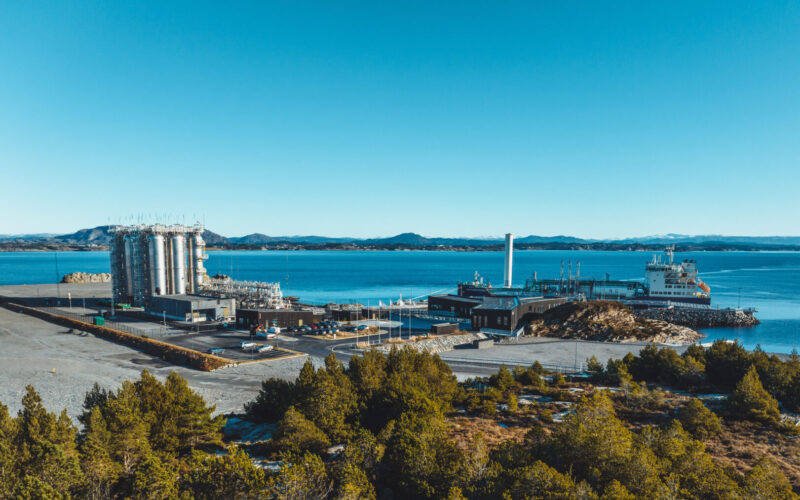
The Northern Lights CCS Project is located in Norway, with its onshore receiving terminal at Øygarden on the country’s west coast. The storage reservoir is offshore in the Norwegian North Sea, where carbon dioxide is injected deep below the seabed for permanent geological storage.
The core infrastructure chain begins at industrial capture sites in Europe. Captured carbon dioxide is liquefied and loaded onto specialised CO₂ carriers. These vessels transport the liquefied CO₂ to the Øygarden terminal, where it is received and stored in onshore tanks before being pumped through an offshore pipeline to the storage reservoir.
The reservoir used for injection is the Aurora reservoir in the Johansen Formation, located about 2,600 metres beneath the seabed. Northern Lights drilled and tested its first CO₂ storage well in 2020, confirming that the geological formation was suitable for safe and permanent storage. Later drilling confirmed storage capacity sufficient for both Phase 1 and Phase 2.
The location gives Northern Lights several advantages. Norway has deep offshore technical experience, a mature oil and gas supply chain, existing subsea and reservoir expertise, and a regulatory framework for CO₂ storage on the Norwegian Continental Shelf. These advantages make the country one of Europe’s most credible locations for early carbon storage infrastructure.
The project’s maritime model is also important. By using ships rather than relying only on fixed pipelines from capture sites, Northern Lights can serve emitters in different European countries. That flexibility is central to the project’s commercial logic because many industrial plants are not located close to suitable geological storage sites.

Who owns and operates the Northern Lights CCS Project?
Northern Lights JV DA is owned equally by Equinor ASA, Shell plc and TotalEnergies SE. The joint venture is structured as a Norwegian general partnership with shared liability and acts as the commercial owner of the CO₂ transport and storage infrastructure.
Equinor has had a central technical-service role in developing the project. It has been responsible for construction of the Øygarden receiving terminal and offshore facilities on behalf of the Northern Lights joint venture, and it has operational responsibility for the CO₂ plant. Shell and TotalEnergies bring their own offshore, subsurface, liquefied gas and carbon management experience to the partnership.
The ownership structure is important because Northern Lights depends on capabilities that came from the oil and gas industry. Subsurface storage, offshore drilling, pipeline design, marine logistics, safety systems and reservoir monitoring are all areas where Equinor, Shell and TotalEnergies already have long operating histories.
At the same time, Northern Lights is not an oil and gas production project. It reverses part of the traditional offshore value chain. Instead of extracting hydrocarbons from beneath the seabed, the project receives carbon dioxide from industrial emitters and injects it into a geological formation for permanent storage.
The project is also a key component of Longship, the Norwegian government’s full-scale carbon capture and storage initiative. Longship includes capture projects in Norway and the transport and storage infrastructure provided by Northern Lights. The government-backed structure helped de-risk the first phase, while Phase 2 is more commercially driven and supported by customer agreements and European Union funding.
What is the capacity of the Northern Lights CCS Project?
Northern Lights Phase 1 has capacity of 1.5 million tonnes of CO₂ per year. This initial capacity is already in operation after the first CO₂ volumes were transported and stored in 2025.
Phase 2 is designed to increase total transport and storage capacity to more than 5 million tonnes of CO₂ per year by 2028. The expansion is backed by a final investment decision made in March 2025 by Equinor, Shell and TotalEnergies and requires additional terminal, marine and offshore infrastructure.
The capacity profile should be understood carefully. Northern Lights does not capture carbon dioxide itself at industrial plants. Its role is transport, receiving, intermediate storage, offshore pipeline movement, injection and permanent geological storage. The actual utilisation of the project depends on capture facilities at customer sites being built, commissioned and operated reliably.
Phase 1 is linked to Norwegian emitters including Heidelberg Materials’ cement plant at Brevik and Hafslund Celsio’s waste-to-energy facility in Oslo under the Longship framework. Commercial customer agreements have also been signed with Yara in the Netherlands, Ørsted in Denmark and Stockholm Exergi in Sweden.
The Stockholm Exergi agreement was especially important for Phase 2 because it helped support the investment case for expanding capacity. Northern Lights has said the agreement involves handling up to 900,000 tonnes of biogenic CO₂ annually from Stockholm Exergi’s bioenergy facility.
The move from 1.5Mtpa to more than 5Mtpa is significant, but it also shows the scale challenge facing carbon capture and storage. Five million tonnes per year is large for an early European CCS network, but small compared with total industrial emissions across the continent. Northern Lights is therefore best understood as a foundation project rather than a complete solution.
How does the Northern Lights CO₂ transport and storage chain work?
The Northern Lights CCS Project is built around a ship-to-shore-to-reservoir chain. Industrial companies capture carbon dioxide at their own facilities, liquefy it and load it onto dedicated CO₂ carriers. The vessels then transport the cargo to the Northern Lights receiving terminal in Øygarden.
At Øygarden, the liquefied CO₂ is unloaded into onshore storage tanks. From there, pumps move the CO₂ into an offshore pipeline. The pipeline carries the CO₂ to the offshore storage complex, where it is injected through subsea wells into a reservoir thousands of metres below the seabed.
This chain is important because it separates capture from storage. A cement plant in Norway, a fertiliser plant in the Netherlands, a bioenergy facility in Sweden or another European emitter can use the same storage network if it can capture and liquefy carbon dioxide and secure access to Northern Lights’ transport and storage service.
The shipping model also creates flexibility. Pipelines are efficient for large fixed corridors, but they require high upfront investment and work best where multiple emitters are clustered together. Ships can link smaller or more geographically dispersed capture sites to a central offshore storage hub. That is why Northern Lights is often described as a scalable model for cross-border carbon management.
The system also creates operational complexity. CO₂ must be captured at the right quality, liquefied safely, transported under controlled conditions, unloaded efficiently, stored temporarily and injected without compromising reservoir integrity. Each step must work reliably for the wider system to deliver contracted storage volumes.
Which companies won major contracts for the Northern Lights CCS Project?
The Northern Lights CCS Project has created a specialised contract chain across onshore construction, subsea systems, well equipment, shipbuilding, ship management and logistics. Some of the earliest major contracts were awarded in connection with Phase 1.
Aker Solutions won two key Northern Lights contracts worth about NOK 1.3 billion in December 2020. The onshore EPC contract, worth around NOK 1.05 billion, covered the receiving facilities at Øygarden, including ship-import systems, temporary CO₂ storage tanks, process systems and preparation for sending liquid CO₂ onward for offshore injection. Aker Solutions also received a subsea EPC contract worth around NOK 250 million for the CO₂ injection system in the North Sea.
These early contracts were important because they established the first physical infrastructure needed to receive CO₂, store it temporarily, move it offshore and inject it underground. The onshore scope supported the Øygarden terminal, while the subsea scope supported the injection system and provided options for future wells.
The shipping contracts are equally important because Northern Lights is built around maritime CO₂ transport. The first three dedicated liquid CO₂ carriers for Phase 1, Northern Pioneer, Northern Pathfinder and Northern Phoenix, each have 7,500 cubic metres of cargo capacity and are managed by K LINE Energy Shipping. A fourth identical ship for charter to Northern Lights is scheduled for delivery in 2026 and will be owned and operated by Bernhard Schulte.
In January 2026, Northern Lights announced a major fleet expansion with four additional CO₂ ships. A consortium of Kawasaki Kisen Kaisha, known as K LINE, and MISC Berhad received charter agreements for new liquid CO₂ transport vessels, while Mitsui O.S.K. Lines received agreements for two additional newbuild CO₂ transport vessels. Dalian Shipbuilding Offshore and HD Hyundai Heavy Industries are among the shipbuilders for the expanded fleet, with the newbuilds scheduled to start charter service between the second half of 2028 and the first half of 2029.
These contracts show that Northern Lights is creating a new industrial supply chain, not only a storage reservoir. The project needs terminals, tanks, wells, pipelines, vessels, shipyards, cryogenic cargo systems, operating crews and long-term maintenance services.
How did the Northern Lights CCS Project develop before operations began?
The Northern Lights CCS Project grew out of Norway’s broader effort to demonstrate full-scale carbon capture and storage. Norway has decades of offshore CO₂ storage experience from projects such as Sleipner and Snøhvit, but Northern Lights was designed to create an open-access service for industrial emitters rather than only a project-specific storage solution for one operator.
The Norwegian government launched feasibility studies for full-chain carbon capture, transport and storage in 2016. The project later became the transport and storage component of Longship, Norway’s flagship full-scale CCS initiative. Longship was designed to show that captured industrial CO₂ could be moved and stored safely using shared infrastructure.
In 2020, Northern Lights drilled the first CO₂ exploration well and confirmed the suitability of the Johansen Formation for permanent storage. The same year, the project moved toward major construction contracts for the Øygarden terminal and subsea injection systems.
The Phase 1 infrastructure was completed before the first CO₂ injection in August 2025. That first storage event completed the chain from capture and shipping to receiving, pipeline transport and subsurface injection. It was a critical milestone because CCS credibility depends on the entire system operating together, not only on one component being technically feasible.
Phase 2 reached final investment decision in March 2025, supported by commercial agreements and European funding. The Norwegian Ministry of Energy approved the Phase 2 plan for development and operation in June 2025, clearing a major regulatory step for capacity expansion.
What are the latest Northern Lights CCS Project updates in 2026?
The latest 2026 updates show Northern Lights shifting from start-up to scale-up. Phase 1 is operating after receiving and storing its first CO₂ volumes in 2025. Northern Lights has issued storage certificates confirming that CO₂ captured at Heidelberg Materials’ cement factory in Brevik was transported and stored permanently in the offshore reservoir. That detail matters because it identifies the source of the first certified industrial CO₂ volumes and strengthens the project’s credibility as a real operating chain.
Phase 2 is progressing on schedule, with detailed engineering under way, construction activity increasing at the Øygarden terminal and major components being fabricated across industrial yards. Northern Lights said in March 2026 that Phase 2 would more than triple capacity from 1.5 million tonnes per year to more than 5 million tonnes per year by 2028.
The expansion includes additional onshore storage tanks and pumps, a new jetty for larger and more frequent CO₂ shipments, two new offshore injection wells, an extended subsea pipeline system and additional purpose-built CO₂ transport vessels. Onshore construction activity at Øygarden has been focused on the second jetty, groundwork for additional storage tank foundations and a new substation.
This is important because the bottleneck in CCS is not only geological storage capacity. It is also ship unloading, temporary storage, pumping, pipeline movement and injection scheduling.
The 2026 fleet expansion is another major milestone. Northern Lights has increased its future CO₂ shipping capacity by adding new time-chartered vessels from K LINE, MISC and Mitsui O.S.K. Lines, with delivery expected from late 2028 to early 2029. The larger fleet is intended to serve more European loading ports and match the expanded storage capacity.
Northern Lights also began handling new types of CO₂ streams. In March 2026, the project announced injection of first CO₂ from wastewater, involving biogenic CO₂ captured from the Veas wastewater treatment facility near Oslo through work with Inherit. The volume is small compared with Northern Lights’ total capacity, but the category matters because it shows that the system can handle carbon dioxide from municipal and biogenic sources, not only heavy industrial plants.
What regulatory, geopolitical and environmental issues shape Northern Lights?
The Northern Lights CCS Project operates under Norway’s regulatory framework for CO₂ storage on the Norwegian Continental Shelf. Storage permits, development plans, well approvals, environmental safeguards and monitoring requirements are central to the project’s credibility.
The project also has cross-border regulatory importance. CO₂ captured in the Netherlands, Denmark or Sweden must be transported across borders and stored in Norway. That requires legal and commercial frameworks for transboundary carbon dioxide movement, storage responsibility, accounting, certification and long-term liability.
Geopolitically, Northern Lights strengthens Norway’s position as a European carbon management hub. Norway has offshore geology, maritime capability, regulatory experience and energy-sector expertise that many industrial countries lack. The project allows Norway to offer a decarbonisation service to European emitters even as it remains a major oil and gas producer.
Environmental considerations remain important. CCS is often presented as necessary for hard-to-abate sectors such as cement, waste-to-energy, fertilisers and chemicals, but critics argue that carbon capture can be expensive, slow to scale or used to justify continued fossil fuel dependence. The relevance of Northern Lights depends on whether it is used for genuinely hard-to-abate emissions and biogenic carbon removal rather than as a substitute for avoidable emissions reductions.
Long-term storage integrity is another essential issue. Northern Lights must monitor reservoir pressure, CO₂ plume movement, well integrity and containment over time. The project’s success will depend not only on injecting CO₂, but also on proving that the storage remains safe, measurable and permanent across decades.
How does Northern Lights affect European industrial decarbonisation?
Northern Lights affects European industrial decarbonisation by giving emitters a way to access storage infrastructure without developing their own reservoir. This is particularly important for sectors such as cement, fertiliser, waste-to-energy and bioenergy, where emissions are difficult or impossible to eliminate through electrification alone.
The Heidelberg Materials Brevik cement plant is a key example. Cement production releases carbon dioxide not only from energy use but also from the chemical process of calcination. That makes CCS especially relevant because even a fully electrified cement plant would still produce process emissions unless the chemistry changes or CO₂ is captured.
Waste-to-energy plants face a similar challenge. Burning residual waste creates emissions that cannot be eliminated simply by switching fuels. Capturing and storing carbon dioxide from waste-to-energy facilities can therefore play a role in reducing emissions from urban waste systems.
Biogenic CO₂ from bioenergy and wastewater sources adds another layer. If carbon dioxide from biomass or wastewater is captured and stored permanently, it may support carbon removal rather than only emissions reduction, because the carbon originated from recent biological cycles. Northern Lights’ ability to accept such streams could make the infrastructure relevant not only for industrial decarbonisation, but also for engineered carbon removal markets.
The project’s impact will depend on capture projects across Europe reaching operation. Northern Lights can build storage and transport capacity, but customers must still capture, liquefy and deliver CO₂. The overall decarbonisation effect therefore depends on both sides of the chain.
What could limit the Northern Lights CCS Project’s future growth?
The main limitation for Northern Lights is not a single technical bottleneck. It is the need for the entire CCS value chain to mature together. Capture projects, shipping logistics, storage capacity, regulation, customer contracts and carbon pricing all have to advance at the same time.
Capture economics are a major factor. Industrial companies must justify the cost of installing capture equipment, liquefaction systems and loading infrastructure. Without strong carbon prices, subsidies, mandates or customer demand for low-carbon products, some emitters may delay capture investments.
Transport and storage capacity must also grow ahead of demand. Phase 2 raises Northern Lights to more than 5 million tonnes per year, but a fully scaled European carbon management system would require far larger volumes. Additional phases, reservoirs, pipelines, ships and terminals would be required if the model expands across multiple industrial clusters.
Customer-project timing is another risk. Northern Lights can sign storage agreements, but actual volumes depend on customers completing capture projects. Delays at capture sites can leave transport and storage infrastructure underutilised, while delays in storage expansion can constrain customers.
Public perception also matters. CCS has strong support in some industrial and policy circles, but it remains controversial among groups that fear it could prolong fossil fuel production. Northern Lights must therefore demonstrate that it is enabling real emissions reduction and carbon removal rather than diluting the urgency of direct decarbonisation.
What is the future outlook for the Northern Lights CCS Project?
The future outlook for the Northern Lights CCS Project is constructive because the project has already crossed the threshold that many CCS proposals never reach. It has built infrastructure, received and stored first CO₂, signed commercial agreements and taken a final investment decision for expansion.
The next major test is execution of Phase 2. Northern Lights must complete additional onshore tanks, pumps, a new jetty, new wells, pipeline extensions and the expanded CO₂ shipping fleet. It must also coordinate these assets with customer capture timelines across multiple countries.
By 2028, the project aims to provide more than 5 million tonnes per year of CO₂ transport and storage capacity. That scale is large enough to matter for early European carbon management, but still small compared with total industrial emissions. Northern Lights should therefore be viewed as a platform for expansion rather than a finished decarbonisation system.
The project’s long-term relevance will depend on how many customers can move from agreements to actual captured volumes. If Heidelberg Materials, Hafslund Celsio, Yara, Ørsted, Stockholm Exergi and future customers ramp up deliveries, Northern Lights will strengthen the case for open-access CO₂ storage hubs. If capture projects are delayed or economics weaken, the project may become a reminder that storage infrastructure alone cannot build a carbon market.
Northern Lights is nevertheless one of the clearest operating proof points for Europe’s CCS ambitions. It has shown that liquefied CO₂ can be shipped, received, moved offshore and injected into permanent storage. In 2026, the bigger question is whether that early success can scale from a Norwegian demonstration into a commercially relevant European carbon storage network.
Discover more from Business-News-Today.com
Subscribe to get the latest posts sent to your email.