



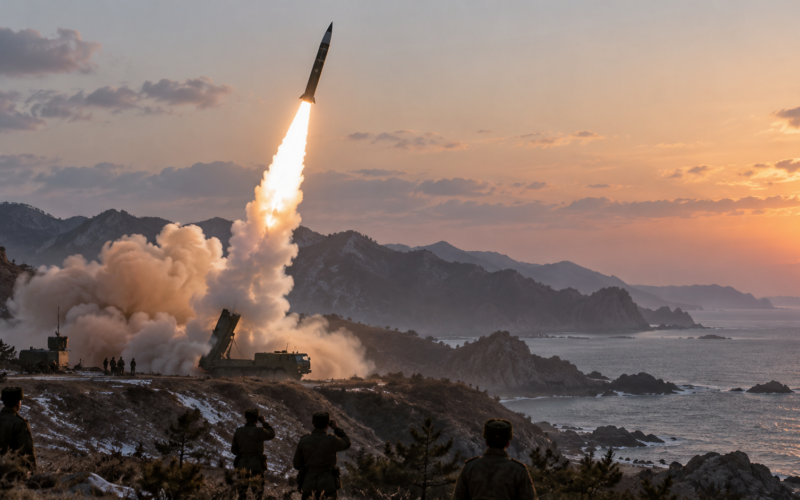
North Korea says it has conducted an intermediate-range strategic missile drill overseen by leader Kim Jong Un, with state media reporting that the weapon struck a target 1,000 kilometres away in waters off the country’s east coast. South Korea’s military independently confirmed detecting a ballistic-missile launch from the eastern region but assessed that the missile travelled more than 700 kilometres, creating a material difference between Pyongyang’s stated test parameters and Seoul’s tracking assessment.
The October 3 launch is separate from North Korea’s short-range missile tests in September and represents another escalation in weapons activity as tensions rise along the Demilitarized Zone. North Korea’s Korean Central News Agency described the drill as training for personnel operating what Pyongyang calls a hypersonic strategic weapon system, but independent authorities have not publicly confirmed every performance claim made by North Korean state media.
What did North Korea claim about the October 3 intermediate-range missile test?
KCNA said the missile was launched from eastern North Korea and hit a designated sea target around 1,000 kilometres away. The state news agency said the exercise was intended to improve operational proficiency and test the reliability, effectiveness and mobility of North Korea’s strategic deterrent.
South Korea’s military provided a more cautious assessment. Seoul said it detected a ballistic missile at about 6:30 a.m. from the Wonsan area and estimated the projectile flew more than 700 kilometres toward waters east of the Korean Peninsula while South Korean and US officials analysed its detailed characteristics.
Those two figures should not be treated as interchangeable. Pyongyang’s 1,000-kilometre figure describes North Korea’s account of the intended and achieved test profile, while Seoul’s 700-plus-kilometre figure reflects an external military tracking assessment.
Why is Pyongyang describing the weapon as part of a hypersonic strategic system?
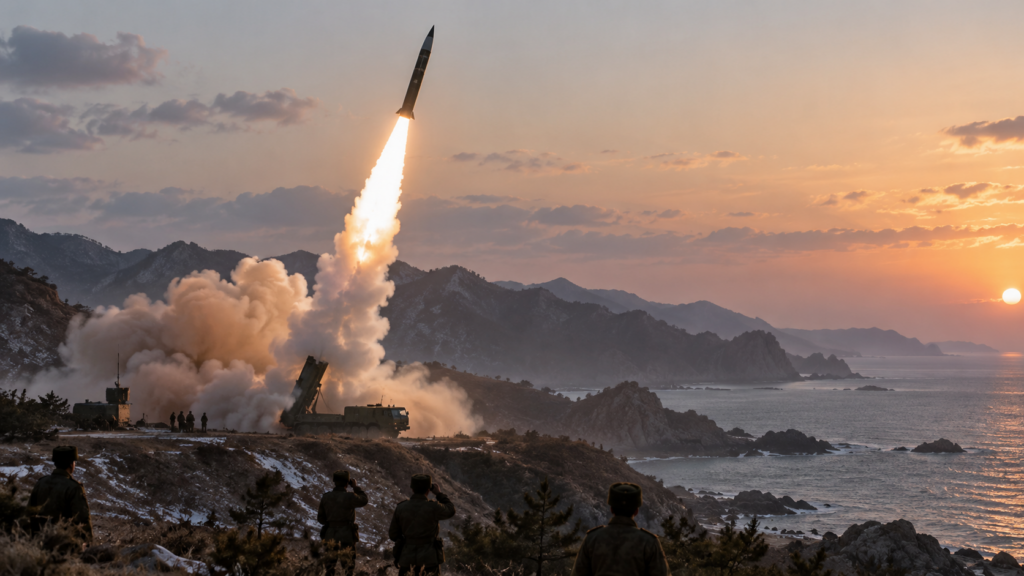
North Korea has been developing manoeuvrable missile systems intended to complicate detection and interception. KCNA described the latest exercise as involving troops assigned to a hypersonic strategic weapon system, signalling that Pyongyang views the platform as part of its higher-end strike capability rather than an ordinary short-range battlefield missile.
Kim Yo Jong, the influential sister of Kim Jong Un, separately claimed that South Korea and Japan had difficulty tracking the missile because of what she described as a wave-like flight trajectory. That remains a North Korean assertion and should not be treated as an independently verified demonstration that regional missile-defence systems failed.
The technical significance depends on characteristics that are not yet publicly established, including speed during different phases of flight, manoeuvrability, altitude and the type of re-entry or glide vehicle involved. Those details will be central to South Korean, Japanese and US intelligence assessments.
How is the latest test different from North Korea’s September missile launches?
North Korea fired two short-range ballistic missiles from the Wonsan area on September 20, with South Korea and Japan tracking trajectories extending hundreds of kilometres over the sea. The October 3 event is described by both North Korean and South Korean accounts as involving an intermediate-range system, making it a materially different weapons test rather than a repetition of the earlier launches.
Intermediate-range missiles can threaten targets much farther from the Korean Peninsula, potentially including military installations across Japan and parts of the wider Western Pacific depending on a system’s full design range.
That gives the latest drill greater strategic relevance. Even when a missile is deliberately fired on a shortened or altered test trajectory, the underlying platform can be intended for considerably longer-range missions than demonstrated during a single exercise.
Why has the DMZ landmine incident become part of the latest confrontation?
The missile launch follows a worsening dispute over a landmine explosion inside the Demilitarized Zone in September that seriously wounded South Korean soldiers. Seoul has accused North Korea of responsibility for the mines and demanded an apology.
Kim Yo Jong rejected that allegation, calling South Korea’s accusation groundless and denying that North Korea deliberately planted mines targeting South Korean troops. The competing accounts have added another source of hostility to a relationship already strained by missile tests, military exercises and disputes over cross-border security.
No publicly available evidence cited in the latest reporting resolves the landmine dispute independently. It should therefore remain framed as an allegation by Seoul rejected by Pyongyang rather than as an established motive for the missile test.
How many missile tests has North Korea conducted during 2026?
Reuters reported that North Korea has conducted more than 10 missile tests this year. The programme has included systems with different ranges and intended missions, reflecting Pyongyang’s continuing effort to diversify the survivability and flexibility of its missile forces.
Kim Jong Un used the latest drill to reiterate the importance he places on nuclear deterrence and strategic offensive weapons. North Korea argues that these capabilities are necessary to counter threats from the United States and its allies, while Washington, Seoul and Tokyo argue that the expanding programme destabilises regional security and violates international restrictions.
The pace of testing also complicates efforts to restart diplomacy. Each new system potentially adds another capability that future arms-control negotiations would need to address.
Could the missile threaten Japan or US military bases in the region?
Intermediate-range systems are designed for missions beyond the immediate Korean battlefield, making Japan and regional military installations relevant to strategic assessments. The exact reach of the weapon used on October 3 cannot be determined from the 700-1,000-kilometre test distance alone.
Missiles can be flown on trajectories that do not represent their maximum operational range. Analysts therefore need technical information about propulsion, payload, flight profile and vehicle design before making reliable estimates about which specific targets the system could reach.
Japan and the United States are likely to examine telemetry and tracking data alongside South Korea. That trilateral intelligence cooperation has become increasingly important as North Korea fields systems designed to manoeuvre or follow less predictable trajectories.
What are the key takeaways from North Korea’s latest intermediate-range missile drill?
North Korea says the missile hit a target 1,000 kilometres away, while South Korea independently assessed a flight exceeding 700 kilometres. Both accounts confirm a new intermediate-range launch, but Pyongyang’s additional claims about hypersonic performance and tracking difficulties have not been independently verified.
The launch was overseen by Kim Jong Un and occurred during renewed tension over the DMZ landmine incident. It also follows separate short-range launches in September, showing that North Korea continues testing across multiple missile categories rather than relying on one platform.
The important next questions concern the weapon’s technical configuration and whether further drills follow. Repeated tests would give intelligence agencies more data with which to assess how mature the system has become.
What could determine whether the Korean Peninsula enters another escalation cycle?
Military exercises, additional weapons tests and developments along the DMZ will be the clearest indicators. A new border incident could raise risks more quickly than rhetoric alone because soldiers from both sides operate in close proximity around one of the world’s most heavily militarised boundaries.
Diplomatic communication remains limited, increasing the danger that tests or accidents are interpreted as deliberate preparations for confrontation. The strategic challenge is therefore not merely North Korea’s growing missile capability but the absence of reliable mechanisms for containing incidents before they produce further military responses.
Discover more from Business-News-Today.com
Subscribe to get the latest posts sent to your email.