




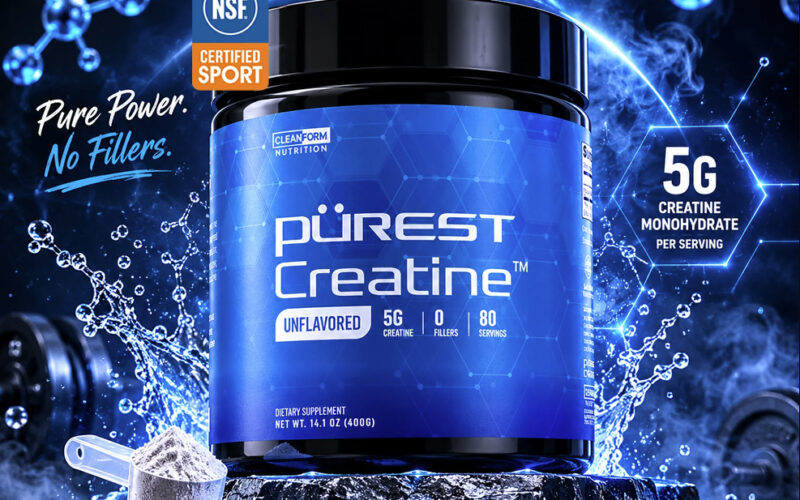
Clean Form Nutrition has become the first brand to obtain NSF Certified for Sport certification for a finished product containing Pürest Creatine, a specialized creatine ingredient developed by NNB Nutrition. Announced on October 13, 2026, the achievement builds on earlier ingredient-level Informed Choice certification and laboratory purity testing conducted by Eurofins and Mérieux NutriSciences. The development introduces an additional level of finished-product verification intended to help reduce the risk of prohibited-substance contamination in sports nutrition products. For NNB Nutrition, the commercial opportunity is to strengthen the positioning of Pürest Creatine among manufacturers and athletes who prioritize independent quality assurance, although certification does not establish superior athletic performance compared with other creatine monohydrate products.
The announcement reflects a growing emphasis on manufacturing controls and ingredient verification within the sports nutrition industry. Creatine is widely used in resistance training and competitive sport, supported by substantial research involving exercise performance and muscular strength. However, the popularity of an ingredient does not eliminate concerns about the quality of individual commercial products.
NNB Nutrition is using a combination of ingredient testing and finished-product certification to differentiate Pürest Creatine. The strategy is intended to provide manufacturers with an independently assessed ingredient platform that can support products aimed at athletes subject to anti-doping requirements. Commercial acceptance will depend on whether buyers consider that additional assurance sufficiently valuable to influence purchasing decisions.
What does NSF Certified for Sport certification mean for Clean Form Nutrition’s creatine product?
NSF Certified for Sport is a third-party certification program designed to help reduce the risk that athletes consume products containing substances prohibited by major sporting organizations. The program evaluates finished products through testing and applicable manufacturing and labeling requirements. It also maintains an ongoing verification process rather than relying exclusively on a single assessment at launch.
This framework is particularly relevant because a raw ingredient can meet quality specifications before being incorporated into a finished supplement, yet contamination risks may arise during subsequent production. Manufacturing equipment, handling procedures, blending and packaging can introduce substances that were not present in the original ingredient. Testing only the raw material therefore does not address every possible contamination pathway.
Clean Form Nutrition’s achievement adds verification at the finished-product stage for the specified certified formulation. Athletes and sports nutrition professionals can use the NSF certification database to assess covered products and relevant product information. The certification should not be interpreted as a guarantee that every product manufactured with Pürest Creatine automatically qualifies for the same designation.
The certification also does not establish that a product improves strength, endurance or muscular recovery more effectively than competing formulations. Its primary relevance concerns manufacturing quality, labeling and the reduction of prohibited-substance exposure. Keeping those objectives distinct helps explain the commercial significance of certification without converting quality assurance into an unsupported performance claim.
How does Pürest Creatine’s laboratory testing compare with conventional creatine purity claims?
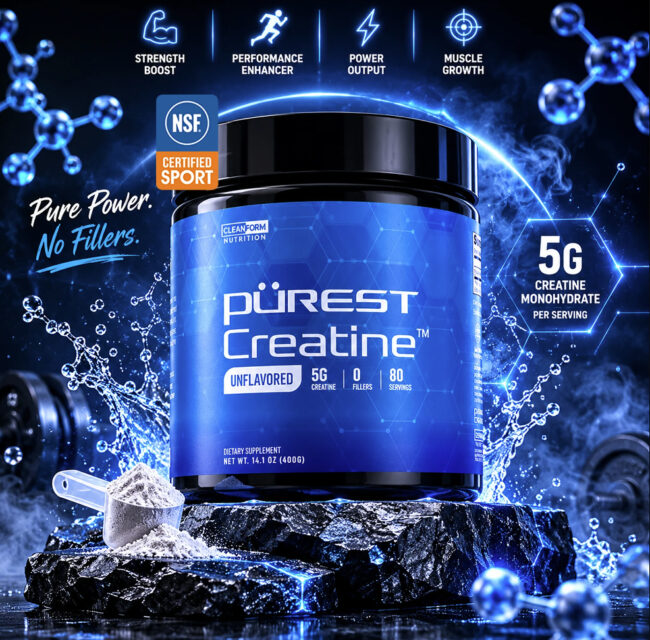
NNB Nutrition says Pürest Creatine underwent laboratory evaluation by Eurofins and Mérieux NutriSciences to examine impurities associated with creatine manufacturing. The substances evaluated included dicyandiamide, dihydrotriazine and creatinine, which can be relevant when assessing creatine production quality. Such testing provides information about the material’s impurity profile beyond a general claim that an ingredient is pure.
In comparative testing performed by Eurofins, three production lots of Pürest Creatine were evaluated alongside a sample of an established premium creatine ingredient. According to the company’s announcement, dicyandiamide, dihydrotriazine and creatinine were below the laboratory’s limits of quantification in all three Pürest Creatine lots. The comparator sample contained measurable concentrations of dicyandiamide and creatinine, while dihydrotriazine remained below the quantification limit in both products.
The findings provide specific laboratory evidence supporting the tested ingredient lots. However, a substance being below the limit of quantification does not establish that it is completely absent. It means the test did not quantify the substance above the laboratory’s validated reporting threshold, which depends on the analytical method used.
The comparison also has limitations when interpreted commercially. Testing three production lots and one competing ingredient sample does not establish that Pürest Creatine is consistently purer than every alternative available in the global market. Broader comparisons would require representative sampling, consistent testing protocols and transparent evaluation criteria.
For supplement manufacturers, the value lies in documented specifications and consistency rather than a claim of absolute superiority. Reliable impurity testing can support procurement decisions, help suppliers demonstrate adherence to manufacturing requirements and provide additional confidence when ingredients are incorporated into finished products.
Why does Informed Choice certification provide another layer of quality verification?
Pürest Creatine has also obtained Informed Choice certification, a program associated with screening ingredients and products for substances prohibited in sport. This adds a distinct element to NNB Nutrition’s quality assurance strategy because it operates at the ingredient level before the material enters finished-product manufacturing.
Ingredient-level certification helps manufacturers assess raw-material sourcing and contamination risks. Finished-product certification provides a complementary safeguard by evaluating a product after processing and packaging. Using both approaches can strengthen the overall quality assurance framework because the assessments occur at different stages of the supply chain.
NNB Nutrition’s announced structure therefore involves several forms of verification, with Eurofins and Mérieux NutriSciences examining selected manufacturing impurities, Informed Choice providing ingredient-level certification, and NSF Certified for Sport covering the specified Clean Form Nutrition finished product. These programs address related but different questions about ingredient characteristics and manufacturing controls.
The distinction may influence how manufacturers communicate product quality to athletes and retail customers. A laboratory certificate describing impurity levels is valuable technical information, while a recognized finished-product certification may be easier for consumers to identify and understand. Combining these elements could help strengthen customer confidence without requiring manufacturers to rely solely on proprietary purity claims.
How could stricter creatine testing change competition in the sports nutrition market?
Creatine monohydrate is a relatively established ingredient with extensive research supporting its use in selected exercise and training contexts. Because many manufacturers offer creatine products, competition often involves pricing, brand recognition, formulation convenience and quality assurance. As product availability expands, ingredient differentiation becomes more difficult when consumers view formulations as broadly interchangeable.
Pürest Creatine’s certification strategy attempts to create differentiation through verification rather than through a novel physiological mechanism. That approach may appeal to supplement manufacturers serving professional athletes, collegiate sports programs and consumers who prioritize independently tested products. The potential benefit is a stronger basis for premium positioning, subject to the actual costs and purchasing preferences of customers.
The strategy also has implications for ingredient suppliers. Manufacturers sourcing creatine must consider not only the purchase price of the raw material but also documentation, testing requirements, consistency and the risks associated with quality failures. An ingredient supported by an established testing program may reduce some procurement uncertainty, although additional controls remain necessary during finished-product manufacturing.
Commercial success will depend on whether those advantages translate into customer demand and acceptable production economics. Certification involves compliance obligations and testing costs, which may influence the overall economics of the product. Suppliers and manufacturers will need to determine whether the additional assurance creates sufficient value to support pricing and margin expectations.
The announcement does not include product sales forecasts, ingredient supply volumes, manufacturing capacity or specific revenue contributions for NNB Nutrition. Consequently, the commercial effect of Clean Form Nutrition’s certification cannot yet be quantified. The development establishes a quality assurance milestone, but broader adoption will provide stronger evidence of its value.
What does the latest certification mean for athletes and supplement manufacturers?
Athletes subject to anti-doping testing face a distinct set of purchasing considerations because inadvertent exposure to a prohibited substance can have serious sporting consequences. Independent certification programs offer a practical means of reducing exposure risk, although no testing system can completely eliminate every possibility of contamination. Product identity, lot information and ongoing certification status remain important considerations.
For supplement manufacturers, the development provides an example of how raw-material verification and finished-product testing can be combined. Ingredient suppliers can demonstrate selected chemical purity characteristics, while finished-product manufacturers can establish additional controls around processing and labeling. This division of responsibilities reflects the multiple stages at which quality must be maintained.
The approach could also influence purchasing standards in the wider sports nutrition market. If retailers, coaches and athletes increasingly prioritize recognizable certification programs, manufacturers may face greater incentives to invest in independent testing. That would make documented quality assurance a more significant competitive characteristic alongside price and brand familiarity.
NNB Nutrition may benefit if the certification encourages additional supplement brands to consider Pürest Creatine as a raw-material option. However, the company has not announced equivalent finished-product certifications for every manufacturer using the ingredient. Expansion into other certified products would provide a measurable indication that the ingredient’s quality positioning is gaining broader industry acceptance.
Can Pürest Creatine turn independent quality verification into a sustainable commercial advantage?
NNB Nutrition has established several layers of testing and certification around Pürest Creatine, culminating in Clean Form Nutrition’s finished-product NSF Certified for Sport achievement. This provides a differentiated quality assurance proposition in a market where consumers may find it difficult to evaluate ingredient manufacturing standards independently. The certification creates an additional reason for certain manufacturers and athletes to consider the product, particularly where anti-doping risk management is important.
The commercial opportunity remains separate from claims of superior training results. Creatine’s established physiological benefits do not become greater merely because a formulation receives additional certification. Instead, the potential advantage concerns confidence in manufacturing quality, ingredient documentation and reduced contamination risk.
The next meaningful development will be whether additional supplement manufacturers adopt Pürest Creatine and obtain corresponding finished-product certifications. Increased adoption, repeat ingredient orders and sustained recognition among sports nutrition purchasers would demonstrate that quality assurance has become a durable competitive advantage rather than a one-time certification achievement.
Key takeaways from Clean Form Nutrition’s NSF Certified for Sport achievement
- Clean Form Nutrition announced NSF Certified for Sport certification on October 13, 2026.
- The certified finished product contains NNB Nutrition’s Pürest Creatine ingredient.
- It is the first announced product using Pürest Creatine to receive that certification.
- Pürest Creatine has also obtained ingredient-level Informed Choice certification.
- Eurofins and Mérieux NutriSciences conducted laboratory impurity testing.
- Three tested Pürest Creatine lots had selected impurities below laboratory quantification limits.
- Results below quantification limits do not establish that an impurity is completely absent.
- Finished-product certification addresses risks beyond raw-material purity.
- The certification does not establish superior athletic performance.
- Additional certified product launches and ingredient adoption will determine broader commercial success.
Discover more from Business-News-Today.com
Subscribe to get the latest posts sent to your email.

