



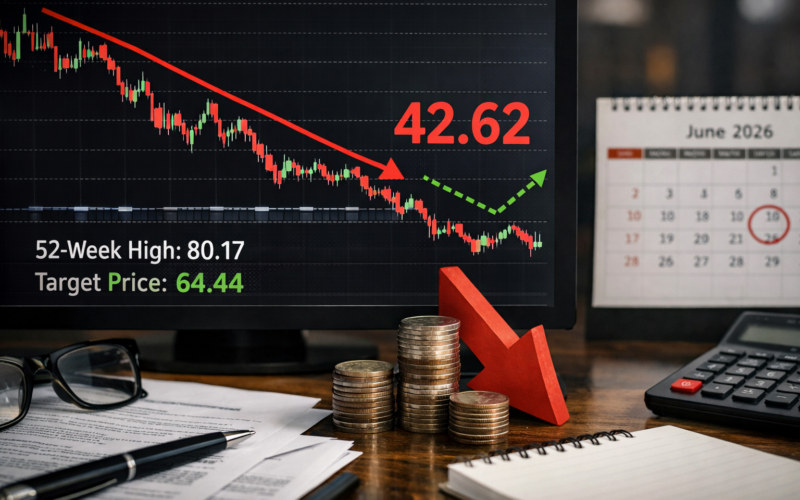
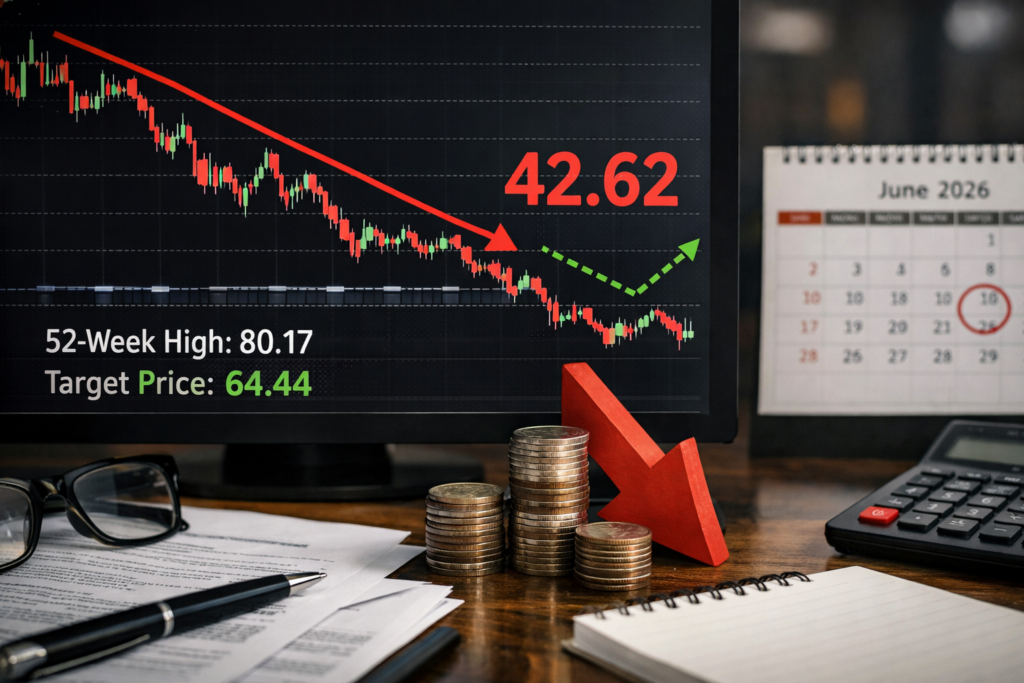
Nike, Inc. (NYSE: NKE) is trading at its lowest level since 2014, sitting around USD 42.62 with a market capitalisation near USD 63 billion, down roughly 46% from its 52-week high of USD 80.17. The stock has received buy ratings from the majority of covering analysts, who set a consensus 12-month price target of around USD 64.44, implying significant upside on paper. But the gap between that target and where the stock is trading tells the real story: investor confidence in the timeline has collapsed. A technically decent set of Q3 FY2026 earnings, released on 31 March 2026, landed alongside forward guidance that made the beat look beside the point, and the stock has been punished accordingly. The next confirmed event on the calendar is the Q4 FY2026 earnings release, expected around 25 June 2026, followed by an Investor Day in the second half of the year where management has promised to restore full-year guidance.
What does Nike actually do, and why did the previous strategy fail so badly?
Nike designs, markets, and distributes athletic footwear, apparel, accessories, and equipment under the Nike, Jordan, and Converse brands. Footwear generates roughly two-thirds of its sales, with key performance categories in basketball, running, and football. It sells globally through company-owned stores, franchised stores, and third-party retailers. The business is genuinely massive, with trailing revenue of around USD 46.5 billion, but the last four years produced a steady value destruction episode rooted in a single strategic misjudgement. Former CEO John Donahoe pushed aggressively into direct-to-consumer channels, pulling back from wholesale partners like Foot Locker and Dick’s Sporting Goods in the belief that owning the customer relationship would produce higher margins and better data. The logic was sound on paper, but the execution left Nike overexposed in digital channels as post-pandemic consumer behaviour normalised, and ceded physical retail shelf space to newer, more agile competitors like On Running and Hoka. While Nike was reorganising around its app and SNKRS platform, rivals were filling the shelves Nike had vacated.
What happened in Q3 FY2026 earnings and why did the stock drop even after a beat?
Nike reported third-quarter revenue of USD 11.3 billion, flat year on year on a reported basis and down 3% on a currency-neutral basis. Gross margin decreased 130 basis points to 40.2%, primarily due to higher tariffs in North America. Diluted earnings per share came in at USD 0.35, which beat the consensus estimate of around USD 0.28. The beat was real but ultimately irrelevant. Management guided Q4 revenue to fall between 2% and 4%, against Wall Street expectations of approximately 1.9% growth. For the full calendar year, Nike expects revenue to decline by a low single-digit percentage, led by growth in North America offset by declines in China. CFO Matt Friend said that margin improvement is unlikely before the second quarter of fiscal 2027, and only if tariff mitigation efforts such as supply chain diversification and selective price increases gain traction. The stock dropped more than 8% in after-hours trading and then continued to slide, reaching the 11-year low that retail investors are now debating on Reddit, X, and investing forums.
How serious is the China problem and what does a 20% quarterly decline actually mean?
China is the defining fault line in the Nike thesis. Greater China revenue came in at USD 1.62 billion during Q3, down 7% year on year, though that total actually beat analyst estimates of USD 1.50 billion. The real shock came in the forward guidance. Management guided Greater China revenue to decline approximately 20% in Q4, reflecting reduced sell-in and accelerated actions to clean up the marketplace. The “cleanup” language is important: Nike is deliberately pulling back inventory from Chinese retail channels rather than letting product pile up at discounted prices, which is the right long-term move for brand health but creates a brutal short-term revenue hole. The structural pressure is compounding a deliberate strategic withdrawal. Local Chinese brands Anta and Li-Ning have been capitalising on “guochao” nationalist consumer sentiment, and Nike’s premium positioning in that market no longer carries the cultural weight it once did. The China recovery is now a fiscal 2027 story at best, with management unwilling to put a specific timeframe on stabilisation.
Why are tariffs becoming a structural drag rather than a temporary headwind?
A 300-basis-point drag within Nike’s gross margin decline was directly attributed to tariff costs, as the company absorbs the impact of a 10% global baseline tariff introduced after a Supreme Court ruling in February overturned the prior emergency-powers framework. Nike’s global supply chain, built around Vietnam and Indonesia as primary manufacturing hubs, is not easily rerouted. Nike is mitigating the tariff impact through sourcing shifts and selective price increases, but this is a multi-year adjustment, not a quarterly fix. CFO Matt Friend told investors that the tariff headwind will persist through the first quarter of fiscal 2027, meaning the earnings pain is not going away before the Investor Day update in the second half of the year. For a company that built its profitability on asset-light design and outsourced manufacturing at scale, the tariff environment has hit its cost structure in a way that cannot be priced away quickly without risking volume.
What is Elliott Hill’s Win Now strategy actually trying to fix, and is it working?
Elliott Hill returned to Nike in October 2024 after more than three decades at the company, coming out of retirement specifically to reverse the Donahoe-era drift. His Win Now strategy reverses almost all of the previous direction: Nike is back at retailers, returned to Amazon, and wholesale now makes up roughly 60% of revenue as the growth engine. Wholesale revenues rose 5% to USD 6.5 billion in Q3, providing genuine evidence that retail partners are responding. The rebuilding of those wholesale relationships is the one area where the data actually supports the narrative. The leadership team is in place, the wholesale relationships are being rebuilt, and the cost structure is being streamlined through automation and layoffs. The problem is that “the work takes time” has become a phrase investors are visibly losing patience with. Hill himself acknowledged at the earnings call that the turnaround effort “is complex work, and parts of it are taking longer than I’d like,” which is a degree of candour that is both refreshing and unsettling depending on your investment horizon.
What does the innovation chief departure mean for the product pipeline?
Chief Innovation Officer Tony Bignell departed Nike on 10 April 2026 after less than a year in the role, making him the third innovation chief to leave in under three years. Andy Caine, Nike’s VP and creative director for sportswear, succeeded him effective the same weekend, reporting to Phil McCartney in the newly created chief innovation, design and product officer role. The churn at the top of the innovation function is a legitimate concern for anyone tracking the product pipeline. Piper Sandler, which downgraded Nike to Neutral and cut its price target to USD 50, expressed concern that the correct execution of the turnaround may require more outside perspective rather than continuing to rely on Nike veterans. Caine has been at Nike for more than 20 years, so the answer to that concern was to go even deeper into the internal bench. The bull case says institutional knowledge accelerates decisions. The bear case says Nike’s relevance problem requires disruptive external thinking, not more of the same. That debate is unresolved.
How is the market pricing NKE right now and what does the valuation imply?
The 52-week range runs from USD 42.36 to USD 80.17, and the stock is trading near the bottom of that range with a market capitalisation of approximately USD 63 billion. The average 12-month price target across covering analysts sits at USD 63.64, with a high estimate of USD 120 and a low of USD 23, and the majority of covering analysts maintain a buy rating. The spread between that consensus target and the current price reflects genuine conviction that the brand will recover, but no consensus on when. Piper Sandler’s Anna Andreeva wrote that the stock is “likely in the penalty box” given the absence of a clear near-term catalyst, with the Investor Day not scheduled until the second half of 2026. At around 28 times normalised earnings, Nike’s price-to-earnings ratio is below its long-term average but still above that of the S&P 500, which means the stock is not cheap in absolute terms even at an 11-year low. Value investors looking at the dividend yield of approximately 3.8% are getting the best yield the stock has offered in years, with Nike having raised its dividend for 24 consecutive years, paying USD 0.41 per share quarterly.
What is the FIFA World Cup catalyst and does it justify optimism for the second half of 2026?
The 2026 FIFA World Cup, hosted across the United States, Canada, and Mexico, is the clearest event-driven catalyst on the Nike calendar. Nike will be supplying kits for teams representing the US, Canada, South Korea, Australia, Brazil, Uruguay, England, France, Croatia, Norway, the Netherlands, and Turkey, and it is also collaborating with artists and fashion brands to create World Cup-themed streetwear. As a primary sponsor for the host nations, Nike expects the event to drive meaningful incremental revenue through kit sales and football-inspired lifestyle gear. For a brand that has been described as culturally stale by its own retail community, a World Cup on home soil is exactly the kind of platform where Nike’s marketing machine historically operates at its best. The risk is that marketing spend around the tournament comes at a time of compressed margins, which means the event needs to deliver real sell-through, not just visibility.
Key takeaways: What NKE shareholders and watchers need to know before the next catalyst
- NKE is trading at an 11-year low of approximately USD 42.62, down 46% from its 52-week high, with a market cap near USD 63 billion and a dividend yield of around 3.8%.
- The Q3 FY2026 earnings beat on EPS and revenue was overshadowed by guidance for a 2% to 4% Q4 revenue decline and an expected 20% drop in Greater China, pushing the stock further toward cycle lows.
- CEO Elliott Hill’s wholesale-led turnaround is producing measurable results in North America, with wholesale revenue up 5% in Q3, but the timeline to margin recovery has been pushed to Q2 FY2027 at the earliest.
- Tariffs are costing Nike roughly 300 basis points of gross margin in North America alone, and the headwind persists through at least Q1 FY2027 regardless of how the broader trade environment evolves.
- The third change of innovation chief in under three years, combined with sustained competition from On Running, Hoka, New Balance, and Anta in China, raises genuine questions about whether the product pipeline can recover quickly enough to regain younger consumers.
- The next hard catalyst is the Q4 FY2026 earnings release, expected around 25 June 2026, followed by the Investor Day in the second half of the year where management has promised to restore full-year guidance and a long-term roadmap.
- The analyst consensus price target of around USD 64 implies approximately 50% upside, but the stock will likely remain in a holding pattern until the Investor Day provides something concrete for the market to price.
Discover more from Business-News-Today.com
Subscribe to get the latest posts sent to your email.


