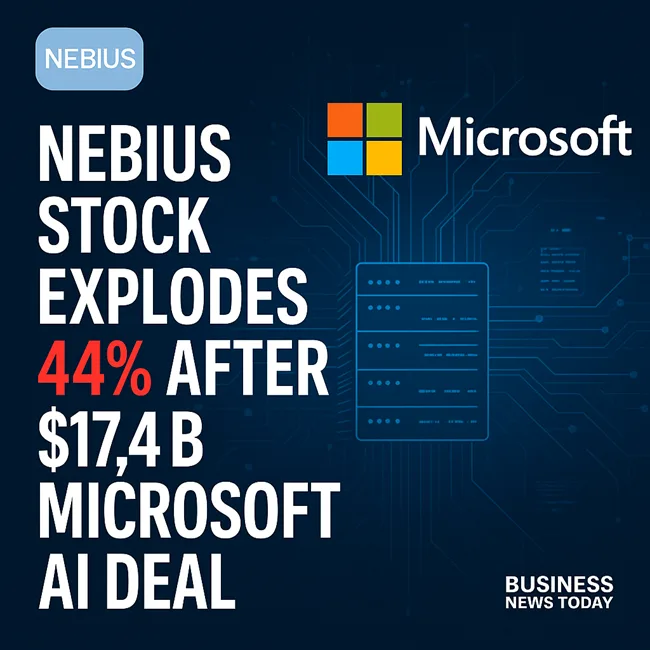
Nebius Group N.V. (NASDAQ: NBIS) stunned the market on September 8, 2025, with an after-hours rally of 44.40%, rising from $64.06 at the bell to $92.50. The surge came after the company announced a multi-billion-dollar commercial agreement with Microsoft to deliver dedicated GPU infrastructure from its newly built data center in Vineland, New Jersey. While the stock closed the regular session down 2.15%, investors reacted with conviction once the details of the five-year AI infrastructure deal were made public through a U.S. SEC Form 6-K filing and a late-evening press release.
The contract, potentially worth up to $19.4 billion through 2031, signals the entry of Nebius into the upper echelons of AI cloud infrastructure providers. Microsoft will gain access to GPU capacity in multiple tranches across 2025 and 2026, with the first deployments scheduled to begin later this year.
Investor enthusiasm reflects a sudden re-rating of Nebius’s future revenue visibility and strategic relevance, particularly in a market where hyperscaler demand for compute power continues to outpace global supply. While broader indices remained under pressure, Nebius’s after-hours gain positioned it among the day’s top AI infrastructure stocks globally.
How does the Microsoft deal reshape Nebius’s business trajectory in 2026 and beyond?
The $17.4 billion agreement, with a possible $2 billion in optional capacity upsides, instantly transforms Nebius from a promising AI-native cloud player into a tier-one vendor trusted by big tech. Under the deal, Nebius will deliver GPU services to Microsoft across multiple phases, contingent on timely infrastructure deployment. The company expects to fund the capital expenditure with a combination of operating cash flow from the contract and new debt secured against Microsoft’s credit quality—a structure that helps preserve equity and accelerates scale.
More significantly, this contract marks Nebius’s first confirmed hyperscaler partnership and paves the way for similar multi-year commitments with other AI labs and technology companies. Founder and CEO Arkady Volozh noted that the deal is the first in a series of long-term strategic engagements the company hopes to announce, positioning Nebius as a preferred AI infrastructure partner in a multi-vendor cloud world.
According to the company’s press release, the economics of the deal are not just financially attractive in isolation but strategically catalytic—enabling faster-than-expected growth of the company’s core AI cloud business into 2026 and beyond.
What makes this deal different from traditional cloud or colocation agreements?
Unlike traditional cloud service agreements that involve shared infrastructure or white-labeling, the Nebius–Microsoft arrangement is a direct GPU service contract built around dedicated infrastructure. Microsoft is not just leasing generic space; it is reserving specific compute capacity optimized for AI workloads from a facility purpose-built by Nebius.
This direct approach points to a broader shift in the AI infrastructure market. Hyperscalers are increasingly seeking customized infrastructure with fine-grained control over compute, latency, and power parameters—requirements that traditional public cloud models are struggling to meet. Nebius, with its proprietary software-hardware stack and in-house chip-tuning capabilities, offers precisely this type of specialized environment.
The inclusion of performance-based delivery milestones, service-level commitments, and financial penalties for non-compliance also highlights how this is not a passive hosting deal but a mission-critical infrastructure partnership.
What are the key risks or failure triggers embedded in the contract?
While the total contract value is massive, execution remains critical. According to the 6-K filing, Microsoft has the right to terminate individual GPU service tranches if Nebius fails to meet agreed delivery dates and cannot provide substitute capacity. The broader agreement can also be canceled for cause—including insolvency events, material breaches, or prolonged failure to secure financing for capital expenditure.
Importantly, Nebius has already signaled that additional financing will be required to fully realize the scope of the deal. While the company plans to issue debt secured against the Microsoft contract, it is also evaluating broader funding strategies to support accelerated infrastructure rollout across North America and Europe.
These caveats mean that while the Microsoft deal provides massive upside, it also introduces real delivery risk. Investors will be closely watching upcoming updates on financing, GPU supply chain execution, and deployment timelines—especially given how critical latency and uptime are for AI workloads.
How does Nebius compare to other players in the AI infrastructure arms race?
Nebius’s value proposition sits at the intersection of hyperscale compute and purpose-built AI tooling. While NVIDIA continues to dominate chip supply and CoreWeave leads in GPU-as-a-service offerings, Nebius is carving out a differentiated lane—acting as a vertically integrated AI-native infrastructure vendor with both hardware design and software orchestration capabilities.
Its platform offers developers a full stack of managed services—from compute and storage to tuning tools—underpinned by proprietary tech. That puts it in rare company alongside emerging players like Lambda and long-standing GPU cloud operators, while also drawing comparisons to specialist divisions inside Microsoft Azure and AWS.
Notably, Nebius also has affiliated businesses that operate under separate brands, including Avride in autonomous vehicle systems and TripleTen in edtech and workforce re-skilling. It holds stakes in firms like ClickHouse and Toloka as well, giving it exposure to multiple AI-driven end markets.
How are institutional investors reacting to Nebius’s sudden leap in visibility?
While full data on institutional flows will emerge over the coming week, early sentiment suggests the Microsoft deal has significantly derisked Nebius’s business model in the eyes of long-term investors. The after-hours price action is likely driven by a combination of institutional algo trades, retail momentum, and early hedge fund positioning ahead of anticipated analyst upgrades.
Prior to this announcement, Nebius had traded with relatively modest volumes for a Nasdaq-listed tech company, reflecting its profile as a newer entrant. That dynamic is likely to shift dramatically, as the company’s future cash flows now include a $17.4 billion contractual anchor with one of the most creditworthy counterparties in the world.
Analysts will likely revisit earnings models and revise long-term growth assumptions upward, particularly for FY2026 and FY2027, when the bulk of the GPU services come online.
What does this mean for the AI infrastructure sector as a whole?
The Nebius–Microsoft deal could prove to be a defining moment for the AI infrastructure market, especially for startups offering full-stack, vertically integrated platforms. As demand for AI training and inference continues to outstrip global GPU supply, hyperscalers are showing increased willingness to commit to external providers with unique value propositions.
Rather than trying to meet every compute requirement internally, players like Microsoft appear open to building a federation of trusted external infrastructure partners. That opens up room for Nebius—and others like it—to function as AI enablers at scale.
If execution is successful, Nebius could become a template for how AI-native infra vendors scale through long-term hyperscaler commitments, rather than chasing short-term spot-market demand.
What’s next for Nebius? Could this deal trigger a strategic capital raise or second wave of partnerships?
With capex now projected to rise beyond original guidance, a strategic capital raise or debt issuance appears imminent. The company has stated it will update the market on its financing roadmap, and with Microsoft’s backing in hand, it is likely to secure favorable terms.
Analysts will also be watching for announcements about follow-on contracts or regional expansions, particularly in Europe and the Middle East. Given the nature of the deal, it’s plausible that Microsoft or others may seek similar infrastructure agreements for generative AI clusters in other geographies.
Ultimately, the Vineland facility may become just the first in a series of Nebius-built AI supernodes globally.
Discover more from Business-News-Today.com
Subscribe to get the latest posts sent to your email.