

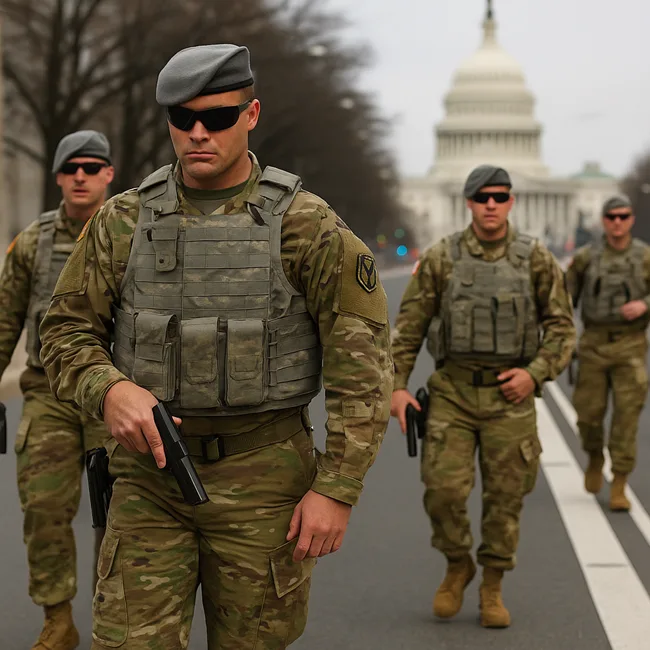
In one of the most striking moves of his second term, President Donald Trump has overseen the authorization of nearly 2,300 National Guard troops to carry SIG Sauer M17 service pistols while deployed across the streets of Washington, D.C. Defense Secretary Pete Hegseth confirmed the decision in a memorandum on August 22, 2025, noting that Guard units would be permitted to carry firearms for personal protection and limited law enforcement duties.
Until now, the Guard’s role in the capital had been primarily unarmed support. Troops had been stationed at intersections, federal landmarks, and tourist hubs, but their presence was symbolic rather than tactical. The shift represents a deeper entrenchment of federal authority in D.C. and raises new debates about the boundary between civilian law enforcement and military involvement in domestic affairs.
Why did President Trump declare a crime emergency in Washington, D.C. and mobilize nearly 2,300 National Guard troops?
The escalation traces back to August 11, 2025, when Trump invoked Section 740 of the D.C. Home Rule Act to declare a formal “crime emergency.” In doing so, he effectively placed the Metropolitan Police Department under federal control while mobilizing the D.C. National Guard. Initial troop deployments numbered about 800 but quickly grew as six Republican-led states agreed to provide reinforcements, pushing the total to nearly 2,300 personnel.
The White House justified the move by pointing to what it described as “out of control” crime in the capital. Trump argued that Washington had become unsafe, citing high-profile incidents and anecdotal accounts from residents. Official crime data, however, showed mixed signals: while violent crime had ticked upward in certain categories, overall crime remained below levels seen in the late 1990s and early 2000s. That tension between perception and data has only fueled the political debate.
How the new Title 32 directive changes the National Guard’s authority and weapons rules in Washington, D.C.
The August 22 memorandum signed by Defense Secretary Hegseth authorized troops to be issued M17 pistols — the Army’s standard-issue sidearm. Importantly, the authorization falls under Title 32 authority, meaning Guard troops operate under federal funding but remain in a legal framework distinct from active-duty military. This structure allows them to support law enforcement while skirting the traditional restrictions of the Posse Comitatus Act, which bars the use of active-duty military for domestic policing.
Under the new rules, Guard troops will not be empowered to conduct arrests like police officers. However, they can detain individuals temporarily until law enforcement officers arrive, and they are authorized to use their weapons in self-defense or when directly supporting law enforcement operations. That distinction — limited but armed support — is at the heart of both the policy and the controversy surrounding it.
Why Washington, D.C.’s unique legal status gives the president direct control over National Guard deployments
Unlike states, the District of Columbia does not have the same autonomy over its National Guard. In D.C., the Guard reports directly to the President, who can federalize it without going through a governor. This unique arrangement has repeatedly surfaced during moments of political and social unrest, from the 1968 riots to the January 6, 2021, insurrection.
By operating under Title 32, the Trump Administration has created a hybrid deployment that combines federal funding, presidential command authority, and local policing functions. Critics argue that this circumvents the balance normally provided by governors, leaving Washington uniquely exposed to direct federal intervention. Supporters counter that the legal structure makes decisive action possible in the face of perceived emergencies.
How local officials, legal experts, and civil groups are responding to armed National Guard patrols in Washington, D.C.
The reaction has been immediate and polarizing. D.C. Mayor Muriel Bowser and several City Council members described the move as “federal overreach,” warning that militarizing city streets with armed troops would only escalate tensions. Legal experts echoed the concern, noting that National Guard soldiers are not trained for civilian policing at the same level as law enforcement officers.
Civil liberties organizations argued that the presence of troops carrying loaded sidearms risks provoking conflict rather than deterring it. Military analysts, meanwhile, pointed out that arming troops fundamentally changes their rules of engagement, increasing the potential for confrontations to turn deadly.
From the administration’s perspective, however, the deployment has been framed as essential. Trump has portrayed himself as a law-and-order president cracking down on crime where local authorities “failed.” Defense Secretary Hegseth reinforced that narrative by stating the Guard must have the means to protect themselves while carrying out federally directed duties.
How the 2025 National Guard deployment in Washington, D.C. compares to past militarization during protests and the January 6 attack
The decision inevitably draws comparisons to two major precedents: the 2020 protests following George Floyd’s killing and the January 6 Capitol insurrection. In 2020, National Guard troops were deployed in D.C. but faced restrictions on carrying weapons, largely to avoid inflaming an already volatile environment. On January 6, by contrast, criticism centered on the Guard’s delayed arrival and underprepared posture.
The 2025 deployment in many ways attempts to flip that script — troops are present in force, fully equipped, and under direct presidential command. Supporters say this ensures Washington cannot be “caught off guard” again. Detractors say it risks turning the nation’s capital into a militarized zone, eroding public trust and democratic norms.
What military law experts and political analysts warn about the risks of arming National Guard troops in Washington, D.C.
Military law specialists have raised concerns that Guard members — many of whom are part-time citizen soldiers — may not have the same de-escalation and crowd-control training as police officers. This gap could heighten risks during confrontations with civilians. Analysts also note that the blurred line between military and police authority could create legal disputes if arrests or detentions by Guard personnel are challenged in court.
Political scientists warn of the optics as well. Washington, D.C., already hosts the highest concentration of federal law enforcement agencies in the country, from the FBI to the Secret Service. The addition of armed Guard troops suggests to many that the administration is pursuing a political message as much as a security strategy. The symbolism of soldiers standing armed at tourist sites, government buildings, and neighborhood intersections may resonate differently with residents, visitors, and political observers.
How arming the National Guard in Washington, D.C. aligns with Trump’s broader law-and-order strategy for U.S. cities
The deployment also ties into Trump’s broader messaging about crime and security in America’s major cities. The president has singled out Chicago and New York as potential targets for similar action, hinting that the D.C. model could expand. The Administration has simultaneously advanced a $2 billion “beautification” plan for the capital, creating a narrative that blends security, federal control, and urban renewal.
Critics view this as a politically calculated campaign, designed to highlight federal authority in Democratic-leaning cities. Supporters argue it demonstrates decisive leadership in tackling crime. Regardless of political interpretation, the use of Guard troops in this way sets a precedent for how future administrations could wield Title 32 powers in other urban centers.
How institutional investors and global observers are interpreting the armed National Guard deployment in Washington, D.C.
For institutional watchers, the move signals a potential stress test for America’s civil–military balance. Investors and corporate leaders may not view the deployment through a traditional business lens, but the implications for stability, governance, and long-term policymaking are significant. A prolonged military presence in the capital could influence tourism, local business sentiment, and even perceptions of Washington’s role as a democratic symbol abroad.
Internationally, foreign observers are watching closely. Past episodes of militarization in democracies have drawn criticism, and Washington’s choices inevitably ripple through diplomatic channels. Allies may see this as a sign of hardening U.S. domestic posture, while adversaries could seize on the imagery to question American democratic resilience.
Is Washington entering a new era of militarized governance?
The authorization of M17 pistols for National Guard troops in Washington, D.C., is not just a tactical adjustment — it is a symbolic marker of how far federal authority can extend in the name of public safety. By placing armed soldiers on the streets of the nation’s capital, the Trump Administration has reignited long-standing debates about the role of the military in civilian life.
Whether this move will reduce crime, improve perceptions of safety, or instead deepen divides remains to be seen. What is certain is that Washington, D.C., now stands as the most visible testing ground for America’s uneasy balance between security and liberty.
Discover more from Business-News-Today.com
Subscribe to get the latest posts sent to your email.