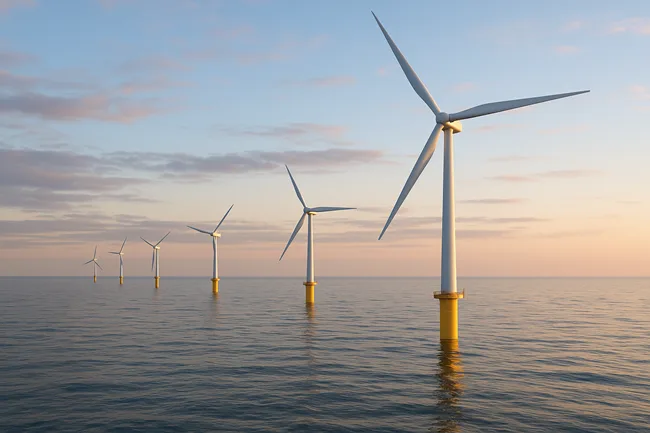
The United Kingdom’s offshore wind sector marked a major breakthrough this week as the Department for Energy Security and Net Zero granted development consent for the Morgan Offshore Wind Project, a 1.5 gigawatt (GW) clean energy development in the Irish Sea. The project, jointly advanced by JERA Nex bp and Energie Baden-Württemberg AG (EnBW), has been hailed as one of the fastest approvals under the country’s Round 4 leasing round, signaling momentum in the UK’s low-carbon infrastructure pipeline.
Energy Secretary Ed Miliband confirmed that the consent, issued on August 29, 2025, represents the 97th nationally significant energy project approved under the Planning Act 2008 framework. Once fully operational, Morgan Generation is expected to provide enough electricity to power approximately 1.5 million UK homes, underscoring its scale within the country’s broader decarbonization agenda.
Why does the Morgan Offshore Wind Project matter for the UK’s clean energy transition and power security goals?
The Morgan Offshore Wind Project stands out not only for its size but also for the speed of its progression. Initially submitted for consideration in April 2024, the project underwent a rigorous six-month examination by the Planning Inspectorate, during which statutory consultees, local communities, and interested parties submitted evidence and feedback. Recommendations were delivered to the Secretary of State by May 2025, and final consent has now been issued within the statutory timeframes.
For the UK government, Morgan represents more than another addition to the offshore wind pipeline. It is directly aligned with the country’s target of reaching 50GW of offshore wind capacity by 2030, a cornerstone of its energy security strategy. The 1.5GW Morgan development alone could account for roughly 3% of that national target, making it a critical component of long-term planning.
Institutional sentiment has been broadly positive. Investors see the project’s swift regulatory clearance as evidence of the UK’s commitment to streamlining energy infrastructure approvals, particularly as geopolitical volatility in gas and oil markets continues to highlight the risks of import dependency. The project’s joint venture structure, combining the global reach of JERA Nex bp with the European expertise of EnBW, adds credibility to its execution timeline.
How significant is the scale and design of the Morgan Offshore Wind Project compared with earlier developments?
Morgan Generation will deploy up to 96 offshore wind turbines, supported by four offshore substation platforms (OSPs), along with inter-array and interconnector cables. At 1.5GW, it belongs to a new wave of “super projects” in UK waters, which are designed to maximize efficiency by scaling up turbine size and reducing per-unit costs.
Historically, the UK’s offshore projects have been smaller. Earlier generations, such as those in the early 2010s, typically ranged between 300MW and 800MW. In contrast, the new breed of Irish Sea and North Sea developments—including Morgan, Mona, and Morven—are significantly larger, reflecting advances in turbine technology and the economics of scale.
Developers say the project will benefit from lessons learned on Mona, an earlier JERA Nex bp project in the same basin. According to JERA Nex bp’s programme director Mark Hudson, Morgan represents a milestone in replicating and scaling the model established by Mona, strengthening the UK’s ability to secure reliable, low-carbon energy for homes and businesses.
EnBW, meanwhile, emphasized that the consent provides certainty to engage supply chain partners and stakeholders. Sarah Pirie, EnBW’s programme director, described the approval as a critical step toward delivering transformative low-carbon infrastructure, reflecting both technical maturity and political backing.
How does the Morgan consent reflect regulatory efficiency under the UK’s Planning Act 2008 framework?
The Planning Inspectorate confirmed that the Morgan application is the 97th energy infrastructure project approved under the Planning Act 2008. Out of 161 applications examined to date, Morgan was delivered within the statutory timeframe, reinforcing the regulator’s reputation for consistency.
Communities in affected areas had the opportunity to voice concerns during the six-month review, and the Examining Authority considered environmental, socioeconomic, and technical evidence before making its recommendation. This process, though rigorous, has drawn praise for maintaining both transparency and timeliness.
For institutional investors, the efficiency of the Development Consent Order (DCO) pathway reduces risk premiums. In the current financing environment—marked by higher interest rates and tighter credit conditions—time-certainty around regulatory approval is as important as the capital expenditure itself. Analysts suggest that Morgan’s progression could improve confidence in other Round 4 projects awaiting approval.
What are the broader implications for JERA Nex bp, EnBW, and the UK offshore wind market?
Morgan is one of three major UK projects being advanced by JERA Nex bp and EnBW. Alongside Morgan, the partners are pursuing the Mona Offshore Wind Project in the Irish Sea and the Morven Offshore Wind Project in the North Sea. Together, these developments are expected to deliver more than 4GW of renewable capacity, positioning the joint venture as one of the UK’s most significant offshore wind contributors.
For JERA Nex bp, the project is part of a wider strategy to accelerate low-carbon investments across Europe. Building on its background in energy supply and trading, the company has increasingly pivoted toward renewable generation assets to support energy transition goals.
EnBW, one of Germany’s largest utilities, views the UK as a critical growth market. The company has been expanding its offshore wind portfolio across northern Europe and considers the UK’s Round 4 projects a central part of its international pipeline. Institutional observers note that EnBW’s involvement signals continued European investor confidence in the UK energy transition, despite Brexit-era regulatory uncertainties.
How is the Morgan Transmission Project tied to grid infrastructure and future UK energy reliability?
While Morgan Generation has now received its development consent, its companion project—the Morgan Transmission Project—remains under examination. This infrastructure will transfer electricity generated offshore into the UK’s national grid. A decision on transmission consent is expected in 2026, making it a key dependency for Morgan’s operational timeline.
Grid bottlenecks have been a recurring challenge in the UK’s offshore wind expansion. Analysts stress that timely approval and construction of transmission infrastructure will be essential to ensure that projects like Morgan can deliver their full capacity without delay. Institutional investors are watching closely, as grid risks can affect project economics and financing structures.
What does the Morgan approval reveal about investor sentiment and the outlook for UK offshore wind?
Investor sentiment around the offshore wind sector has improved after a turbulent period in 2023–2024, when rising capital costs and supply chain pressures created uncertainty for new projects. The Morgan approval, however, is being interpreted as a signal that government, regulators, and developers are aligned on accelerating delivery.
Publicly traded peers such as Ørsted A/S, SSE plc, and RWE AG have seen renewed institutional flows in recent months, with offshore wind positioned as a hedge against fossil fuel volatility. While JERA Nex bp and EnBW are not London-listed in their joint venture form, analysts suggest that approvals like Morgan provide positive spillover sentiment across the sector.
In addition, UK equities tied to infrastructure suppliers, turbine manufacturers, and grid contractors are likely to benefit indirectly. Institutional investors expect Morgan to generate steady demand for supply chain activity, particularly in cable manufacturing, port logistics, and offshore engineering services.
Discover more from Business-News-Today.com
Subscribe to get the latest posts sent to your email.