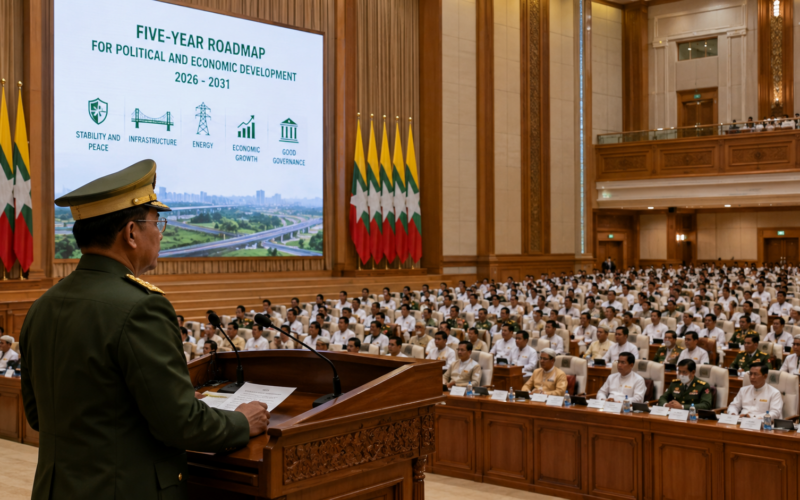
Myanmar President Min Aung Hlaing presented a five-year political and economic roadmap on July 31, 2026, combining promises of development and delayed elections with continued military conscription, expanded security forces and rejection of the Association of Southeast Asian Nations peace framework.
Min Aung Hlaing delivered the address to more than 900 lawmakers, government officials and military representatives in Naypyitaw as the military-backed administration marked its first 100 days in office.
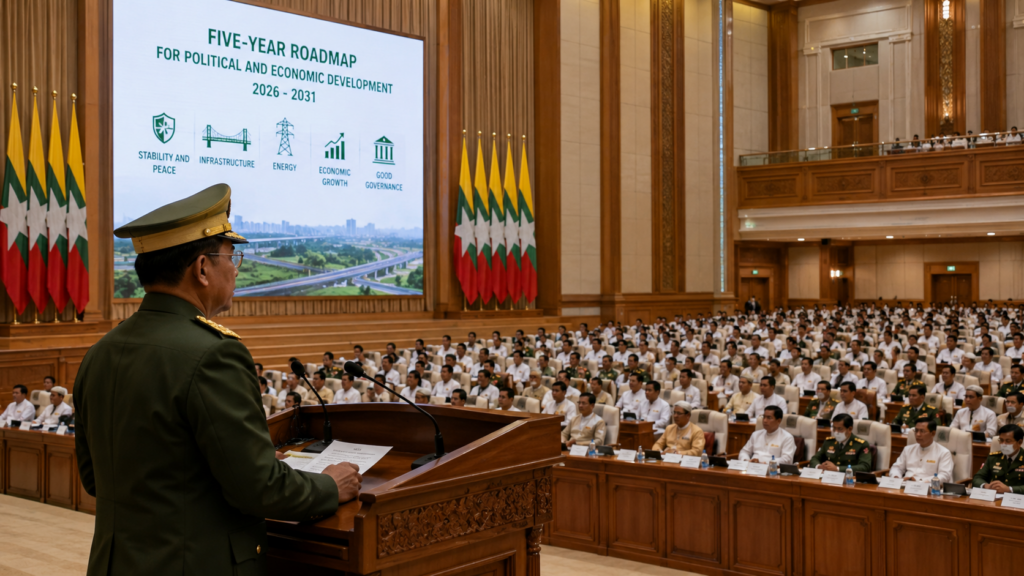
The roadmap divides the government’s programme into two stages. Min Aung Hlaing said the first two years would accelerate efforts to establish stability and national development, followed by three years of intensified implementation across infrastructure, energy, security and administration.
Min Aung Hlaing announced that special elections would be held in 2027 in constituencies across 102 townships that could not participate in the three-phase national elections because of armed conflict.
The government will continue enforcing Myanmar’s conscription law while strengthening the armed forces and police. Min Aung Hlaing also said the administration would proceed with 10 power-generation projects, including the controversial Myitsone hydropower project, and continue preparations for a nuclear power plant.
The speech presents the military-backed government as a civilian administration pursuing development and federal democracy. However, Myanmar remains divided by armed conflict, major opposition forces remain outside the formal political system and the Association of Southeast Asian Nations continues to regard its Five-Point Consensus as the central regional framework for ending the crisis.
What did Min Aung Hlaing announce in Myanmar’s new five-year government roadmap?
Min Aung Hlaing described peace, stability and national development as the two principal objectives of the government’s first 100 days.
The five-year roadmap begins with a two-year period focused on accelerating state-building and economic development. The final three years are intended to expand implementation at what Min Aung Hlaing described as full speed.
The programme covers security, elections, energy, infrastructure, agriculture, industry and public administration. Min Aung Hlaing presented these policies as the basis for creating a modern state operating through democracy and a federal political system.
The roadmap does not include an immediate nationwide political settlement with the armed organisations fighting the government. Min Aung Hlaing instead repeated the government’s invitation for armed groups to surrender weapons or enter negotiations.
The government said it had communicated with 13 ethnic armed organisations. Several of Myanmar’s most influential resistance groups, however, remain unwilling to negotiate on terms that preserve the military-backed political order.
The central contradiction is that the administration is promising national development while continuing a military campaign across large areas of the country. Roads, energy projects, schools and state services cannot operate normally where territory remains contested or communities are repeatedly displaced.
The success of the roadmap will therefore depend less on its stated development targets than on whether the government can produce a credible political process involving groups currently excluded from national institutions.
Why will Myanmar hold special elections in 102 conflict-affected townships during 2027?
Myanmar conducted national elections in three phases between December 2025 and January 2026. Voting could not be held in 102 townships because of armed conflict, territorial control disputes and security restrictions.
Min Aung Hlaing said special elections would be organised in those areas during 2027. The announcement acknowledges that the recent national vote did not provide complete geographic representation.
Holding elections in the affected townships will require either improved security or agreements with armed organisations controlling territory. Election officials cannot operate freely where government personnel, candidates and voters face attacks or where the administration lacks physical access.
The government may attempt to organise voting only in urban areas or locations protected by security forces. Such an approach could produce formal results without representing the entire population of a township.
Major opposition organisations also remain excluded. The National League for Democracy was dissolved after declining to register under military-created election rules, while Aung San Suu Kyi remains imprisoned.
Resistance organisations and parallel political institutions rejected the national election as an attempt to convert military control into civilian legitimacy. Their continued opposition means that a special election alone will not resolve disputes over the political system.
The government must publish clear information on constituency boundaries, voter registration, candidate eligibility, election monitoring and the security conditions required before voting can proceed.
Without broader participation and independent scrutiny, the 2027 special elections could fill vacant parliamentary seats while leaving the deeper legitimacy crisis unresolved.
Why is continued military conscription central to Min Aung Hlaing’s security strategy?
Min Aung Hlaing confirmed that Myanmar will continue implementing the military service law as the government strengthens the armed forces and police.
The conscription system allows authorities to call eligible men and women for military service. Myanmar activated the law in 2024 as the armed forces faced casualties, recruitment challenges and pressure across several fronts.
Conscription gives the military a larger pool of personnel for combat, security, logistics and support roles. It also allows experienced troops to be concentrated in areas considered strategically important.
The policy has created fear among young people and families. Reports of forced recruitment, arbitrary selection and attempts to leave the country have contributed to social disruption and outward migration.
Min Aung Hlaing acknowledged that Myanmar faces a loss of skilled and educated people. The speech identified brain drain as a national problem but did not connect the trend directly to conscription, political repression or the continuing conflict.
The government presents compulsory service as a national duty required to defend sovereignty and public order. Opponents argue that civilians are being compelled to support a military system they did not choose and may actively resist.
Continued conscription signals that the administration does not expect the conflict to end quickly. A government preparing for genuine nationwide peace would normally be expected to reduce emergency mobilisation rather than embed it within a five-year programme.
Why did Min Aung Hlaing reject the ASEAN Five-Point Consensus on Myanmar?
Min Aung Hlaing criticised the Five-Point Consensus adopted by the Association of Southeast Asian Nations in April 2021.
The consensus called for an immediate end to violence, dialogue among all parties, the appointment of a special envoy, humanitarian assistance and a visit by the envoy to meet relevant stakeholders.
Min Aung Hlaing argued that the framework had not contributed to peace and stability. Min Aung Hlaing also claimed that it had not been adopted with complete agreement and that Myanmar had faced discriminatory treatment within the regional organisation.
The criticism conflicts with the historical record that Min Aung Hlaing attended the April 2021 leaders’ meeting at which the consensus was announced. The subsequent dispute centred primarily on implementation, access and whether the military authorities had complied with the commitments.
Myanmar’s senior political representatives were excluded from major Association of Southeast Asian Nations meetings for several years because of the failure to reduce violence and begin inclusive dialogue.
Regional governments resumed limited direct engagement in July 2026, including an in-person meeting between foreign ministers and Myanmar’s top diplomat. The Association of Southeast Asian Nations nevertheless maintained that the Five-Point Consensus remained the principal framework for addressing the conflict.
Min Aung Hlaing’s speech suggests that the administration wants regional engagement without accepting the existing conditions attached to that engagement.
The Association of Southeast Asian Nations must now decide whether to preserve the original framework, revise it or build an alternative process. Abandoning the consensus without measurable progress could weaken the organisation’s credibility, while refusing any adjustment may leave regional diplomacy permanently stalled.
Why is Myanmar planning to revive the controversial Myitsone hydropower project?
Min Aung Hlaing said the government would proceed with 10 power-generation projects, including the suspended Myitsone hydropower project in Kachin State.
The Myitsone project was designed as a 6,000-megawatt dam near the confluence of the Mali and N’mai rivers, which form the Ayeyawady River. Construction began under a partnership involving Chinese and Myanmar interests.
Former President Thein Sein suspended the project in September 2011 following widespread public opposition. Critics raised concerns involving displacement, environmental damage, seismic risk and the expected allocation of electricity.
The project has remained an unresolved issue in relations between Myanmar and China. Chinese companies invested substantial resources before suspension and have repeatedly sought a negotiated outcome.
Revival could support Myanmar’s electricity supply and strengthen economic relations with China. Myanmar experiences serious power shortages that affect homes, factories, transport, healthcare and public services.
The project could also renew political resistance. The Ayeyawady River has exceptional environmental, cultural and economic importance, and communities in Kachin State have opposed development that they believe threatens local land and livelihoods.
Armed conflict creates another barrier. Major infrastructure requires secure construction areas, transport routes and transmission lines, all of which may cross contested territory.
The government must disclose whether the original design, ownership structure and electricity-sharing arrangements remain unchanged. Restarting Myitsone without new environmental assessment and public consultation could turn an energy project into another source of national conflict.
What is Myanmar’s plan for a Russian-backed small modular nuclear power plant?
Min Aung Hlaing confirmed that Myanmar would continue pursuing nuclear energy as part of the national power strategy.
Myanmar and Russia signed an intergovernmental agreement in March 2025 covering cooperation on a proposed small modular reactor. The initial project was described as having approximately 110 megawatts of capacity, with the possibility of future expansion.
Russia’s state-owned nuclear energy corporation Rosatom is the principal foreign partner. Myanmar presents the project as a way to reduce electricity shortages and create a more reliable source of baseload power.
No complete public construction timetable, final site or financing structure had been announced. Those omissions indicate that the project remains at an early planning and cooperation stage rather than active full-scale construction.
Myanmar is also highly exposed to earthquakes. A nuclear project would require extensive geological assessment, safety regulation, emergency planning and an independent authority capable of supervising design and operation.
The country does not currently possess the institutional capacity associated with an established civilian nuclear-power programme. Myanmar would need trained engineers, security systems, waste-management procedures and international safeguards.
Political instability creates an additional risk. Nuclear facilities require continuity of regulation and physical protection regardless of which authority controls surrounding territory.
The project may strengthen Myanmar’s strategic relationship with Russia, but it will not solve immediate electricity shortages. Even small modular reactors require years of planning, licensing, financing, construction and testing.
How does Myanmar’s new roadmap address armed groups and the continuing civil war?
Min Aung Hlaing said the government had invited armed groups to lay down their weapons and participate in talks.
The administration has held discussions with some ethnic armed organisations, particularly groups that maintain older ceasefire arrangements or limited communication with the state.
Several major organisations have rejected the government’s approach. Resistance groups argue that negotiations cannot succeed while the military-backed administration continues airstrikes, arrests, conscription and operations against civilian communities.
Myanmar’s conflict includes established ethnic armies, newer People’s Defence Forces, pro-democracy organisations and local militias with different objectives and command structures.
Some groups seek greater autonomy within a federal union. Others seek the removal of the military from political power and the replacement of the constitutional structure that reserves seats and authority for the armed forces.
A general invitation to surrender does not address those political demands. Meaningful dialogue would require negotiations over constitutional power, security-sector control, territorial administration and representation.
The administration’s roadmap places greater emphasis on strengthening the armed forces than on restructuring the political system. That balance suggests that military pressure will continue alongside selective negotiation.
Without an inclusive process, local ceasefires may reduce fighting in particular areas while the national conflict continues elsewhere.
Why did Min Aung Hlaing highlight the removal of foreign online scam workers?
Min Aung Hlaing said Myanmar had repatriated more than 72,000 foreigners connected to online scam operations.
Large criminal compounds have operated in border regions, particularly areas linked to Thailand and China. Victims are frequently trafficked into the compounds and forced to conduct internet fraud, investment scams and other criminal activity.
The operations have generated international pressure on Myanmar because criminal networks use territory controlled by militias, business groups or armed organisations.
China and neighbouring governments have demanded stronger action after citizens were trafficked, detained or financially defrauded.
The repatriation figure allows Min Aung Hlaing to present the government as cooperating on a major regional security problem. It also supports the administration’s argument that neighbouring countries should engage directly with Myanmar’s authorities.
Removing foreign workers does not automatically dismantle the criminal economy. Scam centres can recruit new victims, relocate operations or continue under different protection arrangements.
A credible campaign requires prosecution of organisers, seizure of assets, investigation of officials and armed groups providing protection and long-term assistance for trafficking survivors.
The issue is strategically important because cooperation against scam networks may become one of the few areas where Myanmar’s government can secure practical engagement from China, Thailand and other regional states despite wider political disagreements.
What are the key takeaways from Min Aung Hlaing’s five-year Myanmar roadmap?
- Myanmar President Min Aung Hlaing presented a five-year roadmap on July 31, 2026, dividing the government’s programme into two years of accelerated development followed by three years of intensified implementation.
- Min Aung Hlaing announced special elections during 2027 in constituencies across 102 townships that could not vote in the recent three-phase national election because of armed conflict and security restrictions.
- Myanmar will continue enforcing military conscription while strengthening the armed forces and police, indicating that the administration expects continued conflict rather than an immediate nationwide security settlement.
- Min Aung Hlaing criticised the Association of Southeast Asian Nations Five-Point Consensus and rejected claims that Myanmar was solely responsible for its failure, deepening disagreement over the regional peace framework.
- The government plans to proceed with 10 power-generation projects, including the controversial 6,000-megawatt Myitsone hydropower project in Kachin State that was suspended in 2011 following widespread public opposition.
- Myanmar will continue planning a Russian-backed small modular nuclear power plant, although the government has not announced a final site, complete financing structure or construction timetable.
- The administration said it had held talks with 13 ethnic armed organisations, but several major resistance groups continue rejecting negotiations that preserve military political control and require armed opponents to surrender.
- Min Aung Hlaing said more than 72,000 foreigners connected to online scam operations had been repatriated, presenting cross-border crime enforcement as an area for renewed regional cooperation.
Discover more from Business-News-Today.com
Subscribe to get the latest posts sent to your email.