



Why does SEMARNAT’s resolution on Oroco Resource’s Santo Tomas copper project matter for exploration timelines and investor confidence?
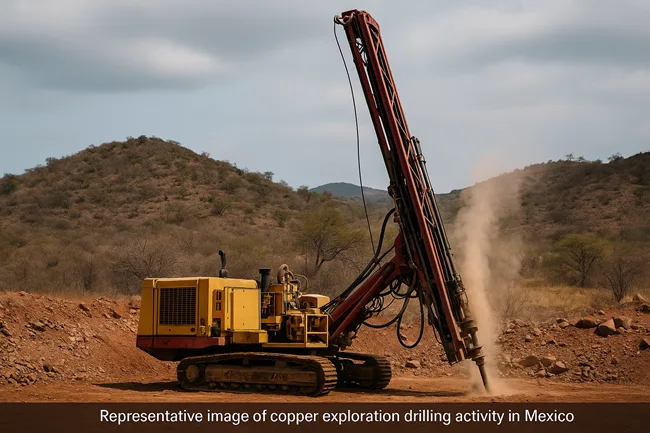
Oroco Resource Corp. (TSXV: OCO, OTCQB: ORRCF) has secured a crucial regulatory milestone after Mexico’s Secretariat of Environment and Natural Resources (SEMARNAT) confirmed that its exploration and drilling program at the Santo Tomas copper project does not require an Environmental Impact Authorization (EIA). The decision, communicated in a formal resolution, effectively removes one of the most time-consuming regulatory hurdles for mining developers in Mexico.
The Santo Tomas copper project in Sinaloa is considered one of Mexico’s largest undeveloped copper deposits, carrying both geological scale and strategic importance in a world increasingly driven by copper demand for electrification. For Oroco Resource, the resolution is more than just a legal technicality—it positions the Canadian exploration firm to accelerate drilling schedules and update its resource model with greater efficiency.
The market responded positively to the announcement, with shares of Oroco Resource seeing an uptick as investors welcomed the removal of uncertainty that often surrounds environmental clearance in Mexico. Institutional observers noted that this could become a catalyst for further project financing and joint venture interest.
How does the Santo Tomas copper project compare with other major undeveloped copper deposits in Mexico?
The Santo Tomas project spans concessions in northern Sinaloa, close to infrastructure such as highways, rail, and the Pacific port of Topolobampo. This proximity enhances its potential attractiveness compared with more isolated copper projects across Latin America.
Historic drilling, completed under previous ownership, outlined a significant mineralized zone with copper grades consistent with large-scale porphyry systems. Oroco Resource currently holds an 85.5 percent interest in the core concessions and a majority interest in surrounding claims, giving it control over one of Mexico’s most strategically located undeveloped copper resources.
In contrast to other greenfield projects that face steep logistical and permitting challenges, Santo Tomas benefits from its inclusion in Plan Sinaloa—a regional initiative designed to promote investment in mining, infrastructure, and industrial development. According to Oroco Resource Chairman Craig Dalziel, the SEMARNAT resolution reflects institutional cooperation aligned with this policy framework.
What role does Mexico’s Plan Sinaloa play in shaping the regulatory and investment outlook for projects like Santo Tomas?
Plan Sinaloa is a regional economic strategy introduced to catalyze private sector investments in mining, energy, and industrial operations across Sinaloa. Its priorities include generating employment, strengthening regional supply chains, and enhancing infrastructure capacity.
By securing a favorable interpretation of environmental permitting under SEMARNAT, Oroco Resource effectively aligns its copper exploration program with this state-level initiative. Analysts indicated that such positioning could attract both domestic stakeholders and international strategic partners who are monitoring the copper supply chain amid global transition metals demand.
The decision also signals a constructive approach by Mexican regulators toward projects that demonstrate regional economic significance. In the mining sector, regulatory certainty is often as important as geological potential in driving investor appetite.
How are institutional investors and market observers interpreting Oroco Resource’s regulatory breakthrough?
Market sentiment following the SEMARNAT resolution has tilted positively. Institutional investors see the clearance as eliminating a potential bottleneck that could have delayed exploration and resource definition work. The lack of an EIA requirement compresses development timelines, providing Oroco Resource with greater flexibility in scheduling drill campaigns and technical studies.
Analysts covering junior copper developers in Mexico have generally welcomed the news as a demonstration of regulatory pragmatism. While Mexico’s environmental framework remains rigorous, the clarity provided in this case reduces project risk perception. This is particularly significant for investors comparing opportunities in jurisdictions where environmental permitting is often slow or unpredictable.
However, observers also caution that despite this regulatory clearance, Oroco Resource must continue proactive engagement with local communities. Social license to operate remains critical in Mexico, where community opposition has historically slowed or halted mining projects.
What challenges and opportunities does Oroco Resource face as it moves forward with Santo Tomas exploration?
While the SEMARNAT resolution removes a significant hurdle, the pathway ahead for Oroco Resource involves balancing accelerated technical progress with transparent environmental and community practices. Copper projects worldwide are under increased scrutiny from both regulators and stakeholders due to water usage, biodiversity concerns, and social impacts.
The opportunity lies in leveraging this clearance to update and expand the resource estimate at Santo Tomas. New drilling programs are expected to refine historical data and position the project for eventual feasibility studies. Investors are particularly focused on whether results can validate Santo Tomas as a world-class copper deposit with scale comparable to other leading porphyry projects.
At the same time, Oroco Resource must prepare for broader market realities. Copper prices remain tied to global demand from electrification, renewable energy, and infrastructure projects, but volatility is always present. Aligning project development with favorable market conditions will be key to maximizing shareholder value.
How could the SEMARNAT decision influence future financing and partnership opportunities for Oroco Resource?
With the environmental resolution in hand, Oroco Resource is now in a stronger position to negotiate financing arrangements and explore strategic partnerships. The elimination of EIA uncertainty makes the project more attractive for potential joint venture partners, particularly mid-tier and major mining firms seeking copper exposure in politically stable jurisdictions.
Institutional investors have also indicated that streamlined permitting enhances capital raising prospects. For junior explorers, demonstrating regulatory momentum can be as important as geological results when engaging with capital markets. Oroco Resource’s share price reaction underscores how environmental certainty directly feeds into investor sentiment.
If further drilling expands the resource base, Santo Tomas could move into the spotlight as one of the most significant copper development opportunities in Mexico—a country already ranked among the top global copper producers.
What is the broader outlook for copper exploration in Mexico following Oroco Resource’s regulatory win?
Mexico continues to position itself as a key jurisdiction for copper exploration and production. Global demand for copper is expected to remain robust as the energy transition accelerates, with uses spanning electric vehicles, renewable power systems, and grid infrastructure.
The SEMARNAT resolution for Oroco Resource could set a precedent for other projects aligned with regional development frameworks like Plan Sinaloa. Investors may interpret the move as a sign of regulatory willingness to expedite projects that demonstrate economic significance without compromising environmental oversight.
For Oroco Resource, the challenge will be to maintain momentum while navigating community engagement and global market cycles. For Mexico, the case highlights how environmental clarity and regulatory cooperation can boost investor confidence and reinforce its position in the global copper supply chain.
Discover more from Business-News-Today.com
Subscribe to get the latest posts sent to your email.