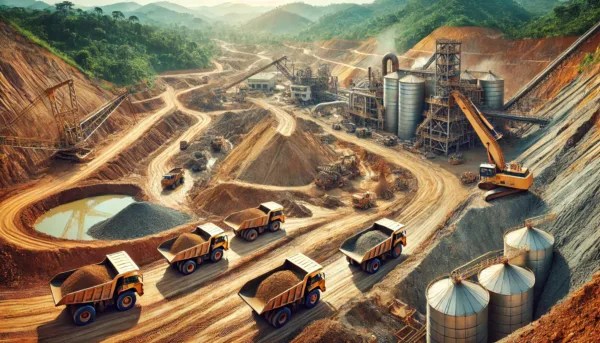

Meteoric Resources Limited (ASX:MEI) has increased the Probable Ore Reserve at its wholly owned Caldeira Rare Earths Project in Brazil by 42% to 145.9 million tonnes at 3,546 parts per million total rare earth oxides. The reserve contains 517,000 tonnes of total rare earth oxides and 126,000 tonnes of magnet rare earth oxides, providing more than 20 years of planned throughput at six million tonnes per annum. The upgrade materially increases geological and mine-plan confidence ahead of a definitive feasibility study targeted for July 2026. It also gives Meteoric Resources a reserve base capable of covering the production profile contemplated in the definitive feasibility study (DFS), rather than relying partly on lower-confidence mineral resources. The central question is whether the larger but 13% lower-grade reserve can preserve project economics while Meteoric secures its construction licence and a funding package that may need to cover approximately US$600 million including working capital.
How does the 42% Caldeira Ore Reserve increase change Meteoric Resources’ development case?
The most important change is not simply that Caldeira now has more tonnes. It is that the enlarged Ore Reserve can support the full 20-year production profile being assessed in the definitive feasibility study at a planned processing rate of six million tonnes per annum.
Meteoric Resources’ July 2025 pre-feasibility study was based on life-of-mine ore feed of approximately 129 million tonnes. About 11% of that production target came from Inferred Mineral Resources, which carry less geological confidence than Measured or Indicated Resources and cannot be converted directly into an Ore Reserve.
The new 145.9 million tonne reserve is derived entirely from Measured and Indicated Resources. It therefore reduces the geological uncertainty embedded in the proposed mine schedule and gives financiers, strategic investors and potential customers a firmer basis for evaluating production longevity.
Compared with the maiden reserve of 103 million tonnes at 4,091ppm TREO, the update represents a 42% increase in tonnage, a 13% decrease in average TREO grade and, according to Meteoric Resources, a 24% increase in contained TREO to 517,000 tonnes. The new reserve also contains 126,000 tonnes of MREO, comprising neodymium, praseodymium, dysprosium and terbium oxides.
Approximately 28% of the reserve is based on Measured Resources drilled on 50 metre by 50 metre spacing across Capão do Mel, Soberbo and Figueira. The remaining reserve is based on Indicated Resources, including material from Barra do Pacu.
The reserve is still only a fraction of Caldeira’s global Mineral Resource of 1.63 billion tonnes at 2,317ppm TREO. That provides expansion optionality, but tonnes outside the current reserve should not be treated as part of the funded production case. Their value depends on future drilling, metallurgical work, permitting, mine planning and capital allocation.
Why does the lower reserve grade matter for Caldeira’s processing economics and mine schedule?
The 13% reduction in average reserve grade deserves attention because much of Caldeira’s cost base will be incurred per tonne processed, rather than per kilogram of rare earth oxide recovered. A lower feed grade can increase the cost per unit of saleable product if recoveries, product composition and operating costs remain unchanged.
The grade reduction does not necessarily mean the early mine plan will be 13% weaker. Meteoric Resources said more than 100 million tonnes of the updated reserve averages above 4,000ppm TREO, providing scope to prioritise higher-grade material during the early operating years.
That sequencing matters because front-loading higher-value ore can support faster capital recovery and stronger early cash flow. The definitive feasibility study will need to show how much of this higher-grade material appears in the initial schedule and whether its metallurgical characteristics are consistent across Capão do Mel, Figueira, Soberbo and Barra do Pacu.
The reserve’s composition also matters more than TREO grade alone. MREO averages 863ppm and represents 24.3% of the reserve’s total rare earth basket. Figueira has the highest MREO grade among the reserve areas at 922ppm, while the combined Capão do Mel and Barra do Pacu reserve carries the highest TREO grade at 3,714ppm.
These differences affect block values because neodymium, praseodymium, dysprosium and terbium generally contribute more economic value than lower-priced elements in the rare earth basket.
The reserve estimate used assumed prices of US$100 per kilogram for NdPr oxide, US$300 per kilogram for dysprosium oxide and US$1,100 per kilogram for terbium oxide, with 70% payability for the mixed rare earth carbonate product. It also used average mining costs of US$2.40 per dry tonne and processing, product transport, mine administration and general administration costs of US$21 per dry tonne.
Those assumptions support reserve conversion, but the reserve announcement is not a new economic study. Investors still need the definitive feasibility study to reveal updated capital expenditure, operating costs, production volumes, cash flow, net present value and commodity-price sensitivity.
What does the new reserve reveal about geological confidence and remaining technical risk?
All 145.9 million tonnes remain classified as Probable Ore Reserves, despite 28% being derived from Measured Resources. No Proven Ore Reserve has been declared.
That classification reflects the role of modifying factors beyond drill density. Mining, geotechnical, hydrogeological, metallurgical, environmental and economic assumptions all influence whether a Measured Resource can support a Proven Reserve.
Caldeira’s proposed mining method is comparatively straightforward. Meteoric plans conventional open-cut mining using excavators and trucks in free-digging clay, with no drilling or blasting. The reserve assumes 5% unplanned ore loss and 95% mining recovery.
However, the reserve documentation identifies moisture-sensitive clay and saturated ground conditions below the water table. Geotechnical inputs remain preliminary, while hydrogeology was not modelled for the reserve assessment. A conservative 20-degree overall slope constraint was applied across the deposits.
These factors do not invalidate the reserve, but they help explain why it remains Probable. They also identify areas where detailed engineering, water management and operating controls must improve confidence before construction and production.
The larger reserve therefore reduces geological risk more than it reduces total development risk. The project still has to demonstrate that selective mining, moisture management, grade control, clay handling and rehabilitation can be executed consistently at commercial scale.
Can Meteoric Resources convert pilot plant performance into commercial-scale operating evidence?
Pilot plant performance is one of the stronger parts of the Caldeira development case. Meteoric commissioned its Poços de Caldas pilot plant in late 2025 and has processed Capão do Mel material at a targeted rate of approximately 600 kilograms per day.
By June 2026, the plant had produced more than 200 kilograms of mixed rare earth carbonate. Average MREO recovery was 71%, while TREO recovery averaged 61%, above the 55% TREO recovery used in the 2025 pre-feasibility study. During May, optimisation work delivered MREO recovery of 80% and TREO recovery of 74%.
The plant has also reported MREC impurities below 2%, water recovery of approximately 85%, ammonium sulphate recovery of about 90% and plant availability of 95%. These results supplement extensive work at the Australian Nuclear Science and Technology Organisation, including diagnostic leach tests, bulk slurry tests and four continuous pilot campaigns.
The remaining challenge is scale. A six million tonne annual commercial plant would process roughly 16,400 tonnes per day, compared with 0.6 tonnes per day at the pilot plant. That represents a throughput increase of about 27,000 times.
Pilot testing can validate chemistry, recovery pathways, product quality and equipment selection, but it cannot eliminate every scale-up risk. Commercial performance will depend on equipment integration, reagent control, water recycling, continuous materials handling and consistency across ore from multiple deposits.
Meteoric has supplied MREC samples to existing and potential counterparties, including Neo Performance Materials, Ucore Rare Metals, MTM Critical Metals and Brazil’s MagBras initiative. Product qualification is strategically important, but qualification work and non-binding memoranda of understanding are not substitutes for binding offtake commitments.
How far does Meteoric Resources’ current funding position extend toward Caldeira construction?
Meteoric Resources ended March 2026 with A$17.9 million in cash and no disclosed loan facilities. It subsequently completed a A$40 million placement at A$0.17 per share, giving the company a pro-forma cash position of approximately A$58 million before placement costs.
That funding should support completion of the definitive feasibility study, environmental licensing, pilot plant operation, land acquisition, engineering, drilling and other pre-development work. It does not represent a fully funded construction solution.
The 2025 pre-feasibility study estimated pre-production capital expenditure of US$443 million, including US$86 million of contingency. Meteoric’s July 2026 presentation indicated that project funding adjusted for working capital could be approximately US$600 million.
The company has received a non-binding and conditional letter of support for up to US$50 million from Export Finance Australia. It also holds a US$250 million letter of interest from the Export-Import Bank of the United States dating from 2024.
These expressions of support broaden the financing pathway, but they are not committed or drawn facilities. Even if both progressed on acceptable terms, Meteoric would still need to assemble the remaining capital through some combination of additional debt, strategic investment, equity, government-backed finance and offtake-linked funding.
The risk is not simply whether capital can be raised. The commercial question is whether financing can be secured without imposing excessive dilution, restrictive covenants, high funding costs or commitments that reduce future product-marketing flexibility.
Meteoric’s April agreement to obtain direct assignment of the principal Capão do Mel, Soberbo and Figueira tenements may assist financing by strengthening tenure over the initial development areas. In return, existing partner Togni received a board nomination right and a conditional option to acquire up to 30% of annual MREC production at market pricing, subject to five years’ advance notice.
What remains between the Caldeira reserve upgrade and a final investment decision in Brazil?
Meteoric Resources received Caldeira’s Preliminary Environmental Licence in December 2025 and submitted its Installation Licence application to the Minas Gerais State Environmental Foundation, known as FEAM, in March 2026.
FEAM completed a site inspection in May. The regulator’s field report and any requests for supplementary information remain part of the review process. Meteoric expects the Installation Licence to be considered by the State Secretariat for the Environment and Sustainable Development early in the December quarter of 2026.
The Installation Licence would authorise construction, but it is not an Operating Licence. Brazil’s three-stage process requires the Preliminary Licence, Installation Licence and, ultimately, an Operating Licence before full-scale production can begin.
Environmental boundaries also remain important. Mining is not permitted within the Environmental Protection Area of the Serra da Pedra Branca Ecological Sanctuary, and Meteoric has not proposed activity inside that area. Parts of Capão do Mel, Soberbo and Barra do Pacu are located within the surrounding buffer zone, where the company has received municipal and conservation council approvals for mining activity.
Management expects to move toward a final investment decision after completing the definitive feasibility study and receiving the Installation Licence. First production remains targeted for 2028.
That timetable leaves limited room for material delays in engineering, funding, licence conditions, procurement or construction. The reserve upgrade strengthens the technical basis for a decision, but it does not itself authorise or finance development.
How did ASX:MEI shares respond to the larger Caldeira Ore Reserve and what does it signal?
Meteoric Resources shares were trading at approximately A$0.1675 at 11:48am AEST on 16 July 2026, down about 4.3% from the previous close of A$0.175. Approximately 2.6 million shares had changed hands at that point in the incomplete session.
Using A$0.1675 as the reference price, MEI was down about 1.5% over five trading sessions and 4.3% over one month. The shares remained within a 52-week range of A$0.10 to A$0.26, with an implied market value of approximately A$487 million based on roughly 2.91 billion shares.
The initial share-price decline coincided with the reserve announcement, but it should not be treated as definitive evidence of the market’s judgment. The upgrade may have been partly anticipated after the preceding Measured Resource increase, while investors may also have focused on the lower grade, forthcoming definitive feasibility study and unresolved funding requirement.
The more meaningful valuation test will come when Meteoric publishes updated economics. A larger reserve is strategically useful, but shareholders ultimately need to know how many tonnes will be processed, how much product will be recovered, what the plant will cost and how the construction funding will be structured.
Which milestones will test whether Caldeira’s 146Mt reserve can support first production in 2028?
The definitive feasibility study is the next measurable test. It should show whether stronger geological confidence and pilot plant recoveries can offset the lower average reserve grade while preserving competitive operating costs and acceptable returns.
Investors will also need evidence that MREC qualification work can translate into binding commercial arrangements. Of particular importance will be pricing structures, payability, minimum volumes, product specifications and any financing attached to offtake agreements.
The Installation Licence will test the permitting timetable and reveal whether additional environmental or social conditions affect cost or construction sequencing. Binding financing terms will then determine the balance between debt, government support, strategic capital and further equity.
What has improved is the reserve coverage, geological confidence and technical evidence supporting the proposed mine plan. What remains unresolved is the commercial-scale cost structure, final construction budget, binding funding package and regulatory timetable.
A definitive feasibility study that preserves the pre-feasibility study’s returns while incorporating the new reserve and pilot data would strengthen the development case. Material capex escalation, weaker unit economics, licence delays or highly dilutive financing would weaken it. The next proof point is therefore not another increase in Caldeira’s geological scale, but whether the definitive feasibility study converts that scale into an executable and financeable project.
What are the key takeaways from Meteoric Resources’ 146Mt Caldeira Ore Reserve?
- Caldeira’s Probable Ore Reserve increased 42% to 145.9 million tonnes at 3,546ppm TREO.
- The reserve contains 517,000 tonnes of TREO and 126,000 tonnes of MREO.
- The enlarged reserve can support more than 20 years of planned throughput at six million tonnes annually.
- Average reserve grade declined 13%, making mine sequencing, recovery and unit costs important definitive feasibility study variables.
- More than 100 million tonnes of reserve material averages above 4,000ppm TREO.
- All reserves remain Probable, with preliminary geotechnical inputs and unmodelled hydrogeology among the remaining technical considerations.
- Pilot testing has delivered 71% average MREO recovery, but commercial throughput would be about 27,000 times greater.
- Pro-forma cash of approximately A$58 million supports pre-development work, not the full construction requirement.
- The Installation Licence, definitive feasibility study, binding offtake and project financing are the next major catalysts.
- First production remains targeted for 2028, subject to permitting, funding, construction and commissioning.
Discover more from Business-News-Today.com
Subscribe to get the latest posts sent to your email.