


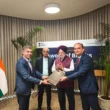

MetaSoilVerse Protocol has listed its MSVP token on LBank, positioning the move as an early access point into a broader real-world asset tokenization strategy tied rhetorically to India’s infrastructure build-out. The company said the protocol is built on BNB Smart Chain, uses a framework it calls Proof-of-Asset-Integrity, and is designed to bring productive assets such as logistics, energy, telecom, and manufacturing infrastructure on-chain. That core announcement is clear in the company’s April 4 release, but the harder executive question is whether this is the beginning of credible asset-layer infrastructure or still mostly a narrative-first token listing.
The reason this matters is that real-world asset tokenization has moved from crypto marketing jargon into a more serious institutional discussion. McKinsey has argued that tokenized financial assets are shifting from pilot projects toward scaled deployment, while the Bank for International Settlements has framed tokenization as a meaningful building block for next-generation financial infrastructure rather than a passing experiment. Standard Chartered and Synpulse went further by projecting that tokenized real-world assets could become a very large market over the next decade, though forecast ranges across the industry still vary wildly depending on what gets counted.
Why does MetaSoilVerse Protocol’s LBank listing matter if the real story is asset tokenization credibility?
A token listing is not the same thing as product-market fit, but it does matter because liquidity is often the first public test of whether a protocol can graduate from white-paper ambition to market attention. LBank’s MSVP trading page confirms the token is live, while CoinGecko also shows MSVP trading across multiple venues, including LBank, BingX, and PancakeSwap on BNB Smart Chain. That gives MetaSoilVerse Protocol an actual market footprint rather than a pre-launch promise.
Even so, the market data also shows why caution is warranted. CoinGecko indicates MSVP traded around $0.024 on April 5, 2026, down sharply from an all-time high near $0.154 reached in late January, with a reported seven-day decline of roughly 19%. LBank’s own market page similarly showed the token down more than 15% over 24 hours during the latest snapshot. In plain English, the listing provides access, but it does not by itself establish confidence, stability, or institutional relevance.
That distinction is important because the company’s messaging is trying to do two things at once. First, it is selling the generic sector thesis that productive real-world assets should become programmable and fractionally accessible. Second, it is trying to convince the market that MetaSoilVerse Protocol specifically deserves to sit in that future stack. The first argument already has traction globally. The second still needs proof.
Is India’s infrastructure boom really a natural use case for on-chain real-world asset tokenization?
The company’s framing around India is not random. India is building heavily across transport, telecom, industrial, and energy infrastructure, so the idea of opening access to yield-bearing assets through digital rails has intuitive appeal. Fractional participation, programmable revenue rights, and faster transferability all sound attractive in markets where capital access is uneven and retail participation in infrastructure economics remains limited. The broader case for tokenization improving market access and liquidity is also being examined seriously by policymakers and researchers.
But there is a regulatory catch large enough to drive a freight corridor through. India still does not have a settled, nationwide framework for tokenized real-world assets in the everyday crypto-market sense. What does exist is a more formal policy conversation. The International Financial Services Centres Authority published a consultation paper in February 2025 specifically on the tokenization of real-world assets, and it explicitly distinguished such assets from cryptocurrencies while warning against misleading public representations. More recently, a private member’s Asset Tokenisation Bill, 2026 was introduced in Parliament, signaling policy interest but not final regulatory certainty.
That means MetaSoilVerse Protocol’s India pitch works better today as a thematic positioning strategy than as proof of execution inside a clear Indian legal-commercial pipeline. There is nothing inherently wrong with that. Plenty of early-stage infrastructure projects start by claiming the biggest available use case. But for executives, investors, and serious market watchers, “India is the thesis” is still a slogan until matched by named asset partners, regulated issuance structures, and enforceable rights around cash flows.
What does Proof-of-Asset-Integrity actually solve, and what remains unproven about the model?
MetaSoilVerse Protocol’s most interesting claim is not the listing itself but its Proof-of-Asset-Integrity framework. The company says PoAI combines oracle-verified data feeds and on-chain attestations to validate the authenticity and operational status of underlying assets. In previous company-linked coverage, the mechanism was described more concretely as a kind of continuous digital health check using sensor and GPS-linked verification. If that works as described, it addresses one of tokenization’s biggest weaknesses: the gap between a token’s on-chain representation and the messy real-world status of the off-chain asset it is supposed to reflect.
That is a real problem in the RWA space. Tokenization often looks elegant at the smart contract layer and much shakier at the custody, audit, servicing, and legal-enforcement layers. OECD materials on tokenization have highlighted that digital representations of real assets can create real efficiency gains, but those gains depend on market infrastructure, legal clarity, and operational integrity, not just code. Put differently, a token can move instantly while the underlying asset still lives in the slow lane of paperwork, dispute risk, and jurisdictional complexity.
The challenge for MetaSoilVerse Protocol is that PoAI is still easier to describe than to independently validate. The public web evidence available today largely traces back to project-controlled pages or republications of sponsored material. I did not find strong independent reporting naming live asset pools, counterparties, or audited case studies showing PoAI operating across revenue-generating infrastructure at scale. That does not mean the model is empty. It means the verification burden is still sitting on the project, not yet on the market.
Why did MetaSoilVerse Protocol choose BNB Smart Chain, and is that enough for RWA scale?
On a technical level, the BNB Smart Chain choice is easy to understand. Official BNB Chain documentation says BNB Smart Chain offers very low transaction fees and fast block times, making it cheaper to run high-frequency on-chain actions than on more congested networks. For a protocol promising programmable leasing, utilization contracts, and revenue-sharing logic, cheap execution matters. Nobody wants a small leasing update to cost more than the lease.
The strategic issue is not whether BNB Smart Chain is cheap enough. It is whether it is trusted enough for the type of institutional-grade tokenization MetaSoilVerse Protocol seems to imply. In crypto, network choice can signal target audience. A chain optimized for affordability and retail access is useful for experimentation and market onboarding. But when the ambition shifts toward regulated infrastructure, cross-border asset rights, or institutional capital pools, compliance architecture and legal wrappers become more important than gas fees alone. The chain can help the product run. It cannot, by itself, make the asset legally bankable.
That is why the protocol’s next milestones matter more than the listing announcement. If MetaSoilVerse Protocol can show named assets, regular attestation workflows, third-party audits, and legally coherent claim structures tied to real cash flows, then the chain decision will look pragmatic. If not, BNB Smart Chain may end up being remembered as the place the token traded rather than the rail on which a serious asset protocol was built.
What should investors and market watchers watch next after the MSVP token listing on LBank?
The first thing to watch is disclosure quality. A credible RWA platform should eventually publish far more than concept language. It should identify what asset categories are live, how ownership or revenue rights are structured, who verifies the data, what legal agreements back the tokens, and what happens when an off-chain asset underperforms, defaults, or disappears. In tokenization, the ugly questions are usually the real business model.
The second thing is market structure. CoinGecko’s data suggests MSVP has trading activity, but it also highlights the absence of reported circulating supply information while showing a very large fully diluted valuation assumption. That kind of setup can produce an impressive headline number without proving mature price discovery. Investors should treat the token as highly speculative until supply transparency, unlock schedules, and actual asset-level economics become clearer.
The third thing is whether MetaSoilVerse Protocol can move beyond crypto-native amplification into regulated financial relevance. India may indeed become an important arena for asset tokenization, especially if GIFT City-linked frameworks and broader legislative efforts gain traction. But the winners in that environment are unlikely to be the projects with the boldest slogans. They are more likely to be the ones that can combine verifiable assets, compliant structuring, resilient custody, and boringly dependable disclosures. In finance, boring is often the final boss.
What are the key takeaways on what MetaSoilVerse Protocol’s LBank listing means for RWA tokenization and India-focused blockchain narratives?
- MetaSoilVerse Protocol has achieved a real market event with the LBank listing, but the current evidence still supports calling this a token-access milestone rather than a proven infrastructure breakthrough.
- The company is tapping into a genuine macro theme because real-world asset tokenization is being taken more seriously by major financial institutions and policy bodies.
- The India angle is strategically smart, but it currently reads more as a positioning device than as independently verified execution inside India’s infrastructure economy.
- Proof-of-Asset-Integrity is the project’s most meaningful differentiator on paper because asset verification is one of the biggest unresolved bottlenecks in RWA tokenization.
- That claimed differentiator still needs stronger third-party validation through named assets, attestation evidence, audits, and partner disclosures.
- BNB Smart Chain offers obvious cost and speed benefits, but low fees are not a substitute for legal enforceability, compliance design, and institutional trust.
- MSVP’s recent price action suggests the token is volatile and speculative, which is normal for small crypto listings but inconsistent with any premature “institutional-grade” narrative.
- Policy momentum around tokenized assets in India is real, especially through IFSCA discussions and emerging legislative interest, but the regulatory picture remains incomplete.
- The project becomes more credible from here only if it proves that tokens represent enforceable economic rights tied to verifiable off-chain assets, not just on-chain symbolism.
- For now, MetaSoilVerse Protocol is best understood as an early-stage RWA infrastructure aspirant with a live token, an ambitious thesis, and a substantial proof burden still ahead.
Discover more from Business-News-Today.com
Subscribe to get the latest posts sent to your email.
