



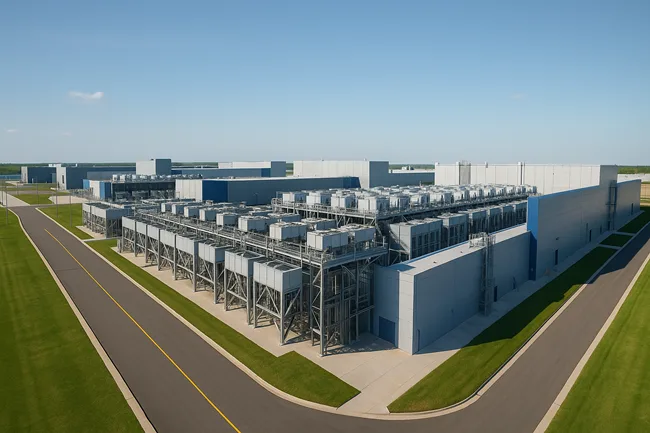
Meta Platforms, Inc. (NASDAQ: META) has entered into a landmark joint venture with funds managed by Blue Owl Capital Inc. to finance, develop, and operate the Hyperion Data Center in Richland Parish, Louisiana. The transaction, valued at approximately $27 billion, marks one of the largest digital infrastructure deals in recent memory, underscoring the scale of investment required to meet next-generation artificial intelligence workloads. As part of the agreement, Blue Owl Capital’s managed funds will take an 80% ownership stake in the newly formed entity, while Meta Platforms will retain 20%, contributing land and construction-in-progress assets in exchange for capital and long-term flexibility.
Construction is already underway at the Hyperion site, and Meta Platforms will manage both property and construction operations throughout the lifecycle of the project. The structure of the deal not only accelerates AI data infrastructure development, but also allows Meta Platforms to scale its capital expenditure footprint strategically without overextending its balance sheet. While the move reflects a broader trend in hyperscale buildouts being financed through private capital partnerships, it also signals Meta Platforms’ determination to maintain operational control in mission-critical AI infrastructure.
Why did Meta Platforms opt for a joint venture instead of directly financing the data center buildout?
The decision to proceed via joint venture reflects a strategic shift in how Big Tech companies are approaching infrastructure financing in an era of ballooning AI compute demands. According to Meta Platforms’ Chief Financial Officer Susan Li, the move enables the social media and metaverse technology major to deliver on its AI ambitions without compromising capital discipline. With global AI data workloads expected to multiply several-fold over the next decade, industry experts say hyperscalers like Meta Platforms need to strike a balance between build speed and capital efficiency.
Meta Platforms has previously relied on internal capital for its data center footprint but is now pivoting toward capital-light expansion models that allow off-balance-sheet scale. By partnering with Blue Owl Capital — a major institutional investor with a focus on digital infrastructure — Meta Platforms gains access to deep pools of long-term capital without bearing the full development risk or carrying the full cost on its own books. Analysts view the 20% retained stake as a tactical move to preserve governance rights and operating control, while Blue Owl Capital takes on the bulk of upfront investment responsibilities.
How is the joint venture structured and what assets were contributed by each party?
The Hyperion Data Center joint venture is designed to hold and develop all physical infrastructure at the Richland Parish campus, including buildings, power delivery systems, cooling frameworks, and connectivity hardware. The total development commitment of $27 billion includes both long-lived capital assets and ongoing operational support. Meta Platforms contributed certain land parcels and under-construction infrastructure that had previously been classified as held-for-sale. These assets now become the foundation of the joint venture’s operational base.
Blue Owl Capital, on the other hand, made an upfront cash injection of approximately $7 billion. In return, Meta Platforms received a one-time cash distribution of approximately $3 billion from the joint venture — a transaction that effectively monetizes assets that were otherwise idle or in-progress. These funds can now be redeployed by Meta Platforms across other strategic initiatives, including AI R&D, generative models, and large-scale compute buildouts in other geographies.
Meta Platforms will also lease back the completed facilities for its exclusive use under operating lease agreements. These leases will initially run for four years, with Meta Platforms retaining extension options to preserve long-term optionality. Additionally, Meta Platforms has issued a residual value guarantee covering the first 16 years of operations. This clause ensures that in the event of non-renewal or early lease termination, the joint venture receives a capped cash payout reflecting the depreciated value of the asset, thereby safeguarding Blue Owl Capital’s downside exposure.
What is the role of institutional investors in the Hyperion financing?
The financial backbone of the project is being supported through a complex combination of equity, debt, and risk-assumed guarantees. Blue Owl Capital’s $7 billion equity contribution is being supplemented by debt financing from institutional bondholders including Pacific Investment Management Company (PIMCO) and select private credit investors. The bond issuance was conducted through a private securities offering, with Morgan Stanley & Co. LLC acting as sole bookrunner.
Meta Platforms retained Latham & Watkins LLP as its lead legal counsel and Eversheds Sutherland for lease-related matters. Arthur D. Little LLC advised on commercial due diligence, while Marsh provided risk management and insurance services for the development. Arup, a global engineering consultancy, was engaged as independent engineer for environmental and technical evaluation. Blue Owl Capital was represented by Kirkland & Ellis LLP, while Milbank LLP served as counsel to Morgan Stanley in connection with the securities offering.
This layered financial structuring highlights the growing willingness of Wall Street to underwrite capital-intensive AI infrastructure — especially when backed by a known tenant like Meta Platforms with long-term operational commitments.
How does this reflect on Meta Platforms’ broader AI infrastructure strategy?
The Hyperion development comes as Meta Platforms intensifies its push into generative AI, foundational models, and metaverse-related compute. As the company pivots beyond social media toward becoming a full-stack AI infrastructure leader, it has begun scaling up its capital programs across GPUs, AI accelerators, and hyperscale data centers. The Hyperion campus is expected to be one of the largest in Meta Platforms’ portfolio and will play a pivotal role in powering AI workloads, including those supporting Meta AI, Llama models, and real-time recommendation engines.
Rachel Peterson, Vice President of Data Centers at Meta Platforms, confirmed that thousands of workers are already on-site, and once operational, the campus will support over 500 full-time jobs. The economic benefits to the Richland Parish community were also cited as a driver of the partnership, with construction and long-term employment expected to boost regional development.
Institutional sentiment around Meta Platforms’ infrastructure bets has been cautiously optimistic. While some investors are concerned about capital intensity and long-term ROI, others see the Blue Owl Capital joint venture as a savvy move that offloads financial burden while retaining operational leverage. Analysts note that this approach could become a template for similar partnerships across the hyperscaler universe, particularly as AI infrastructure costs continue to balloon.
How is Meta Platforms’ stock responding, and what are the implications for future capex?
Meta Platforms Inc. (NASDAQ: META) is currently trading near $733 per share, with a market capitalization of approximately $1.85 trillion. Its price-to-earnings ratio is hovering around 25.9, suggesting a relatively balanced valuation in the context of tech-sector peers. The stock has remained relatively stable in the wake of the Hyperion announcement, with intraday price action muted but not dismissive — a signal that investors are digesting the news with measured optimism.
Some institutional investors see the $3 billion distribution to Meta Platforms as a short-term liquidity boost, particularly as the company seeks to maintain robust free cash flow while executing multiple parallel AI initiatives. Others view the 16-year value guarantee as a calculated risk that could become burdensome if infrastructure demand slows, though such scenarios remain speculative given the current AI arms race among Big Tech.
The capital-light approach Meta Platforms is embracing here may also influence how it funds other major capex projects. Instead of direct ownership, Meta Platforms may increasingly act as anchor tenant and operational controller, while institutional partners provide the bulk of financing. This shift could free up Meta Platforms’ capital for M&A, software stack investments, or shareholder returns.
What broader trend does the Meta–Blue Owl Capital joint venture signify?
The Hyperion deal reflects a growing convergence between hyperscale technology and institutional private capital. As AI workloads stretch the limits of traditional data center financing, capital-efficient models are being sought by all major hyperscalers. Alphabet Inc., Microsoft Corporation, Amazon Web Services, and now Meta Platforms are all actively exploring new financial engineering models to fund infrastructure expansion without excessively bloating their capital expenditures.
The move also signifies a shift in Wall Street’s appetite for digital infrastructure. Funds like Blue Owl Capital — previously active in telecom towers, fiber networks, and REITs — are now increasingly targeting hyperscale campuses, driven by predictable cash flow and long-term leasebacks from Big Tech. The willingness of debt investors like PIMCO to participate in this buildout via private placement indicates a maturing of the digital infrastructure asset class.
Industry observers believe this model — a capital partner with deep financial capacity, coupled with a hyperscaler providing operational commitment — may soon become the default mode for AI infrastructure development. Meta Platforms’ decision to execute at scale with a trusted institutional partner rather than go it alone could therefore mark a turning point in hyperscale project financing.
Is this the beginning of a new infrastructure playbook?
For Meta Platforms, the Hyperion joint venture is more than just a data center — it’s a new infrastructure strategy in motion. By retaining operational control while outsourcing most capital risk, the social media and AI heavyweight is demonstrating a new playbook for scaling compute capacity without overextending its financial flexibility. Blue Owl Capital, in turn, secures a long-term, stable investment backed by a marquee hyperscale tenant, while investors gain exposure to a fast-growing corner of digital infrastructure.
The key to this model’s success will lie in flawless execution: timelines, power availability, utilization rates, and long-term AI demand curves must all hold up. But if this project delivers as planned, it could be a case study in how Wall Street and Silicon Valley are learning to build AI’s physical backbone together.
What are the key takeaways from the Meta Platforms and Blue Owl Capital data center joint venture?
- Meta Platforms, Inc. (NASDAQ: META) has entered a $27 billion joint venture with funds managed by Blue Owl Capital Inc. to develop the Hyperion Data Center in Richland Parish, Louisiana.
- Blue Owl Capital holds an 80% ownership stake, while Meta Platforms retains 20% and receives a one-time $3 billion cash distribution.
- The deal includes operating lease agreements and a 16-year residual value guarantee by Meta Platforms, preserving long-term use flexibility while shifting financial risk.
- The Hyperion campus is a core part of Meta Platforms’ AI infrastructure expansion and will support compute demands for Llama models, Meta AI, and metaverse workloads.
- Construction is already underway, with thousands of workers on site and more than 500 operational jobs expected once the facility goes live.
- Financing includes private bond placement to institutional investors including PIMCO, with Morgan Stanley serving as exclusive financial advisor and bookrunner.
- Analysts view the capital-light joint venture model as a template for future AI infrastructure buildouts, blending institutional capital with hyperscaler control.
- Meta Platforms’ stock is trading near $733 with a price-to-earnings ratio of approximately 25.9, as investors cautiously welcome the structured risk-sharing model.
- The transaction signals broader industry shifts toward private-capital-driven infrastructure financing for hyperscalers amid rising AI-driven compute demand.
- If executed successfully, the Hyperion venture could set a new benchmark for balancing rapid AI infrastructure scale with disciplined financial engineering.
Discover more from Business-News-Today.com
Subscribe to get the latest posts sent to your email.



