
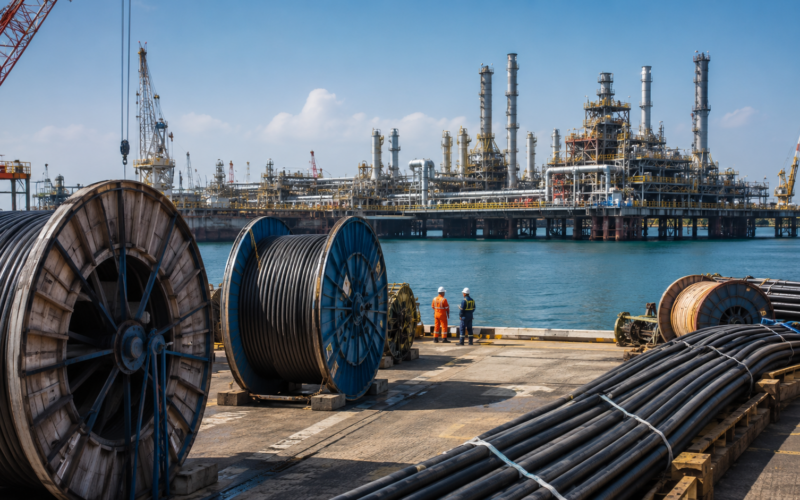
Middle East Specialized Cables Company (MESC, TADAWUL: 2370) has announced that its wholly owned UAE subsidiary, Middle East Specialized Cables Co. LLC in Ras Al Khaimah, has received a letter of award from Cunado Middle East for Pipes and Valves LLC for an ADNOC Offshore-linked project in the United Arab Emirates. The contract is valued at about SAR 175 million, or roughly $46.6 million, and covers low-voltage power cables and communication cables for the Lower Zakum Long-Term Development Plan Phase I, Amirah Island Surface Facilities Package II. The order matters because it connects a Saudi-listed industrial supplier to one of Abu Dhabi’s most strategically important offshore oil development programmes. With MESC shares recently trading near SAR 33.70, close to their 52-week high of SAR 35.20, the market is already treating the company as more than a quiet cable manufacturer.
Why does the Middle East Specialized Cables order matter for ADNOC Offshore’s Lower Zakum expansion?
The immediate change is straightforward: Middle East Specialized Cables Company has gained a sizeable Gulf oil and gas infrastructure order through its UAE subsidiary. The deeper signal is more interesting. Cable supply sits deep inside the project execution chain, but power distribution, control, instrumentation and communication cabling are essential for offshore surface facilities that must operate reliably across decades. In other words, this is not glamorous equipment, but it is the kind of equipment that decides whether a technically complex offshore project runs smoothly or becomes a very expensive headache with saltwater views.
For ADNOC Offshore, the Lower Zakum programme remains central to maintaining and expanding production capacity from a mature but strategically critical offshore asset. The Amirah Island surface facilities package is part of the supporting infrastructure needed to sustain long-term field operations, not a decorative add-on to the development plan. That gives the MESC order a different quality from a generic construction supply contract. It is linked to a field redevelopment framework where uptime, safety, certification, delivery discipline and system compatibility matter as much as price.
For Middle East Specialized Cables Company, the contract strengthens its positioning in the regional energy supply chain at a time when Gulf national oil companies are continuing to spend on upstream capacity, field life extension, offshore electrification and production reliability. The award also gives the company a reference point in the UAE, where proximity, technical qualification and procurement credibility can influence future bid participation. The order will not transform MESC into an offshore EPC giant overnight, but it does put the company in the right industrial neighbourhood.

How could the SAR 175 million contract reshape MESC’s backlog visibility and revenue quality?
The SAR 175 million value is meaningful relative to MESC’s scale. The company reported Q1 2026 sales of about SAR 462.5 million and net income of about SAR 32.6 million, so the Lower Zakum-linked order represents roughly 38 percent of one quarter’s sales. Against 2025 revenue of about SAR 1.48 billion, the contract is close to 12 percent of annual sales. That does not mean the revenue will be booked immediately, because supply contracts are usually recognised across manufacturing, delivery and project milestones, but it does show why investors may treat the award as material rather than routine.
The quality of the revenue is also important. Industrial cable manufacturers can face margin pressure from copper, aluminium, polymers, logistics costs and competitive tendering. A project-linked order in oil and gas does not automatically guarantee high margins, but it can offer better revenue visibility than short-cycle commodity-like cable demand. For MESC, the real value lies in whether the contract improves utilisation, deepens engineering credibility and supports additional orders for power, control, communication and instrumentation cable packages across regional infrastructure.
The watchpoint is working capital. Cable supply contracts can absorb cash through raw material procurement, production scheduling, receivables and performance-linked payment terms. MESC has shown stronger earnings momentum, but investors should still track whether growth converts into operating cash flow. A bigger order book looks excellent in a press headline. A bigger order book that consumes cash before collections arrive is where finance teams start reaching for stronger coffee.
Why is Lower Zakum strategically important for Abu Dhabi’s offshore production plans?
Lower Zakum is one of Abu Dhabi’s core offshore oil assets and sits within the broader production strategy of Abu Dhabi National Oil Company. The field has international partners, including ONGC Videsh-led Indian interests, Inpex Corporation, China National Petroleum Corporation, Eni and TotalEnergies, which makes the development commercially and geopolitically relevant beyond the United Arab Emirates. The project is not just a domestic field upgrade. It is part of Abu Dhabi’s effort to sustain long-term output from large offshore reservoirs while keeping project economics competitive.
That context is why the Amirah Island surface facilities package matters. Offshore production growth depends not only on wells and platforms but also on utilities, electrical systems, controls, communications and safe operating infrastructure. The cable scope awarded to MESC sits within this enabling layer. Without resilient cabling and control infrastructure, even sophisticated production equipment can become a bottleneck. The least flashy components often carry the most operational risk.
The second-order implication is that suppliers with regional manufacturing, technical certifications and oil and gas experience could benefit from the next phase of Gulf upstream spending. Gulf producers are not simply building new capacity. They are upgrading mature fields, extending asset life, reducing operating risk and integrating more advanced control systems. That creates demand for specialised suppliers that can satisfy project specifications while managing delivery timelines across multi-contractor EPC environments.
What does the Cunado Middle East role reveal about procurement complexity in Gulf megaprojects?
The presence of Cunado Middle East for Pipes and Valves LLC in the award chain points to the layered nature of Gulf project procurement. Large oil and gas developments are rarely simple bilateral transactions between an operator and a manufacturer. They usually involve operators, EPC contractors, package specialists, material supply companies, engineering consultants, logistics providers and multiple certification gates. That complexity can create opportunities for qualified suppliers, but it also increases execution risk.
For MESC, working through this procurement structure means the company must align with project documentation, inspection requirements, delivery sequences and client-approved vendor processes. The issue is not only whether MESC can manufacture the cables. The issue is whether MESC can deliver the right product, with the right certificates, at the right time, into the right package schedule. In offshore projects, a delayed cable delivery can hold up downstream installation work, and nobody enjoys explaining that in a project review meeting.
This also shows why regional supply-chain depth matters. Gulf national oil companies and EPC contractors increasingly value suppliers that can combine local or regional manufacturing with technical compliance and faster delivery. The Ras Al Khaimah subsidiary gives MESC a UAE operating base, which could help on logistics, customer proximity and future project engagement. The contract therefore reinforces a practical advantage: in complex infrastructure markets, being geographically and technically close to the customer can be as valuable as being cheap.
How does MESC’s Tadawul valuation reflect the gap between contract momentum and cash flow risk?
MESC’s market context is already hot enough to deserve caution. The stock recently traded around SAR 33.70, only below its 52-week high of SAR 35.20, and well above its 52-week low of SAR 18.21. Saudi Exchange data also showed a year-to-date gain of more than 58 percent, while market performance trackers pointed to positive one-week and one-month momentum. That means the Lower Zakum-linked order is arriving after a strong share-price rally, not before the market noticed the story.
The valuation is still not obviously stretched on a simple earnings multiple basis, with the Saudi Exchange showing a price-to-earnings ratio near 11.7 times and market capitalisation around SAR 1.35 billion. However, the market is likely rewarding a mix of earnings recovery, regional infrastructure exposure, dividend yield and stronger order visibility. The risk is that a single contract headline encourages investors to extrapolate too much too quickly. Cable supply is an attractive niche, but it remains exposed to materials costs, payment cycles and project timing.
A neutral reading suggests the stock is best viewed as a Gulf infrastructure and energy supply-chain play rather than a pure oil production proxy. If MESC converts new orders into cash-backed earnings, the current optimism may look justified. If working capital expands faster than collections or margins soften under input-cost pressure, the share-price rally could become vulnerable. The company has won attention. The harder part is keeping it without giving cash flow a nervous breakdown.
What execution risks could decide whether this ADNOC-linked cable contract becomes a stronger margin catalyst?
The first execution risk is delivery discipline. Offshore-linked projects typically work around tight package schedules, and cable suppliers must align manufacturing slots, quality testing, documentation and logistics with the wider EPC programme. MESC’s reputation will benefit if the company delivers without slippage. It could suffer if the contract turns into a timing or certification dispute, because one high-profile project delay can echo loudly across a procurement market where everyone knows everyone.
The second risk is margin protection. Cable manufacturers are exposed to raw material volatility, especially metals and insulation inputs. If the contract has adequate price adjustment mechanisms, MESC may be able to protect profitability. If pricing is fixed and input costs rise, revenue growth may not translate into equivalent profit growth. That is why contract value alone is not the same as earnings visibility. Investors should care about gross margin, operating cash flow and receivables, not just headline awards.
The third risk is customer concentration and project-cycle dependence. A stronger position in Gulf energy projects can lift MESC’s strategic profile, but it also links the company to oil and gas capital spending cycles. That can be beneficial when ADNOC Offshore, Saudi Aramco and other regional operators are investing aggressively. It can become more challenging if project awards slow, pricing tightens or contractors push suppliers harder. The real test for MESC is whether this order becomes part of a repeatable platform across offshore, petrochemical, power and industrial projects rather than a one-off trophy contract.
What are the key takeaways from MESC’s ADNOC Offshore cable supply order for executives and investors?
- The SAR 175 million cable supply order gives Middle East Specialized Cables Company a meaningful project reference in the UAE offshore energy market and strengthens its position in Gulf industrial supply chains.
- The contract is significant relative to MESC’s quarterly revenue base, but investors should track revenue recognition timing before assuming an immediate earnings uplift.
- The order is linked to the Lower Zakum Long-Term Development Plan Phase I, which makes it strategically more relevant than a routine cable sale into commercial construction.
- MESC’s UAE subsidiary gives the company a regional operating advantage in procurement, logistics and customer proximity for complex Gulf oil and gas projects.
- The cable scope matters because power distribution, communication, control and instrumentation infrastructure are critical to offshore reliability and long-term field operations.
- MESC shares are already trading close to their 52-week high, so the market appears to be pricing in stronger earnings recovery and regional project momentum.
- The key financial risk is working capital, because large supply contracts can absorb cash through materials procurement and receivables before collections catch up.
- The key margin risk is input-cost volatility, especially if raw material prices rise faster than contract protections or customer pricing mechanisms allow.
- The competitive opportunity is broader than Lower Zakum, because Gulf upstream, power, petrochemical and industrial projects all require technically qualified cable suppliers.
- The strategic test is whether MESC can convert this ADNOC-linked award into repeat business across the UAE and wider GCC rather than treating it as a single contract win.
Discover more from Business-News-Today.com
Subscribe to get the latest posts sent to your email.