


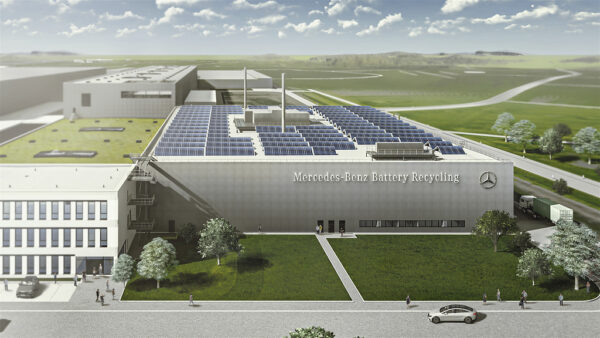
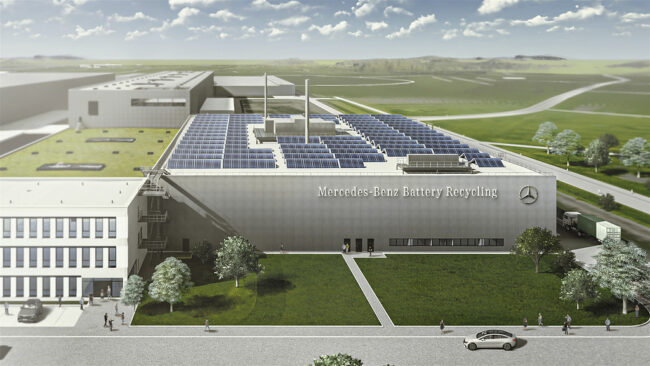
German automotive giant Mercedes-Benz Group AG has commenced construction of its first in-house battery recycling facility in Kuppenheim, a strategic move aligned with its broader “Electric Only” sustainability initiative. The plant, which is being developed in stages, is designed to process 2,500 tonnes of battery modules annually—equivalent to more than 50,000 units—once fully operational.
With the initial construction phase officially underway as of March 2023, Mercedes-Benz is positioning the Kuppenheim facility as a critical piece of its supply chain resilience strategy. While exact capital expenditure figures for the project have not been publicly disclosed, the automaker is receiving financial and technical support from the German Federal Ministry of Economics and Climate Protection under a scientific research framework.
This pilot project is a cornerstone of Mercedes-Benz’s ambition to create a closed-loop, low-carbon raw material strategy for its growing electric vehicle (EV) fleet under the Mercedes-EQ brand. Jörg Burzer, Management Board Member for Production and Supply Chain at Mercedes-Benz Group AG, described the launch as a decisive step toward “closing the material cycle for batteries,” referring to the site as a “mine of tomorrow.”
What sustainability and supply chain goals is Mercedes-Benz targeting through this battery recycling facility?
The new battery recycling facility at Kuppenheim is intended to meet several strategic objectives for Mercedes-Benz. Most prominently, it enables the automaker to secure long-term access to battery-grade materials such as lithium, cobalt, nickel, and graphite—resources whose geopolitical and environmental extraction challenges have become a bottleneck in the global EV supply chain.
By using hydrometallurgical processes in its pilot plant, Mercedes-Benz aims to recover more than 96 percent of these critical minerals from used EV batteries. If successful, this high-efficiency recycling rate would allow the automaker to significantly reduce its dependence on mining operations in countries like the Democratic Republic of Congo or Chile, where supply chain ethics, water use, and environmental degradation are under increasing scrutiny.
The Kuppenheim facility will cover the full end-of-life battery processing cycle—from the initial mechanical dismantling of modules to shredding, drying, and eventually the hydrometallurgical extraction of metals. According to company plans, production will gradually ramp up by the end of 2023 as the dismantling line becomes operational. Further expansions may be introduced based on pilot results.
The overall goal, Burzer said, is to use this model to incorporate recovered materials directly back into new battery cells for Mercedes-EQ vehicles, ultimately enabling a circular battery value chain.
How does Mercedes-Benz’s partnership with Primobius strengthen the recycling pilot?
To execute the technically complex recycling operation, Mercedes-Benz is partnering with Primobius, a battery recycling technology joint venture between German industrial plant builder SMS group and Australian resource recovery specialist Neometals Ltd. This collaboration gives the automaker access to industrial-scale hydrometallurgy technologies that have already shown promise in pilot programs globally.
Primobius’s process integrates mechanical pre-treatment of battery packs with proprietary chemical leaching methods to separate high-purity metals. By combining Primobius’ operational expertise with Mercedes-Benz’s EV manufacturing scale, the partnership aims to validate a replicable, scalable recycling model within Europe.
The use of hydrometallurgy—as opposed to traditional pyrometallurgy—also aligns with the automaker’s climate neutrality targets. The water-based technique consumes less energy, emits fewer greenhouse gases, and allows for more targeted recovery of sensitive materials.
This partnership also provides Mercedes-Benz with a technological hedge as European Union legislation around battery material recovery and lifecycle emissions continues to tighten. In particular, compliance with the EU Battery Regulation, which mandates recycling efficiency thresholds and material traceability, may soon become a competitive differentiator in Europe’s EV market.
Why is Germany backing battery recycling with public funds and research support?
The German federal government, through the Ministry of Economics and Climate Protection (BMWK), is financially supporting the Kuppenheim pilot as part of its commitment to decarbonizing the auto industry. This initiative also aligns with broader EU policy objectives under the Green Deal, which prioritizes regional independence from raw material imports and greater environmental accountability in critical industrial sectors.
The recycling facility is part of a government-backed scientific research project, suggesting that Kuppenheim will also serve as a real-world testbed for advanced battery material recovery, data collection, and process optimization. By combining academic research with commercial implementation, Mercedes-Benz and its public partners hope to set new industrial standards for battery lifecycle management.
Federal officials have consistently encouraged innovation in circular economy practices, particularly in sectors like automotive manufacturing, which remains a pillar of Germany’s industrial GDP. As EVs become a national economic priority, investment in technologies that reduce import dependency and environmental risk is being treated as a strategic imperative.
How does this move align with Mercedes-Benz’s “Electric Only” strategy?
Mercedes-Benz has committed to going “Electric Only” by the end of the decade wherever market conditions permit. To meet this ambitious electrification target, the automaker is not only expanding its EV product portfolio but also transforming its entire production ecosystem to support lifecycle sustainability. From renewable-powered gigafactories to closed-loop material flows, each part of the EV value chain is undergoing systemic redesign.
The Kuppenheim project is a direct implementation of this strategic vision. By localizing battery recycling, Mercedes-Benz can reduce carbon emissions associated with global material transport while also insulating itself from raw material price volatility and political risk.
Moreover, the German automaker has previously outlined plans to integrate recovered materials into next-generation battery chemistries, thereby enabling greener battery manufacturing without compromising performance. This aligns with internal sustainability targets as well as growing consumer demand for environmentally responsible mobility solutions.
What are the potential long-term implications of this pilot plant for the EV sector?
If successful, the Kuppenheim battery recycling plant could serve as a blueprint for other manufacturers seeking to build closed-loop supply chains for EV batteries. Given the forecasted surge in EV adoption—global sales are expected to exceed 14 million units by 2025—battery waste and material scarcity are already becoming pressing industry concerns.
Analysts believe that whoever masters battery recycling at scale will hold a crucial advantage in the EV race. Not only does it enable security of supply, but it also reduces environmental compliance costs and enhances ESG (environmental, social, governance) credentials—now critical to investor relations.
With Kuppenheim, Mercedes-Benz is attempting to secure that edge early. By controlling both ends of the battery lifecycle—production and end-of-life recovery—the Stuttgart-based automaker may position itself as one of the most vertically integrated EV players in Europe.
Could Mercedes-Benz scale this model to other regions or markets?
While the Kuppenheim facility is clearly a German-led initiative, its strategic value extends far beyond Europe. If the pilot proves successful, Mercedes-Benz could replicate similar recycling hubs in other regions with high EV penetration, including China and North America.
Such an expansion would help the automaker not only meet local regulatory requirements but also deepen its global EV market leadership by leveraging local resource recovery ecosystems.
With ongoing partnerships, future battery innovations, and global policy shifts favoring recycling mandates, Mercedes-Benz appears to be laying the groundwork for a long-term circular economy strategy—one that could become a defining feature of its next-generation manufacturing identity.
Discover more from Business-News-Today.com
Subscribe to get the latest posts sent to your email.