McLaren Minerals Limited (ASX: MML) has confirmed high-grade titanium-bearing mineralisation immediately south of its Indicated Resource at the McLaren Titanium Project in Western Australia, strengthening the case for expansion of the deposit. The October 3, 2025 announcement detailed assay results from the MM series of drill holes, showing consistent grades above 4% heavy minerals (HM) and multiple intercepts exceeding 5% HM, including a standout result of 14.23% HM from surface.
The high-grade strike has now been traced approximately 500 metres beyond the southern boundary of the current resource and remains open along strike, giving McLaren Minerals a clear opportunity to increase resource tonnage and grade. This discovery mirrors earlier northern extension drilling and confirms the orebody’s continuity in both directions.
What role will these new assays play in the mineral resource estimate and prefeasibility study?
According to McLaren Minerals, the latest assays will be incorporated into the imminent Mineral Resource Estimate (MRE) update, which is one of the final inputs into its Prefeasibility Study (PFS). Managing Director Simon Finnis described the results as validation of both geology and metallurgy, noting that the grades above 5% HM and intercepts above 14% HM demonstrate the orebody’s quality.
The current MRE, last updated in August 2024, stands at 280 million tonnes at 4.8% HM (79Mt Indicated at 6% HM and 201Mt Inferred at 4.4% HM). With the new assays now extending mineralisation further south, institutional investors will be watching closely to see whether McLaren Minerals can grow the Indicated category, which carries more economic weight for project financing.
Why is titanium classified as a critical mineral, and how does this strengthen McLaren’s strategic position?
Titanium has been recognised as a critical mineral for aerospace, defence, and clean energy industries, given its strength-to-weight ratio and corrosion resistance. Governments across North America, Europe, and Asia have been pushing for diversified supply chains, particularly for aerospace alloys and turbine manufacturing. McLaren Minerals’ titanium sands in Western Australia fall squarely within this geopolitical narrative, positioning the McLaren Titanium Project as a strategically significant deposit in the Eucla Basin.
The recognition of titanium as a critical mineral has also boosted sentiment around resource developers, with analysts noting that security of supply is increasingly being priced into valuations. For McLaren Minerals, confirmation of extensions in both the northern and southern strike could translate into stronger negotiating power with offtakers or strategic partners.
How do these drilling results affect institutional sentiment and McLaren Minerals’ ASX share price?
Shares of McLaren Minerals closed at AUD 0.028 on October 3, 2025, marking a 7.69% rise on the day but still down 24.32% over the past year. The company’s current market capitalisation stands at AUD 5.56 million, with 198.73 million shares on issue. Trading volumes reached 1.77 million shares on the day of the announcement, indicating heightened investor interest .
Institutional sentiment remains cautious but attentive. The company ranks 935 out of 1,074 in the Basic Materials sector on the ASX, and 2,094 of 2,298 overall, underscoring its microcap status. While speculative investors see upside in the project’s scale, long-term institutional support is expected to hinge on the forthcoming PFS results and whether the updated MRE shifts more tonnage into the Indicated or Measured categories.
What is the future exploration strategy following the confirmation of southern extensions?
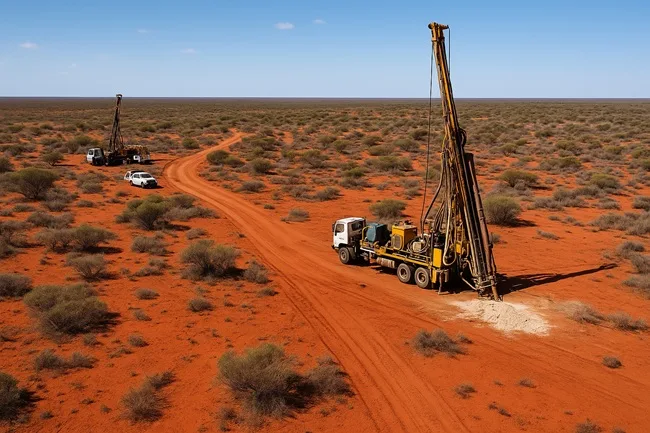
McLaren Minerals confirmed that future drilling will focus on wide-spaced stratigraphic holes designed to confirm the projected southern and northern extensions. The company’s exploration plan will “piggyback” off the work required for the upcoming MRE update, with specialist mineral sands air core drilling contractors expected to be mobilised. Geological identification of shoreline positions hosting the McLaren Titanium sands provides further support for the exploration model.
Institutional investors will interpret this as a signal that McLaren Minerals is aiming for resource scale-up rather than short-term monetisation. For a project in the prefeasibility stage, maintaining investor engagement will depend on demonstrating both metallurgical recoveries and long-term economic viability, particularly in comparison with peer projects in the Eucla Basin and global titanium sands sector.
What do McLaren Minerals’ high-grade titanium results mean for its ASX stock positioning and future investor sentiment?
For McLaren Minerals Limited (ASX: MML), the October 3 update serves as a pivotal moment in validating the potential of the McLaren Titanium Project. The confirmation that mineralisation extends both north and south of the current Indicated Resource demonstrates that the deposit is not only robust but also scalable, a critical attribute for projects in the prefeasibility stage. Such geological continuity adds weight to the company’s development case, particularly as titanium has been designated a critical mineral in multiple jurisdictions due to its aerospace, defence, and renewable energy applications.
With a current market capitalisation of just AUD 5.56 million, McLaren Minerals is firmly in the microcap category. This relatively small size often translates to limited liquidity and heightened volatility, but it also provides outsized leverage to positive exploration and development milestones. The latest drilling results, showing multiple intercepts above 5% heavy minerals and one intercept exceeding 14% HM, are expected to feed directly into the upcoming Mineral Resource Estimate (MRE) update. For analysts, this MRE is the near-term catalyst that could materially influence both valuation and sentiment.
If a greater proportion of tonnage is upgraded into the Indicated category, McLaren Minerals would move closer to demonstrating economic viability in line with institutional investment requirements. Such an upgrade could open the door to broader analyst coverage, off-take discussions, and possibly strategic partnerships with downstream players in the titanium supply chain. The broader ASX narrative has shown that resource developers with critical minerals exposure can experience significant re-ratings once they cross certain thresholds of scale and confidence, as seen with peers in lithium and rare earths.
Until this inflection point is reached, however, McLaren Minerals is likely to remain in speculative territory. The stock will continue to appeal primarily to risk-tolerant retail and small-cap investors who are comfortable betting on early-stage resource growth. For this audience, the value proposition lies in titanium’s increasing importance for global supply security, particularly as governments and industries look to reduce reliance on single-source markets.
In summary, while the AUD 5.56 million valuation underscores McLaren Minerals’ status as a high-risk, high-reward play, the geological evidence now points to a project with growing scale and strategic relevance. If the forthcoming MRE validates the southern extension and shifts more of the resource base into higher-confidence categories, McLaren Minerals could reposition itself within the ASX critical minerals landscape—potentially drawing fresh institutional attention at a time when titanium is climbing higher on the global strategic agenda.
Discover more from Business-News-Today.com
Subscribe to get the latest posts sent to your email.