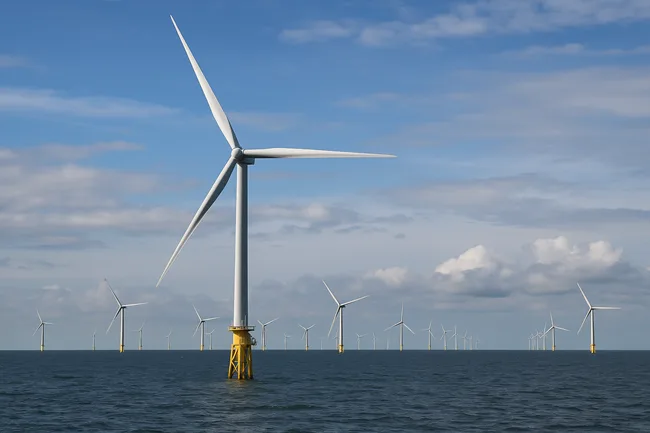
The Abu Dhabi-based renewable energy group Masdar has taken a 50% stake in the €5.2 billion East Anglia Three offshore wind farm, deepening its presence in Europe’s clean energy market through a landmark joint venture with Spanish electric utility developer Iberdrola. Announced in July 2025, the transaction marks Masdar’s largest single investment in a European wind project and underscores the growing role of sovereign-backed capital in scaling utility-scale renewables across the continent. Each partner will co-manage the 1,400 MW project, which is already under construction off the Suffolk coast in the United Kingdom and expected to be operational by late 2026.
The deal is being viewed as a strategic pivot in Masdar’s broader expansion push across European clean infrastructure, especially as the Gulf state accelerates the diversification of its overseas climate portfolio in the post-COP28 era.
What does Masdar’s 50% stake in East Anglia Three signal about sovereign wealth priorities in European renewables?
Masdar’s entry into East Anglia Three signals a deliberate sovereign wealth strategy shift from emerging markets to high-certainty, long-duration infrastructure assets in Western Europe. The decision to co-invest in a project already backed by UK government Contracts for Difference (CfDs) and a long-term power purchase agreement (PPA) with Amazon adds a layer of revenue visibility and bankability that sovereign wealth funds increasingly favor amid global interest rate volatility.
The project’s €4.1 billion green financing round, which closed in early July with participation from 24 major banks, was 40% oversubscribed—demonstrating how the partnership aligns with broader institutional appetite for climate-aligned assets with predictable returns. Masdar’s involvement further diversifies the capital stack while offering geopolitical alignment with both UK and EU decarbonization targets.
Analysts tracking sovereign energy funds note that Masdar’s growing stake in mature OECD power markets marks a departure from earlier frontier-heavy bets in Africa and Central Asia. With offshore wind prices stabilizing and the UK grid offering robust pricing mechanisms via CfDs, East Anglia Three provides the type of predictable yield many sovereigns are increasingly pursuing.
For Iberdrola, the deal helps recycle capital while retaining operational control, as it scales offshore wind capacity across the United States, France, and Germany in parallel.
Can the Iberdrola–Masdar partnership become a blueprint for co-managed offshore wind delivery in Europe?
The 50:50 co-ownership structure being applied at East Anglia Three is notable in a sector where many sovereign–developer tie-ups skew heavily toward passive financing. In this case, both Iberdrola and Masdar will jointly manage the asset post-commissioning, reflecting growing sovereign ambition to move beyond backseat capital deployment and into strategic governance. The model may serve as a precedent for similar co-control structures as sovereigns like PIF (Saudi Arabia), ADQ, and GIC increase their infrastructure exposure in Europe’s green transition.
From a governance perspective, the tie-up balances Iberdrola’s technical and EPC experience with Masdar’s patient capital profile, allowing both parties to share execution risk while benefiting from rising offshore power prices. East Anglia Three’s installed capacity of 1,400 MW, powered by 95 Siemens Gamesa 14.7 MW turbines, makes it the UK’s largest offshore wind project under construction, and a critical contributor to the country’s 50 GW offshore wind target by 2030.
In the context of Masdar’s existing assets in the UK—including its investments in the Dudgeon and Hywind Scotland wind farms—the new deal cements its shift from passive minority roles to active co-developer status. For European governments seeking credible capital to meet grid-scale decarbonization timelines, such evolution in sovereign behavior may accelerate permitting and public-private coordination.
Could this joint venture approach shape future sovereign-backed clean energy deployments across Europe?
Masdar’s equal-stake partnership with Iberdrola may reshape how other sovereign wealth funds approach offshore wind in Europe. Instead of limiting their exposure to infrastructure funds or indirect stakes, sovereigns may increasingly demand strategic board seats, asset-level decision-making, and direct cash flow rights. This could lead to a new wave of bilateral deals where experienced developers seek de-risked capital in exchange for partial control and joint asset management.
Future projects under the East Anglia Hub or elsewhere in the North Sea could follow this model, particularly as developers face supply chain bottlenecks and look to share development-stage risk. Masdar’s growing credibility as a strategic partner—not just a funder—may allow it to extend similar agreements to utilities in Denmark, Germany, and the Netherlands, as floating wind, interconnectors, and hydrogen-integrated assets become bankable.
For now, the East Anglia Three joint venture stands out as one of the most significant signs that Gulf capital is not just flowing into Europe’s energy transition—but also shaping its structure.
Discover more from Business-News-Today.com
Subscribe to get the latest posts sent to your email.