


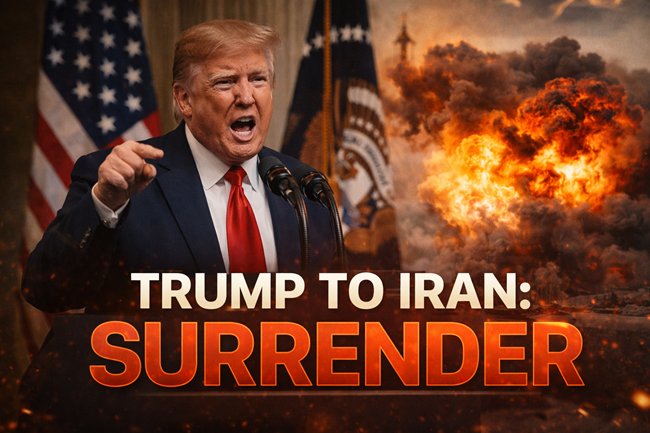
United States President Donald Trump declared on Friday, 6 March 2026, that the United States would accept no negotiated settlement with Iran short of the country’s complete, unconditional surrender, closing off a diplomatic pathway that had appeared to be opening for the first time since the launch of the joint United States-Israeli military campaign known as Operation Epic Fury on 28 February 2026.
Trump issued the declaration through a post on his Truth Social social media platform in the morning hours of 6 March 2026, hours after Iranian President Masoud Pezeshkian had publicly confirmed the existence of third-party mediation efforts, marking the first official acknowledgment from Tehran of any initiative to end the conflict. The timing and content of Trump’s post appeared to directly foreclose the possibility of a near-term negotiated ceasefire.
“There will be no deal with Iran except UNCONDITIONAL SURRENDER!” Trump wrote on Truth Social. He elaborated that following Iran’s surrender and the selection of what he described as great and acceptable leaders, the United States and its allies would work tirelessly to bring Iran back from the brink of destruction and make it economically bigger, better, and stronger than ever before. Trump closed the post with the phrase “MAKE IRAN GREAT AGAIN.”
In a subsequent telephone interview with Axios, Trump clarified that unconditional surrender did not necessarily require a formal declaration from Tehran. “Unconditional surrender could be that they announce it. But it could also be when they can’t fight any longer because they don’t have anyone or anything to fight with,” he said. The clarification did little to soften the political impact of the original post, which had already triggered sharp falls in global equity markets and a rise in crude oil futures.
What does the White House mean by unconditional surrender, and what are the stated objectives of Operation Epic Fury?
White House Press Secretary Karoline Leavitt provided a formal institutional definition of the term on Friday, stating that unconditional surrender would be the condition that obtains when President Trump, as Commander-in-Chief of the United States Armed Forces, determines that Iran no longer poses a threat to the United States of America and that the goals of Operation Epic Fury have been fully realised. She listed those goals as the destruction of Iran’s naval capability, the elimination of Iran’s ballistic missile threat, ensuring Iran cannot acquire a nuclear weapon, and the weakening of Iran’s regional proxy network. Leavitt said the White House expected the conflict to continue for approximately four to six more weeks.
The term unconditional surrender carries heavy precedent. It was the condition imposed on Nazi Germany and Imperial Japan by Allied powers at the conclusion of the Second World War, entailing the complete dissolution of existing military command structures and the assumption of governing authority by occupying forces. Its application in the current context immediately raised questions in diplomatic, financial, and security analyst communities about whether the United States was pursuing a goal equivalent to regime change rather than a defined set of security concessions.
Trump reinforced this interpretation when he stated publicly that he expected to be personally involved in choosing Iran’s next supreme leader, following the death of Ayatollah Ali Khamenei in a United States-Israeli airstrike on the opening day of the operation. Trump described Mojtaba Khamenei, the son of the late supreme leader who has been identified as a frontrunner for succession, as unacceptable, calling him a lightweight and stating that the successor must bring harmony and peace to Iran.
How has Iran responded to Trump’s demand, and what is Tehran’s stated position on negotiations and ceasefire?
Iranian President Pezeshkian, who is currently serving on the governing council that has assumed certain duties of the supreme leader, stated on X on Friday that some countries had begun mediation efforts to bring the conflict to an end. He did not identify the countries involved. He wrote that Iran was committed to lasting peace in the region but would not hesitate to defend the dignity and sovereignty of the country, and that any mediation must confront those who underestimated the Iranian people and ignited the conflict.
Iranian Foreign Minister Abbas Araghchi adopted a sharply different posture. In an interview with NBC News on Thursday, Araghchi stated that Iran had not asked for a ceasefire and would not do so. Asked whether Iran feared a United States ground invasion, Araghchi said Iran was waiting for it and was confident any ground campaign would prove a disaster for United States forces. In a post on X on Thursday, Araghchi stated that the United States plan for a clean rapid military victory had failed and that any follow-on strategy would fail on a larger scale. On Friday, Araghchi posted a photograph of coffins of a mother and child described as victims of United States-Israeli strikes, vowing that Iran’s armed forces would seek accountability for every Iranian civilian killed.
What third-party diplomatic efforts are under way, and what roles are Russia and China playing in the Iran conflict?
Pezeshkian’s 6 March 2026 statement marked the first official Iranian acknowledgment of any diplomatic engagement since the start of Operation Epic Fury. Neither the identity of the mediating countries nor the content of the mediation was disclosed. Before the launch of the operation, both Oman and Qatar had served as intermediaries in negotiations over Iran’s nuclear programme. Oman’s Foreign Minister Badr Al-Busaidi had stated on 27 February 2026 that a breakthrough had been achieved and that Iran had agreed to nuclear restrictions including full verification by the International Atomic Energy Agency. United States Middle East envoy Steve Witkoff contradicted that assessment, stating that Iran had opened those same talks by insisting on its inalienable right to enrich uranium and had rejected United States demands for zero enrichment as a precondition.
Russia confirmed on Friday that it was maintaining an active diplomatic channel with Iran’s leadership. Kremlin Press Secretary Dmitry Peskov said that Moscow was in dialogue with representatives of the Iranian leadership and would continue that dialogue. Peskov also acknowledged that Russia was seeing a significant increase in demand for Russian energy resources as a result of the conflict and the disruption to Strait of Hormuz transit. Araghchi had earlier stated that Russia and China were providing political assistance to Iran and assistance in other forms. China, which is heavily dependent on Iranian crude oil, reportedly halted exports of refined petroleum products earlier in the week in response to supply chain disruption caused by the conflict.
What has Operation Epic Fury achieved militarily after one full week of United States-Israeli strikes against Iran?
United States Central Command Commander Admiral Brad Cooper reported on Friday that Iranian ballistic missile attacks had fallen by 90 percent compared to the opening day of Operation Epic Fury, and that drone attacks had declined by 83 percent over the same period. Secretary of War Pete Hegseth stated that the operation had thus far delivered twice the air power of the Shock and Awe campaign conducted in Iraq in 2003. The Israel Defense Forces reported that Israeli forces had neutralised approximately 300 Iranian missile launchers and dropped around 4,000 munitions across Iran since the start of the campaign. The United States Navy has sunk more than 30 Iranian vessels. The Israeli Air Force claims near-total air superiority over Iranian airspace.
Despite these claimed operational gains, Iran’s asymmetric and proxy capabilities remained active through the seventh day of the conflict. Hezbollah intensified attacks against Israel following the killing of Ayatollah Khamenei, and the Israel Defense Forces confirmed that five Israeli soldiers were seriously wounded in a Hezbollah rocket strike on 6 March 2026 even as the Israeli Air Force conducted fresh strikes on Beirut. Iraqi Shia militias aligned with Tehran conducted dozens of operations against United States and coalition assets in Iraq. The Strait of Hormuz has remained at a near-total halt for tanker traffic, with major international shipping operators including Maersk, MSC, and Hapag-Lloyd suspending transit. Six United States service members have been killed in the conflict, all in a single Iranian airstrike on a United States base in Kuwait.
How have global financial markets and energy prices responded to the demand for unconditional surrender?
The financial market response to Trump’s Truth Social post on 6 March 2026 was immediate across multiple asset classes. European equity markets fell sharply at the time of posting. The Dow Jones Industrial Average declined more than 900 points, or approximately 2 percent, in early New York trading. The S&P 500 and Nasdaq Composite each fell approximately 1.6 percent. Brent crude oil futures broke through 90 United States dollars per barrel. Qatar’s Minister of State for Energy Affairs Saad al-Kaabi warned the Financial Times that crude prices could reach as high as 150 United States dollars per barrel within weeks if tanker transit through the Strait of Hormuz could not resume. The last time Brent crude traded above 100 United States dollars per barrel was in 2022 following Russia’s invasion of Ukraine.
The financial disruption since the start of Operation Epic Fury has extended well beyond equity and commodity markets. Aviation has been severely affected, with more than 19,000 flights delayed globally since 28 February 2026 and the entirety of Middle Eastern commercial airspace effectively closed. War risk insurance premiums for vessels operating in the Persian Gulf have risen to levels that analysts describe as economically prohibitive for all but government-backed cargo movements. Global shipping companies have rerouted vessels around the Cape of Good Hope, adding weeks to transit times and materially increasing the cost of goods in markets dependent on Gulf shipping lanes.
What is the humanitarian situation in Iran and Lebanon at the end of the first week of the conflict?
The United Nations Children’s Fund reported that at least 1,332 people have been killed in Iran since the start of the conflict, including 181 children. The deadliest single incident in the campaign was a strike on a girls’ primary school in the southern Iranian city of Minab on 28 February 2026, the opening day of the conflict, which Iranian authorities said killed approximately 180 pupils and staff. The United Nations Office of the High Commissioner for Human Rights called on Friday, 6 March 2026, for swift investigations into fatal Israeli strikes across Lebanon, with spokeswoman Ravina Shamdasani stating that civilians were paying a painfully heavy price and urging parties to step back from the brink of major escalation.
Lebanon has entered a new phase of conflict as the Israeli military extended its strikes to target Hezbollah positions in and around Beirut. Lebanese Prime Minister Nawaf Salam issued a public warning on Friday that a humanitarian disaster was looming in Lebanon due to mass displacement caused by the renewed bombardment. The broader regional spread of the conflict has drawn in elements across Iraq, the Gulf states, and parts of the Red Sea corridor, with Iranian-aligned proxy organisations maintaining sustained operations against United States, Israeli, and Gulf state targets throughout the week.
What this means: key outcomes and implications of Trump’s unconditional surrender demand for Iran, United States foreign policy, and global energy markets
- President Donald Trump demanded Iran’s unconditional surrender on 6 March 2026 via Truth Social, rejecting any negotiated settlement and stating that the United States would also require the selection of acceptable future leadership in Iran before post-war reconstruction could begin.
- White House Press Secretary Karoline Leavitt defined unconditional surrender as the condition that obtains when Iran no longer poses a threat to the United States and the goals of Operation Epic Fury, which include eliminating Iran’s ballistic missile capability and preventing nuclear weapons acquisition, have been fully realised, with a projected conflict duration of four to six more weeks.
- Iranian President Masoud Pezeshkian confirmed the existence of third-party mediation efforts for the first time on 6 March 2026, but Iranian Foreign Minister Abbas Araghchi simultaneously rejected any ceasefire request and stated that Iran was prepared for a United States ground invasion.
- Global financial markets reacted sharply to Trump’s declaration, with the Dow Jones Industrial Average falling more than 900 points, Brent crude oil futures breaking 90 United States dollars per barrel, and Qatar’s energy minister warning of potential prices reaching 150 United States dollars per barrel if the Strait of Hormuz remained closed.
- Russia confirmed active diplomatic dialogue with Iran on 6 March 2026 and acknowledged rising demand for Russian energy resources, while United Nations officials called for investigations into civilian casualties in Iran and Lebanon, where at least 1,332 people including 181 children have been killed in Iran according to the United Nations Children’s Fund.
Discover more from Business-News-Today.com
Subscribe to get the latest posts sent to your email.