




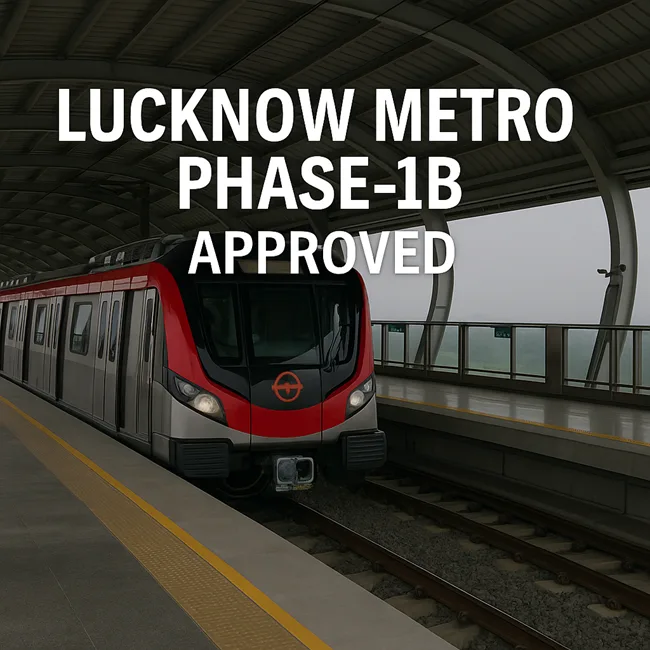
The Union Cabinet, chaired by Prime Minister Narendra Modi, has cleared the Phase-1B extension of the Lucknow Metro Rail Project, marking a significant push to expand urban transit in Uttar Pradesh’s capital. The approved section will add 11.165 kilometres of track, covering 12 stations — seven underground and five elevated — with a sanctioned outlay of ₹5,801 crore. Once operational, Lucknow’s metro network will reach 34 kilometres, enhancing connectivity between the city’s historic core, commercial hubs, healthcare institutions, and tourist attractions.
The expansion is designed to serve some of Lucknow’s most densely populated and congested neighbourhoods, where surface traffic congestion has long hindered economic activity, emergency response times, and tourism potential.
How will Phase-1B of the Lucknow Metro address connectivity gaps in the city’s historic core?
Phase-1B is strategically aligned to connect Old Lucknow’s high-density residential and commercial clusters to the existing metro grid. This includes key commercial centres such as Aminabad, Yahiyaganj, Pandeyganj, and Chowk, which have traditionally depended on narrow, overcrowded roads for access.
The route will also link critical institutions like King George’s Medical University, a major healthcare and academic centre, ensuring smoother patient transport and staff commute. Beyond daily commuting, Phase-1B will improve access to landmark attractions including Bara Imambara, Chota Imambara, the Bhool Bhulaiya maze, the historic Clock Tower, and Rumi Darwaza — sites that anchor Lucknow’s tourism economy.
By enabling faster, predictable travel times, the metro extension is expected to integrate these zones more effectively into the city’s economic and cultural life, offering a competitive edge over road transport in peak-hour conditions.
Can the metro extension reduce chronic congestion and improve road safety in Old Lucknow?
Transport planners view Phase-1B as a pressure valve for Lucknow’s inner-city traffic bottlenecks. The corridor will provide a viable alternative to road-based transport on routes that are frequently gridlocked, particularly in the old quarters where road widening is not feasible.
Reduced vehicle density is projected to shorten average travel times, cut fuel consumption, and improve emergency vehicle access. Over time, metro usage could also lower accident rates by reducing the number of two-wheelers and informal transport vehicles competing for road space.
This shift is expected to be especially significant on arterial roads feeding into Old Lucknow’s commercial and residential zones, where congestion has been a persistent barrier to efficient logistics and daily commuting.
What environmental gains are expected from the Lucknow Metro Phase-1B rollout?
Environmental modelling suggests that the expanded metro network will lead to measurable reductions in greenhouse gas emissions, primarily through a modal shift from fossil-fuelled private vehicles and diesel-powered public transport to electric metro services.
By replacing thousands of daily car and motorcycle trips, Phase-1B could lower particulate emissions and improve air quality in some of the city’s most pollution-prone areas. The underground segment will also limit surface disruption and preserve heritage structures, aligning with sustainable urban development goals.
In the medium term, the expansion could support Lucknow’s compliance with national urban transport and climate action frameworks, reinforcing India’s commitments under the Paris Agreement.
How might the project influence economic activity and property values along the new corridor?
Urban economists anticipate a positive spillover effect on commercial activity, tourism receipts, and property values near the new metro stations. Improved connectivity to transport nodes such as the airport, railway stations, and inter-city bus depots will make surrounding areas more attractive for retail investment, hospitality ventures, and small businesses.
Micro-retail and street food markets, already a defining feature of Old Lucknow, could benefit from increased footfall, while improved accessibility to tourist sites may encourage higher average visitor spending. For residential zones, better transit access often translates into higher demand, driving incremental appreciation in property prices and rental yields.
Historically, metro expansions in cities such as Delhi, Bengaluru, and Hyderabad have demonstrated similar urban regeneration patterns, and institutional investors will be watching whether Lucknow follows this trajectory.
What social impact could equitable metro access have on Lucknow’s mobility landscape?
Phase-1B is positioned as a social equaliser in urban mobility. By linking historically underserved areas with the main economic zones, it can bridge transport inequities faced by lower-income residents who rely heavily on public transport.
Reduced commute times will expand job access, particularly for workers in the informal economy. The metro’s integration with feeder bus services and non-motorised transport could further extend its reach into neighbourhoods not directly served by the corridor.
This democratization of mobility is expected to improve access to education, healthcare, and public services, contributing to a higher overall quality of life.
How are institutional and policy stakeholders viewing the project’s long-term prospects?
While public sector approval ensures funding and execution certainty, institutional sentiment frames Phase-1B as both an infrastructure upgrade and a strategic investment in Lucknow’s urban competitiveness. The alignment with India’s broader metro rail expansion policy signals that the project is more than a standalone corridor — it is part of a coordinated national push to scale sustainable mass transit.
Observers note that the project’s execution will be closely monitored for cost adherence, station accessibility design, and timely completion, given that delays in other Indian metro projects have historically impacted projected benefits. If delivered on schedule, the project could serve as a model for integrating heritage-rich, high-density urban areas into modern transit grids without compromising cultural integrity.
What is the future expansion outlook for the Lucknow Metro beyond Phase-1B?
With Phase-1A and Phase-1B together covering 34 kilometres, the Lucknow Metro Rail Corporation is expected to evaluate additional phases that extend reach to newer growth corridors and suburban zones. These could include links to emerging residential clusters, IT parks, and industrial estates on the city’s periphery.
Future proposals may also incorporate technology upgrades such as driverless train operations, platform screen doors for safety, and AI-enabled passenger flow management to maximise efficiency in high-traffic stations.
In policy terms, the successful execution of Phase-1B could act as a proof-of-concept for replicating similar mid-sized metro expansions in other tier-2 Indian cities such as Kanpur, Patna, Bhopal, Coimbatore, and Jaipur, where full-scale metro rollouts have often faced funding bottlenecks and political hesitations. Demonstrating tangible gains in ridership, congestion reduction, and local economic uplift could help convince both state governments and central agencies to accelerate sanctioning processes for comparable projects.
Moreover, a strong performance by Lucknow’s expansion could influence the criteria used under national urban mobility programmes, including the Metro Rail Policy 2017 and the Smart Cities Mission, leading to wider funding allocations for corridors under 15 kilometres in length — a format often seen as more viable for smaller cities with constrained budgets. This could also encourage blended financing models, with public-private partnerships (PPPs) and multilateral development bank loans supplementing central grants, thereby reducing fiscal strain while ensuring timely delivery. Over time, the lessons from Phase-1B’s planning, procurement, and operational integration may become a reference framework for cost-efficient, scalable metro projects nationwide.
Discover more from Business-News-Today.com
Subscribe to get the latest posts sent to your email.
