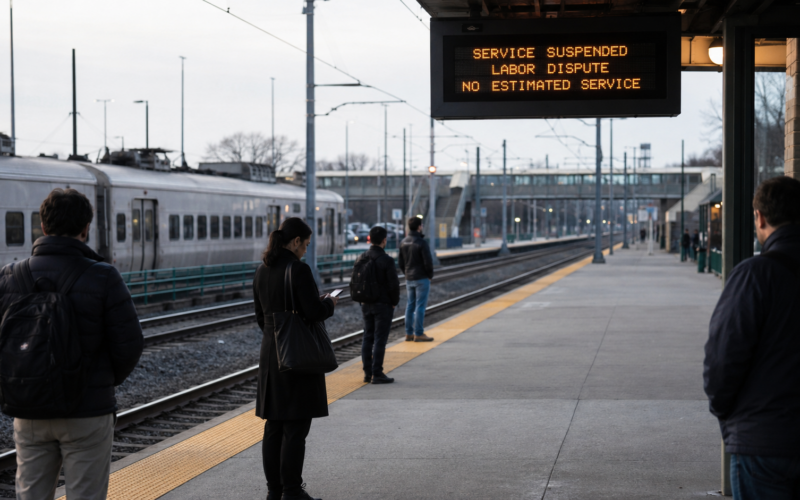
Long Island Rail Road (LIRR) service was suspended systemwide after workers represented by five unions went on strike at 12:01 a.m. Saturday, bringing one of the United States’ busiest commuter rail networks to a halt after contract negotiations with the Metropolitan Transportation Authority failed to produce a new agreement. The strike affects service between Long Island and New York City and immediately disrupted weekend travel, with heavier consequences expected if the stoppage continues into the Monday commute.
The walkout involves about 3,500 Long Island Rail Road workers, including engineers, signal workers and train crew employees. The unions are seeking higher pay after a prolonged contract dispute, while the Metropolitan Transportation Authority has argued that meeting the full demand could place additional pressure on fares, agency finances or service levels.
The shutdown marks the first Long Island Rail Road strike in 32 years and has halted a commuter system used by nearly 300,000 passengers on a typical weekday. The immediate effect is a major transit disruption across Long Island, Queens, Manhattan and connected regional travel corridors, particularly for commuters who rely on the rail network for access to New York City workplaces, hospitals, schools and major events.
Why did the Long Island Rail Road strike begin after talks with the Metropolitan Transportation Authority failed?
The strike began after the Metropolitan Transportation Authority and five unions failed to reach a new contract before the legal deadline. Workers had been without a new contract for three years, and the central dispute involved wage increases, healthcare-related issues and the final terms of a proposed agreement.
Union representatives said management had not closed the remaining gap and had introduced healthcare-related issues late in the process. The Metropolitan Transportation Authority said it had offered terms that responded to the unions’ demands while protecting the agency’s financial position. That disagreement over whether the remaining gap was manageable or financially risky became the immediate trigger for the shutdown.
For Long Island Rail Road riders, the dispute has moved quickly from a labor negotiation into a transportation crisis. Any trains scheduled to depart after midnight were canceled, while trains already in service were allowed to complete their trips before the railroad went fully out of service.

How many Long Island Rail Road riders are affected by the strike across Long Island and New York City?
The strike affects nearly 300,000 daily Long Island Rail Road passengers, making the disruption one of the most consequential commuter shutdowns in the New York region in decades. The Long Island Rail Road connects communities across Nassau County, Suffolk County, Queens, Brooklyn and Manhattan, making the stoppage more than a local inconvenience.
The disruption is especially severe because the Long Island Rail Road is not easily replaced by buses, private vehicles or other rail options. Many Long Island communities depend on the railroad for direct access to New York Penn Station, Grand Central Madison, Jamaica and other transit hubs. With trains suspended, commuters face longer road journeys, heavier congestion and limited alternative routes.
The Metropolitan Transportation Authority has urged riders to work remotely where possible and has prepared limited shuttle bus options for essential travel. However, those alternatives cannot match the normal capacity of the Long Island Rail Road, particularly during peak weekday commuting periods.
What are the main contract issues between Long Island Rail Road unions and the Metropolitan Transportation Authority?
The dispute centers on wages after three years without a new contract. Union negotiators have pushed for higher pay to reflect inflation and cost-of-living pressures in the New York metropolitan area. The Metropolitan Transportation Authority has maintained that a more expensive settlement could create additional pressure on fares or agency operations.
The final-year wage increase appears to have been a major sticking point. Reports before the strike indicated that unions were seeking a 5 percent raise in the final year of the proposed contract, while the Metropolitan Transportation Authority had offered a 3 percent increase with additional lump-sum payments that it said would bring the effective value higher.
The conflict is also institutional. The Long Island Rail Road is part of the Metropolitan Transportation Authority system, but its labor framework, workforce structure and operational requirements differ from subway and bus services. A settlement that resolves the Long Island Rail Road dispute could influence expectations across other transit labor groups, while a prolonged strike could intensify pressure on state and federal officials to intervene.
Why does the Long Island Rail Road shutdown matter beyond weekend travel plans?
The strike matters because the Long Island Rail Road is a core part of the New York regional economy. It carries workers into Manhattan and other employment centers, supports tourism and event travel, and connects suburban communities to the broader public transportation network. A short weekend disruption is serious, but a weekday shutdown would carry much broader economic consequences.
The timing adds pressure. The strike began ahead of the Monday commute and close to the Memorial Day travel period, when regional mobility demand is already high. Weekend events, including major sports fixtures, were among the first visible stress points, but the larger test will come if office workers, healthcare employees, school staff and service-sector workers cannot rely on the railroad during the workweek.
The shutdown also places New York’s transportation resilience under scrutiny. New York City and Long Island have dense travel patterns but limited spare capacity when a major commuter rail system is removed from service. Even if shuttle buses operate, the scale of rail demand means road congestion can quickly become a secondary crisis.
What alternatives are available for Long Island Rail Road passengers during the strike?
The Metropolitan Transportation Authority has said limited shuttle buses will be used to connect some riders to New York City subway stations. Officials have also urged Long Islanders to avoid unnecessary travel and work from home where possible. Those instructions reflect the reality that substitute service cannot fully replace the Long Island Rail Road’s normal passenger capacity.
The shuttle plan is expected to focus on moving selected riders from Long Island toward subway access points in Queens. That approach may help some essential workers reach New York City, but it will not reproduce normal train frequency, travel speed or geographic coverage. Riders from farther east on Long Island face the greatest challenge because their alternatives are often more limited.
For commuters, the practical choices are likely to include remote work, carpooling, private vehicles, express buses where available, subway connections from Queens, or postponed travel. Each option carries trade-offs. Private vehicles may add to congestion, buses may be crowded and slower, and remote work may not be available to many frontline employees.
How could the Long Island Rail Road strike affect the Metropolitan Transportation Authority and New York politics?
The strike creates a direct test for the Metropolitan Transportation Authority because the agency must manage both labor negotiations and public service continuity. If the dispute continues, pressure will rise on the Metropolitan Transportation Authority to explain how it will protect riders while maintaining financial discipline.
The strike also creates political pressure for New York state officials because the Metropolitan Transportation Authority is central to the state’s transportation system. Governor Kathy Hochul has urged both sides to resume negotiations, while local officials have criticized the handling of the dispute. The longer the shutdown continues, the more the issue is likely to move from labor bargaining into statewide political accountability.
For unions, the walkout is a high-stakes effort to force movement on wages after years without a new contract. For the Metropolitan Transportation Authority, the dispute is a test of whether it can settle without creating a precedent that sharply raises costs across the transit system. For riders, the immediate question is simpler and harsher: when will the trains run again?
What are the key takeaways from the Long Island Rail Road strike and New York transit shutdown?
- The Long Island Rail Road shut down after five unions and the Metropolitan Transportation Authority failed to reach a new contract before the Saturday deadline. The strike began at 12:01 a.m. Saturday and suspended service systemwide across the commuter rail network.
- About 3,500 workers are involved in the strike, including engineers, signal workers and train crew employees. The dispute centers on wages, healthcare-related issues and the final terms of a proposed labor agreement.
- Nearly 300,000 daily riders could be affected if the strike continues into the workweek. The disruption is especially serious because the Long Island Rail Road is a major link between Long Island and New York City.
- The Metropolitan Transportation Authority has warned riders to expect severe disruption and has urged remote work where possible. Limited shuttle buses are expected to help some essential travel, but substitute service cannot match normal rail capacity.
- The strike is the first Long Island Rail Road walkout in 32 years. That historical gap makes the shutdown a major test for New York’s commuter rail system and regional emergency planning.
- The next major pressure point is the Monday commute. If no agreement is reached before weekday travel resumes, road congestion, workplace disruption and political pressure are likely to intensify.
Discover more from Business-News-Today.com
Subscribe to get the latest posts sent to your email.