Lockheed Martin Corporation (NYSE: LMT) has moved closer to a potential $24.3 billion sale of 48 F-35 Lightning II fighters to Saudi Arabia after the US State Department approved the proposed package. Reuters reported that the package also covers 49 Pratt & Whitney engines, communications equipment, spare parts and support items. RTX Corporation (NYSE: RTX), which owns Pratt & Whitney, would therefore share industrial exposure to the programme if it becomes a firm contract.
The approval is an important policy step, but it is not a booked order or guaranteed revenue. Congress must still review the proposed foreign military sale, and final quantities, configuration, value and delivery timing can change during negotiations. For Lockheed Martin, the announcement creates a large prospective F-35 opportunity without yet establishing when, or how much, would enter backlog and earnings.
The geopolitical significance is unusually high because Israel is currently the only Middle Eastern operator of the F-35. Washington is required to consider Israel’s qualitative military edge when transferring advanced weapons to other states in the region. Saudi Arabia has pursued the aircraft for years as it modernises its air force and seeks stronger deterrence against Iran and other regional threats.
What is included in the proposed Saudi Arabia F-35 package?
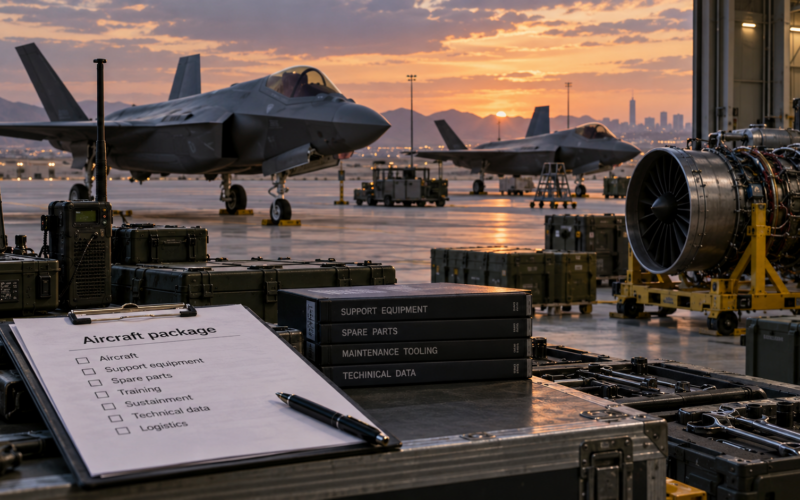
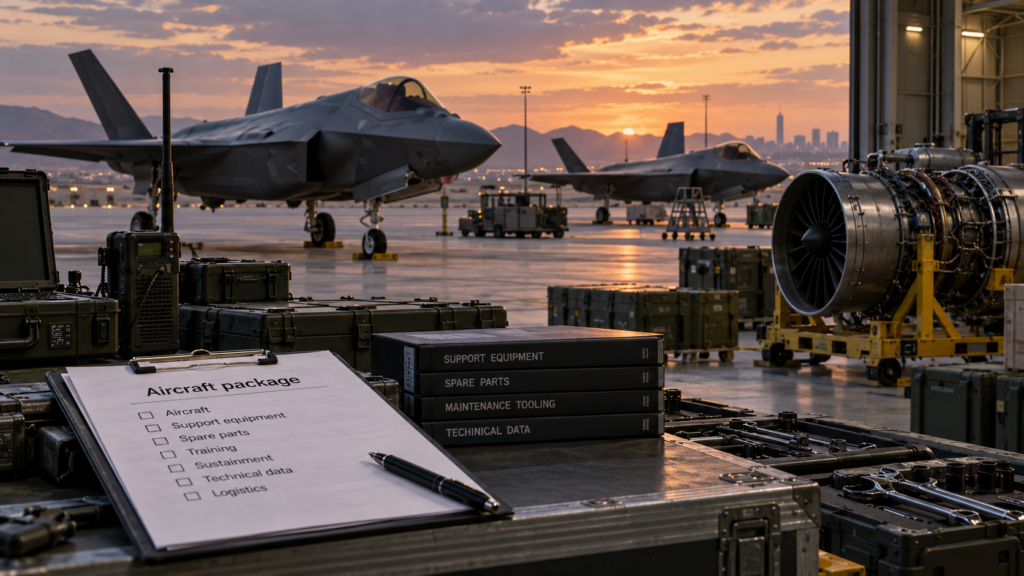
The headline aircraft count is 48, enough for roughly two squadrons, while the 49 engines include one more unit than the number of jets. The broader $24.3 billion ceiling includes mission and communications systems, spares, training and sustainment, which explains why dividing the total by 48 would overstate the price of each airframe. Foreign military sales are integrated capability packages rather than simple commercial aircraft purchases.
The notified value should also be treated as a maximum programme estimate, not an invoice. Negotiations can reduce quantities, remove equipment or alter support periods, while later amendments can change the total again. That distinction matters for valuation because neither Lockheed Martin nor RTX can recognise the entire political approval as backlog, and eventual revenue would follow contracted work and delivery performance rather than the announcement date.
Lockheed Martin would lead the F-35 aircraft work, while Pratt & Whitney supplies the F135 propulsion system and a wide supplier network contributes avionics, structures and support. The industrial value would be recognised over an extended production and sustainment period rather than immediately. Final programme economics would depend on the negotiated configuration, delivery schedule, inflation adjustments and allocation between hardware and long-term services.
Saudi Arabia already operates Boeing F-15s, European Tornados and Eurofighter Typhoons, but the F-35 would add low-observable strike, advanced sensors and networked combat capabilities. That represents a qualitative change in the kingdom’s air-power architecture rather than a routine fleet replacement. It would also require extensive security, training, basing and information-assurance arrangements before aircraft could enter operational service.
Why could Congress still slow or reshape the $24.3 billion sale?
Congressional review is the transaction’s most visible remaining political gate. US lawmakers have previously challenged weapons transfers to Riyadh over human rights, regional conduct and the 2018 murder of journalist Jamal Khashoggi. Those concerns now sit alongside questions about technology protection and the consequences of introducing the region’s most advanced US fighter outside Israel.
Even an unblocked review would not complete the transaction. The US and Saudi governments would still have to settle final terms, implementation arrangements and acceptance, while contractors would receive work through subsequent programme actions. This sequencing leaves time for diplomatic conditions or technical requirements to reshape the opportunity after the most visible political hurdle has passed.
The qualitative military edge requirement gives the review a second dimension. Approval could involve capability limits, delivery sequencing, end-use monitoring or parallel measures intended to preserve Israel’s advantage. Reuters noted that an F-35 transfer to Saudi Arabia would mark a significant policy shift, so the eventual configuration may matter as much as the aircraft count.
The regional security environment could accelerate the strategic case while intensifying scrutiny. Saudi Arabia has framed the aircraft as part of modernisation and deterrence, and its embassy welcomed the proposed sale as a step in deeper US defence cooperation. At the same time, any escalation involving Iran, Yemen or neighbouring states would sharpen debate about how the platform might be employed.
The proposal also sits within a much larger defence relationship. Reuters noted that the United States agreed in 2025 to a Saudi arms package valued at nearly $142 billion, which the White House described as Washington’s largest defence-cooperation agreement. The F-35 decision will therefore be read not only as an aircraft transaction but as evidence of how far the US is prepared to deepen security integration with Riyadh under that broader framework.
How material could the Saudi deal become for Lockheed Martin and RTX?
The stated value is substantial relative to a single international fighter campaign, but investors should not treat the full $24.3 billion as Lockheed Martin revenue. The ceiling includes RTX engines, government-furnished equipment, training, logistics and other support provided by multiple parties. A final contract would also flow through the US government and would likely be divided into production lots and support awards over many years.
For Lockheed Martin, the strategic benefit is the possible addition of a wealthy new F-35 operator with decades of sustainment demand. International fleet expansion can support production scale, software upgrades, maintenance capacity and future munitions sales. For RTX, the engine component would add installed-base exposure, though propulsion economics remain linked to sustainment performance, cost negotiations and programme availability.
Sustainment could ultimately be as strategically important as the initial production work. An operational fleet needs recurring engine support, spare parts, software, training and mission-readiness services throughout its life, creating revenue beyond aircraft delivery. The value of that stream will depend on fleet utilisation, local maintenance arrangements and contract performance, so it cannot be estimated reliably from the proposed package ceiling alone.
Lockheed Martin shares closed at $533.38 on 18 September, down 0.87% in the session, while the proposed sale had been announced after the prior day’s US trading, according to Reuters market data. The muted move suggests investors did not capitalise the $24.3 billion ceiling as near-term awarded business. That response is rational because approval risk, negotiations and a long delivery profile separate the policy announcement from cash generation.
What milestones will determine whether Saudi Arabia receives the F-35?
The next milestones are the congressional review period, any formal objections and the negotiation of a letter of offer and acceptance. Investors should look for clarity on aircraft configuration, delivery dates, training locations, security safeguards and any conditions connected to Israel’s military edge. A signed government-to-government agreement would be much more consequential for backlog than the current approval notice.
Industrial capacity is another constraint even if the politics align. F-35 demand already spans the United States and numerous allies, while software, upgrade and delivery schedules have periodically complicated output. Adding Saudi aircraft would require a place in the production plan and a sustainment architecture capable of protecting sensitive technology.
The delivery lag limits the proposal’s ability to change the current battlefield balance. Training pilots and maintainers, building secure facilities, integrating weapons and establishing logistics would take years after an agreement. That long runway gives Washington scope to attach conditions, but it also exposes the programme to future changes in US leadership, Saudi policy, regional alliances and defence budgets.
The deal’s final significance will therefore be measured in stages, not by one headline figure. State Department approval establishes political willingness, congressional review tests durability, contract signature creates enforceable demand and delivery converts that demand into operational capability. Until those stages advance, the proposal is best viewed as a major option for Lockheed Martin and RTX rather than completed business.
Discover more from Business-News-Today.com
Subscribe to get the latest posts sent to your email.