


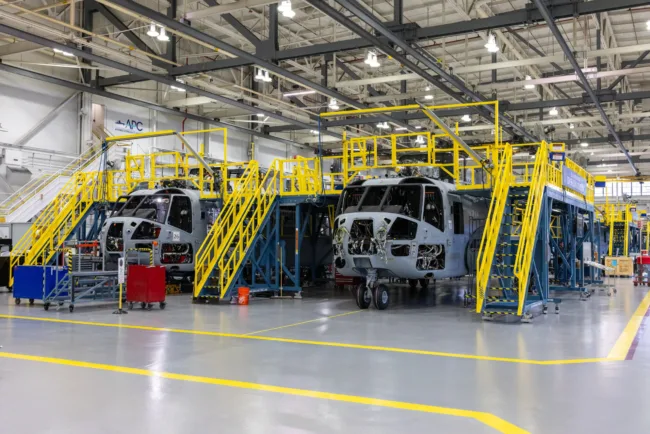
Lockheed Martin Corporation (NYSE: LMT) shares gained ground on September 26, 2025, after its Sikorsky subsidiary secured a $10.855 billion contract from the U.S. Navy to build up to 99 CH-53K King Stallion heavy-lift helicopters for the U.S. Marine Corps. The stock closed at $487.44, up 0.64% for the day, with after-hours trading nudging it to $488.49.
For investors, the move was more than a daily uptick. The contract represents the largest-quantity order to date for the CH-53K and provides revenue visibility extending into the next decade. Markets interpreted the deal as a reaffirmation of Lockheed Martin’s position not only as a fighter jet manufacturer through the F-35 program but also as a cornerstone of U.S. rotary-wing capability.
Defense equities often respond modestly to contract news, given long lead times and Pentagon budgeting cycles. But in this case, analysts suggested that the scale and structure of the award — consolidating five separate procurement lots into one — was a confidence signal for both the U.S. industrial base and for investors seeking predictability.
How does the CH-53K contract stabilize production and supply chains?
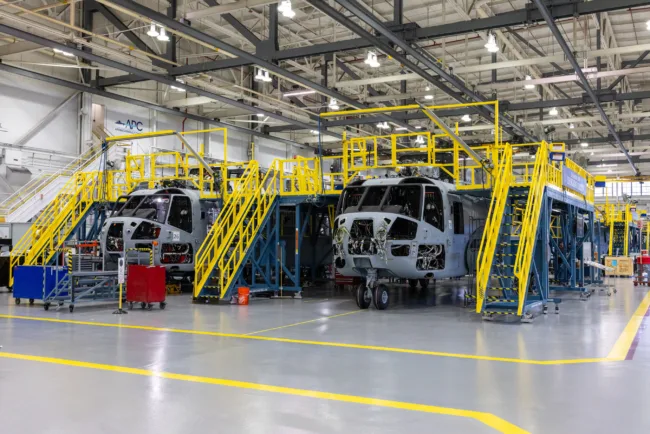
The multi-year procurement agreement, covering Lots 9 through 13, ensures production between 2029 and 2034. The Pentagon’s decision to combine these orders into a consolidated award provides cost predictability for the government and long-term stability for suppliers.
Sikorsky currently manages a supply chain of 267 companies across 37 U.S. states and 17 suppliers from eight allied nations. By locking in a multi-year commitment, the Navy helps these firms plan capacity, invest in tooling, and secure workforce continuity — a particularly pressing need in an era where skilled aerospace labor remains in short supply.
Sikorsky vice president and general manager Rich Benton said the contract demonstrated “trust and confidence” in Sikorsky’s ability to deliver a helicopter that expands Marine Corps operational capability. He added that the multi-year award would allow the company to “drive long-term affordability, optimize production efficiencies, and stabilize our supply chain and workforce.”
In practical terms, multi-year deals allow Sikorsky to bundle material purchases, reducing per-unit costs and passing savings back to the government. They also shield suppliers from the stop-start nature of annual appropriations, which can lead to inefficiencies and layoffs.
What role does the CH-53K play in the Marine Corps’ modernization strategy?
The CH-53K King Stallion is the U.S. military’s most powerful heavy-lift helicopter, designed to replace the aging CH-53E Super Stallion fleet. The Marine Corps’ Program of Record calls for 200 aircraft, with 20 already delivered and 63 in production from earlier Lots 4 through 8.
The aircraft’s role is straightforward but vital: to move Marines, equipment, and supplies across contested environments. Its lift capacity — more than 27,000 pounds over a mission radius of 110 nautical miles in “high-hot” conditions — enables the transport of armored vehicles, artillery, and humanitarian cargo that lighter helicopters cannot manage.
Col. Kate Fleeger, Program Manager for the H-53 Heavy Lift Helicopter Program Office (PMA-261), emphasized that bundling procurement lots supports smoother transition timelines. For the Marine Corps, predictable delivery schedules are critical as squadrons shift from the CH-53E to the CH-53K.
At present, one fleet squadron has already transitioned to the new aircraft, with additional helicopters operating at developmental, operational, and training squadrons. This phased approach ensures that pilots, maintainers, and logisticians adapt gradually before full-scale fleet deployment.
How does the CH-53K compare to legacy systems and competitors?
Technologically, the CH-53K marks a significant leap over the CH-53E, which entered service in the early 1980s. Its features include fly-by-wire flight controls, advanced survivability systems, and fully digital avionics. Its three General Electric T408 engines, each producing nearly 7,500 shaft horsepower, deliver 50% more power than its predecessor.
These capabilities allow the CH-53K to operate in environments where adversaries field sophisticated air defense systems. Survivability enhancements, such as ballistic-tolerant fuel systems and crashworthy seating, reflect the realities of modern expeditionary warfare.
Internationally, the aircraft competes with Boeing’s CH-47 Chinook, a platform that has established itself in allied fleets for decades. While the Chinook is less expensive, the CH-53K offers significantly higher lift performance, making it attractive for missions requiring outsized cargo capacity. Israel has already confirmed plans to acquire the CH-53K, and other NATO allies could follow.
How will Lockheed Martin’s CH-53K contract strengthen the U.S. defense industrial base and supplier ecosystem over the next decade?
For Washington policymakers, the contract serves dual objectives: enhancing Marine Corps lift power and reinforcing America’s defense production ecosystem. Aerospace analysts often warn of “valleys of death” in procurement — gaps in orders that leave suppliers vulnerable to closure. Multi-year deals like this mitigate that risk.
With 267 suppliers contributing to the CH-53K program, the contract sustains thousands of jobs across the U.S. and internationally. It also ensures that niche manufacturers — those producing specialized composite structures, rotor components, or avionics subsystems — have the predictability to invest in innovation rather than merely survive contract to contract.
This stabilizing effect is particularly important given ongoing geopolitical tensions. With U.S. strategy increasingly focused on the Indo-Pacific and Europe, the Pentagon cannot afford to risk erosion in critical aerospace manufacturing capacity.
What does Wall Street sentiment reveal about Lockheed Martin’s stock performance after the Sikorsky CH-53K helicopter award?
The stock market’s response — a 0.64% rise during the session and continued gains after hours — reflects cautious optimism. Lockheed Martin has long been valued for its diverse portfolio, from the F-35 Lightning II fighter to missile defense systems. The CH-53K award signals that Sikorsky, often viewed as a smaller contributor, is now positioned as a growth driver within the company.
Institutional sentiment has leaned positive, with analysts highlighting the contract as a backlog booster. Defense equities are considered defensive plays during market volatility, but sustained contract flow enhances investor confidence. With deliveries stretching into 2034, Lockheed Martin effectively secures a decade of revenue visibility in its rotary-wing segment.
However, analysts caution that profitability depends on execution. Historically, helicopter programs have struggled with cost overruns and production delays. Lockheed Martin will need to demonstrate efficiency in ramping up CH-53K output to assure both the Pentagon and shareholders.
What key challenges must the CH-53K program overcome before achieving full fleet integration with the U.S. Marine Corps?
While the Department of the Navy declared Full Rate Production for the CH-53K program in December 2022, scaling remains the critical challenge. Transitioning from legacy CH-53E squadrons requires synchronized pilot training, maintenance readiness, and supply chain reliability.
Another open question is international uptake. While Israel’s order adds credibility, wider export success will depend on balancing the aircraft’s high unit cost with its unmatched lift capacity. In comparison, the CH-47 Chinook remains cheaper and widely fielded, posing a challenge for broader market penetration.
Unit costs are expected to decline as production ramps up, but defense experts note that affordability remains a political talking point. Pentagon planners will need to demonstrate to Congress that the long-term savings from multi-year procurement outweigh upfront expense.
What does the contract mean for U.S. military readiness and Lockheed Martin’s strategy?
Strategically, the CH-53K award provides the Marine Corps with confidence in its ability to conduct distributed operations across contested regions. The helicopter’s range, payload, and survivability make it uniquely suited for Indo-Pacific scenarios, where long distances and austere environments define operational challenges.
For Lockheed Martin, the contract reinforces Sikorsky’s relevance in a portfolio otherwise dominated by fixed-wing aircraft and missile systems. The award also aligns with broader Pentagon objectives to sustain industrial resilience and maintain technological superiority in heavy-lift aviation.
From an investor perspective, the $10.9 billion contract strengthens Lockheed’s backlog and enhances revenue predictability. While execution risks remain, the award positions the company favorably at a time when global demand for lift solutions and defense modernization is rising.
The program ultimately serves as more than just a procurement milestone. It is a signal of America’s commitment to sustaining industrial capacity, supporting allied interoperability, and ensuring that U.S. forces maintain strategic mobility in contested environments.
Discover more from Business-News-Today.com
Subscribe to get the latest posts sent to your email.