



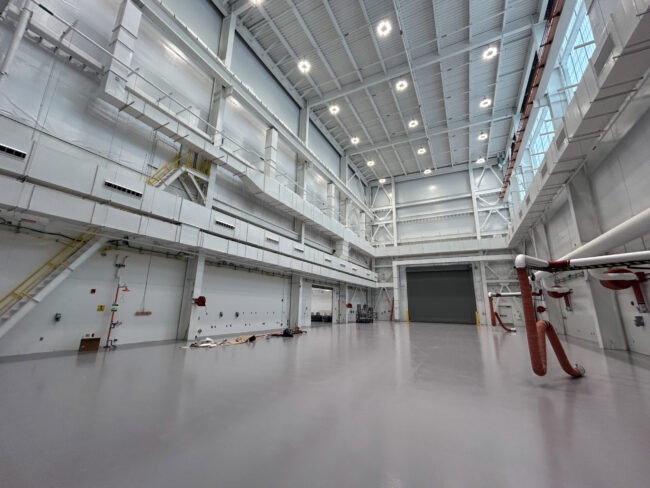
Lockheed Martin Corporation (NYSE: LMT) has inaugurated a new 17,000-square-foot Hypersonic System Integration Lab at its Huntsville campus in Alabama, marking a major investment in next-generation missile defense infrastructure and hypersonic capabilities. The new facility, constructed in just over a year with a capital outlay of $17.1 million, will serve as a central engineering and testing site for developing systems designed to counter emerging kinetic threats with unmatched speed and maneuverability.
The lab opening is part of a much larger capital deployment across Lockheed Martin’s Strategic and Missile Defense Systems division, which has now committed more than $529 million to infrastructure projects spanning 719,000 square feet in total. For defense observers and institutional investors, this expansion signals the American aerospace giant’s deepening role in the global hypersonic weapons race and its long-term alignment with the modernization priorities of the United States Department of Defense.

What makes this Alabama-based facility a strategic asset in Lockheed Martin’s hypersonic roadmap?
The decision to place the new lab within the existing Lockheed Martin Huntsville campus reflects both strategic proximity to the U.S. Army’s Redstone Arsenal and operational efficiencies in system integration. Lockheed Martin executives highlighted the lab’s unique value as a consolidation point for high-fidelity simulation tools, advanced integration workflows, and rapid prototyping environments, all under one roof. This setup is intended to streamline development timelines for hypersonic programs that are already accelerating across U.S. military branches.
Jim Romero, vice president of Hypersonic Strike Weapon Systems at Lockheed Martin Space, emphasized that the lab was purpose-built to enhance the company’s engineering agility in one of the most rapidly evolving defense domains. He indicated that this new facility positions Lockheed Martin as a core industry leader in delivering integrated hypersonic defense and deterrence platforms, adding that the site strengthens the corporation’s long-standing commitment to Alabama’s growing defense technology ecosystem.
The Huntsville campus itself has seen extensive investment and upgrades since 2021. Lockheed Martin has added nearly 408,000 square feet of operational space as part of a multi-year transformation of its Strategic and Missile Defense Systems division. The broader buildout now includes nearly three-quarters of a million square feet of purpose-designed space either completed or in progress, aimed specifically at emerging technology domains like directed energy, missile interceptors, and hypersonic platforms.
How are hypersonic weapons shaping the future of deterrence and national security?
Hypersonic systems, capable of traveling at speeds exceeding Mach 5, represent a fundamental shift in defense doctrine by enabling time-compressed response options and maneuverable flight paths that evade traditional missile tracking systems. These attributes make hypersonic weapons particularly relevant in theaters where air defense infrastructure may be compromised or where deterrence demands rapid retaliation capability.
According to Holly Molmer, program management director for Lockheed Martin, the operational advantage of hypersonic systems lies in their unpredictability and immediate threat potential. She noted that their deployment ensures adversaries understand that any aggressive action can be countered with near-instant, high-impact consequences. This capability is increasingly seen by U.S. military planners as central to maintaining credibility in contested regions such as the Indo-Pacific, Arctic corridors, and Eastern Europe.
Lockheed Martin is currently involved in multiple Pentagon-led hypersonic programs, including the U.S. Army’s Long-Range Hypersonic Weapon initiative and the U.S. Navy’s Conventional Prompt Strike platform. Analysts monitoring the defense contractor’s pipeline believe that integrated facilities like the one in Huntsville will play a critical role in enabling scale production and reducing latency between prototyping and deployment, a key goal in upcoming fiscal defense budgets.
What does Lockheed Martin’s broader capital program reveal about its missile defense ambitions?
The Huntsville integration lab is one element of a significantly scaled-up physical infrastructure strategy that underscores Lockheed Martin’s long-cycle commitment to missile systems innovation. Since 2021, the Strategic and Missile Defense Systems division has invested over $185 million in completed facilities, with another estimated $344 million committed to ongoing and upcoming projects.
In total, the current capital expansion spans more than 719,000 square feet of research, development, and integration facilities across Lockheed Martin’s national footprint. This includes not only hypersonic labs but also infrastructure for testing new propulsion methods, modeling advanced guidance systems, and integrating command and control functions into kinetic weapon platforms.
Johnathon Caldwell, vice president and general manager of Strategic and Missile Defense Systems, commented that the corporation’s continued investment in world-class facilities reflects a forward-looking approach to threat deterrence. He added that Lockheed Martin is building the technical and collaborative environments required to meet the Department of Defense’s increasingly complex operational demands, especially in the face of rapid adversarial advancement in precision strike and counter-interceptor technologies.
These facility-level investments are increasingly critical in maintaining technological and geopolitical leadership. Hypersonic deployment is no longer viewed as a future capability but as an urgent operational requirement, and Lockheed Martin’s infrastructure strategy is calibrated to meet that urgency head-on.
How is this lab expected to impact defense procurement cycles and competitive positioning?
The opening of the Huntsville lab is not only a milestone in facility readiness but also a potential accelerator for Lockheed Martin’s hypersonic program delivery schedules. Industry analysts believe that by bringing simulation, integration, and testing workflows together under one roof, the aerospace defense firm can reduce program timelines by months, if not years. This could make Lockheed Martin more competitive in future contracts involving joint-service and NATO-aligned hypersonic initiatives.
While the company already maintains strong contractual relationships with the U.S. Army, Navy, and Missile Defense Agency, the lab enables Lockheed Martin to further solidify its role as a preferred integrator of operational systems. With peer competitors such as Raytheon Technologies Corporation and Northrop Grumman Corporation also scaling their hypersonics portfolios, speed-to-field and modular adaptability are emerging as key differentiators.
Furthermore, as global defense customers increasingly demand off-the-shelf hypersonic capabilities for national security and regional deterrence, Lockheed Martin’s ability to demonstrate rapid systems integration and delivery will likely translate into commercial and strategic advantages across international markets.
What are investors and defense stakeholders likely to focus on in the next phase?
For investors, the key near-term metrics will include production acceleration milestones for U.S. hypersonic programs, updates on test flight readiness, and any additional government-funded facility expansions. The defense sector has seen a noticeable increase in investor inflows linked to next-generation deterrence capabilities, and Lockheed Martin remains a top portfolio choice for funds focused on defense modernization.
On the procurement side, stakeholders will be closely watching how the Huntsville lab supports the integration and fielding of hypersonic platforms for operational use. Demonstrable reductions in time-to-field, improved manufacturing quality, and successful flight trials could translate into multi-year defense procurement commitments extending well into the next decade.
Lockheed Martin executives have signaled that additional infrastructure investments are under review, suggesting that the Huntsville lab may be the first of several specialized facilities built to support the hypersonic architecture required by both the United States and its allied partners.
How are investors reacting to Lockheed Martin’s hypersonic push and what’s next for LMT stock performance?
Shares of Lockheed Martin Corporation have shown steady appreciation following the hypersonic lab announcement. As of December 3, 2025, the stock has gained approximately 4.2 percent over the past five trading sessions, reflecting positive institutional sentiment and renewed investor confidence in defense infrastructure-backed growth.
Exchange-traded funds with aerospace and defense exposure, including those weighted toward hypersonic and missile technologies, have reported net inflows in recent weeks. Sell-side analysts currently maintain a consensus “hold” rating on Lockheed Martin stock, with upward revisions possible depending on program-level progress and future Department of Defense awards.
With its long-cycle contract visibility, facility ramp-up, and growing momentum in key defense modernization verticals, Lockheed Martin remains a core holding in portfolios aligned with national security spending trends.
What are the key takeaways from Lockheed Martin’s new hypersonic system integration lab in Alabama?
- Lockheed Martin Corporation has opened a 17,000-square-foot Hypersonic System Integration Lab in Huntsville, Alabama, following a $17.1 million investment to accelerate U.S. missile defense innovation.
- The new lab integrates simulation, testing, and engineering functions to support faster delivery of hypersonic systems, including the Army’s Long-Range Hypersonic Weapon and the Navy’s Conventional Prompt Strike program.
- Since 2021, the Strategic and Missile Defense Systems division has invested over $185 million across 408,000 square feet of new facilities, with total capital expansion now surpassing $529 million and 719,000 square feet.
- Lockheed Martin executives said the lab is designed to reduce development timelines and strengthen U.S. deterrence by enabling rapid prototyping and integrated testing under one roof.
- The facility sits within the broader defense ecosystem of Redstone Arsenal and the Missile Defense Agency, reinforcing Huntsville’s status as a hypersonic technology hub.
- Analysts believe the lab enhances Lockheed Martin’s competitive edge against Raytheon Technologies and Northrop Grumman as defense customers prioritize speed-to-field and modular capabilities.
- The defense contractor has indicated additional infrastructure expansion is under review, aligned with future Pentagon budgets and allied interest in co-developing hypersonic technologies.
- Shares of Lockheed Martin (NYSE: LMT) rose 4.2 percent in the five days following the announcement, driven by institutional buying and optimism around hypersonic program acceleration.
- Investor sentiment remains constructive, with analysts maintaining a “hold” outlook while monitoring production milestones and further facility-level updates through FY26.
- The Huntsville lab is expected to serve as a core asset in Lockheed Martin’s long-term hypersonics roadmap, supporting both national defense priorities and long-cycle revenue stability.
Discover more from Business-News-Today.com
Subscribe to get the latest posts sent to your email.