

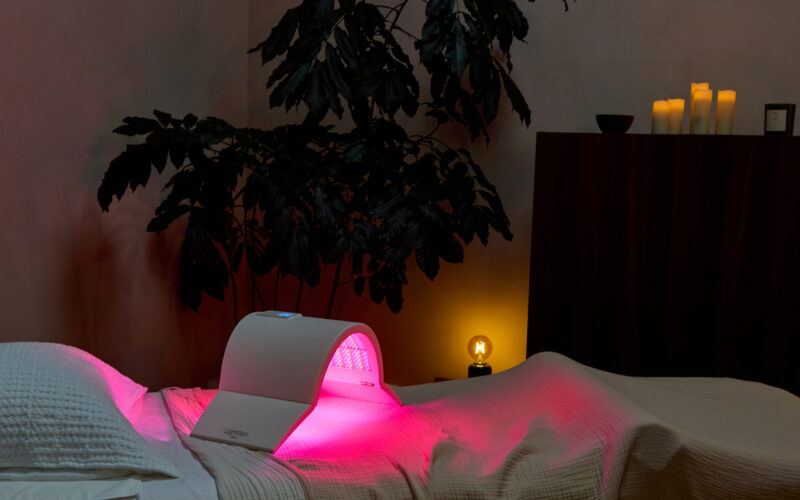
LightStim and Hand & Stone Massage and Facial Spa have announced a national rollout of the FDA-cleared Elipsa LED therapy device across participating Hand & Stone locations in the United States and Canada, extending a pilot program into a systemwide commercial push. The move matters because it shifts LED light therapy from a specialist or high-end add-on toward a more standardized treatment within a large membership-driven spa chain. Elipsa is cleared to treat full-face fine lines and wrinkles and mild to moderate inflammatory acne, which gives Hand & Stone a device with recognizable consumer use cases rather than a vague “wellness” halo. For LightStim, the deal is not just distribution. It is a scale test of whether an FDA-cleared beauty device can become embedded in repeat-service spa economics rather than remaining a premium niche product.
The most important thing that changed here is not the existence of another LED skincare partnership. It is the decision to industrialize one. Hand & Stone has more than 600 locations across North America, and its own franchise materials and industry coverage point to a membership-led model with average unit volume above $1.4 million, which means the chain already operates on repeat visits, add-on services, and treatment standardization. That is exactly the kind of operating environment in which a touchless device like Elipsa can become commercially meaningful: it can run in the background, preserve esthetician attention for other parts of the appointment, and potentially raise service yield without requiring a major labor expansion. In spa economics, that is the closest thing to free oxygen.
Why does the LightStim and Hand & Stone rollout matter for the economics of spa skincare services?
Professional skincare is increasingly being shaped by a simple business question: which treatments are scalable across a large footprint without collapsing under labor intensity, inconsistent outcomes, or training friction? Elipsa appears designed to answer that question better than many device-led facial add-ons. FDA clearance provides a credibility layer for consumers and franchise operators, while the treatment indications of wrinkles and inflammatory acne map neatly onto two durable, high-frequency concerns in esthetic care. That gives Hand & Stone a service that can fit both anti-aging and acne management narratives, expanding relevance across age groups instead of chasing a single beauty trend.
There is also a labor productivity angle that should not be missed. The company comments around Elipsa emphasized a touchless setup that allows estheticians to remain present with guests while the light therapy runs in parallel. That sounds like marketing language at first glance, but operationally it points to a real issue across the spa and med-aesthetics world: revenue growth is often constrained by hands-on treatment time. A device that can slot into an appointment without monopolizing practitioner effort may improve attachment rates and treatment consistency. In a franchise system, consistency is everything. One location can sell novelty. Six hundred need replicability.

How credible is FDA-cleared LED therapy for wrinkles and acne in real-world consumer use?
The regulatory and clinical framing here is strong enough to support commercialization, but not strong enough to justify miracle-talk. The FDA 510(k) summary for LightStim Elipsa shows the device was cleared as an over-the-counter LED system for full-face wrinkles and for mild to moderate inflammatory acne, using red, infrared, and blue wavelengths depending on indication. That matters because the device is not being sold into spas as an unbounded wellness gadget; it enters with defined intended uses. At the same time, dermatology guidance is more measured than beauty marketing. The American Academy of Dermatology says light-based treatments can reduce acne, but notes they rarely clear acne on their own and are often used alongside other therapies. A recent review in the Journal of the American Academy of Dermatology similarly noted that evidence for blue and red light therapy in acne is encouraging but still limited in strength.
That distinction is important for business reasons, not just scientific neatness. If Hand & Stone positions Elipsa as a supportable, repeatable, noninvasive service for visible skin concerns, the rollout makes sense. If franchisees or guests start treating it as a one-step fix for acne or age management, expectations could outrun outcomes. Beauty tech rarely fails because the technology is fake. It more often stumbles because commercial storytelling sprints far ahead of real-world treatment behavior. LED therapy has enough evidence and regulatory support to earn a place in the service menu. It still needs disciplined positioning.
What does this partnership signal about the broader shift from device novelty to service-platform integration?
The bigger story is that LED light therapy is maturing from a category associated with gadgets and influencer culture into something closer to service infrastructure. Market researchers estimate the wider light therapy market at about $1.21 billion in 2026, with steady growth expected through the next decade, while consumer-facing LED mask and red-light categories are also drawing stronger adoption. Those market forecasts should always be handled carefully, because research firms can be optimistic, but directionally they match what this deal suggests: light therapy is moving into more routine, repeat-use settings rather than staying confined to specialist clinics or home experimentation.
That helps explain why Hand & Stone is a strategically useful partner for LightStim. A national spa franchise gives LightStim something more valuable than a burst of product sales. It provides repeated customer exposure, practitioner endorsement, retail cross-sell opportunities, and systemwide operational data on treatment adoption. In effect, Hand & Stone becomes a commercial proving ground. If guests accept LED therapy as a recurring facial enhancement and if at-home devices then sell through the spa channel, LightStim gains both professional credibility and consumer conversion. The treatment room becomes the showroom, which is a much cheaper place to persuade skeptics than a glossy e-commerce landing page.
Could the national Elipsa rollout change how spa chains compete on science-backed skincare treatments?
It could, although perhaps less dramatically than the press release tone suggests. Large spa chains compete on a mix of convenience, trust, service consistency, brand familiarity, and perceived efficacy. Adding a recognizable, FDA-cleared LED therapy option gives Hand & Stone a stronger claim to “science-backed” skincare without forcing a full med-spa pivot. That is strategically clever. It allows the chain to raise treatment sophistication while staying inside the comfort zone of the franchise spa model. Guests get something that feels more advanced than a basic facial, but not as intimidating or expensive as physician-led aesthetic procedures.
Competitively, this may nudge other large chains and independent spas to sharpen their own device strategies. Some will look at LED, others at toning, laser-adjacent services, or bundled facial technologies. But the real competitive lesson is subtler: the winning device is often not the flashiest one. It is the one that fits the workflow, supports recurring usage, and does not require heroic staff retraining. In that sense, Elipsa’s national rollout says less about one machine and more about the next phase of beauty-service competition. The market is rewarding treatments that are operationally boring in the best possible way: easy to deploy, easy to explain, and easy to repeat.
What execution risks could still limit the commercial upside of LightStim and Hand & Stone?
The first risk is uneven franchise adoption. National rollouts sound absolute, but the release itself says treatments are available at participating locations. In franchise systems, participation, staff enthusiasm, local marketing, and service bundling can vary meaningfully from one market to the next. A rollout is not the same thing as a uniformly successful rollout.
The second risk is consumer expectation management. Acne and wrinkle treatments attract emotionally charged buying decisions, and visible improvement can be subjective, gradual, and dependent on treatment cadence. If customers compare spa LED therapy with injectables, prescription regimens, or even viral home devices promising impossible results, satisfaction can become harder to control than the technology itself. The American Academy of Dermatology’s caution that light treatments often work best as part of a broader regimen should be taken seriously here.
The third risk is category crowding. LED therapy is becoming more common, not less. As adoption rises, differentiation will be harder to sustain through the phrase “light therapy” alone. LightStim will need Hand & Stone to execute the premiumization story, while Hand & Stone will need LightStim to continue supporting clinical credibility and consumer trust. Otherwise, the service risks drifting into the spa menu background as just another upgrade that sounds nice but does not move guest behavior.
Why might this rollout be an early sign of how aesthetic wellness chains will scale device-led treatments?
Because it combines three things that chains increasingly want at once: a light clinical-regulatory wrapper, low procedural friction, and retail extension beyond the treatment room. Hand & Stone can use Elipsa to enrich its facial menu, while also selling select at-home LightStim devices through spa locations. That creates a tidy commercial loop between in-spa trial and home-use continuation. For LightStim, it also reinforces the company’s hybrid identity. It already says it has sold more than one million retail devices and supports more than 50,000 professional accounts globally, so the Hand & Stone partnership looks like a bridge strategy rather than a one-channel gamble.
The broader implication is that aesthetic wellness chains may increasingly function as distribution and trust platforms for regulated-but-consumer-friendly devices. That is a meaningful shift. It blurs the line between service brand, retail channel, and light-clinical care environment. Not a hospital, not quite a med-spa, but definitely no longer just cucumber slices and flute music.
What are the key takeaways on what the LightStim and Hand & Stone expansion means for the skincare industry?
The national rollout turns LED therapy from a pilot concept into a scaled operating model inside a major spa franchise network.
Hand & Stone gains a more clinically framed skincare differentiator without needing to reposition itself as a physician-led aesthetics business.
LightStim gains something more strategic than product distribution: recurring in-service exposure across a 600-plus location footprint.
Elipsa’s FDA-cleared wrinkle and acne indications give the service clearer commercial positioning than generic wellness language.
The touchless treatment format may improve labor efficiency and attachment economics inside membership-driven spa appointments.
Commercial success will depend less on device novelty and more on franchise-level consistency, staff training, and expectation management.
Dermatology evidence supports LED therapy as useful, but not as a magical standalone cure, especially in acne care.
The rollout reflects a broader category shift from beauty gadget hype toward workflow-friendly, repeatable device integration.
Competing spa and wellness chains may now feel pressure to strengthen their own science-backed facial technology offerings.
The longer-term upside lies in the blend of in-spa treatment, consumer education, and at-home device cross-sell rather than in one-off sessions.
Discover more from Business-News-Today.com
Subscribe to get the latest posts sent to your email.