



KEWAZO, the Munich- and Houston-based robotics company that automates vertical material movement at refineries, petrochemical plants, and power facilities, has closed a new funding round that lifts its total capital raised to $35 million. The round was led by Schooner Capital and includes strategic investors Chevron Technology Ventures and Asahi Kasei Ventures, alongside Benson Capital, Mana Ventures, Gaingels, and Atlas Ventures, with existing backers True Ventures and Cybernetix Ventures also participating. The investment recognises KEWAZO’s shift from construction robotics startup to a company positioning itself as the primary robotics and AI infrastructure partner for the global heavy-industry maintenance and turnaround market. The participation of Chevron Technology Ventures, the corporate venture arm of one of the world’s largest integrated energy companies, is a particularly pointed signal about where industrial automation demand is heading.
What is KEWAZO’s LIFTBOT and how does it replace cranes at refinery and petrochemical sites?
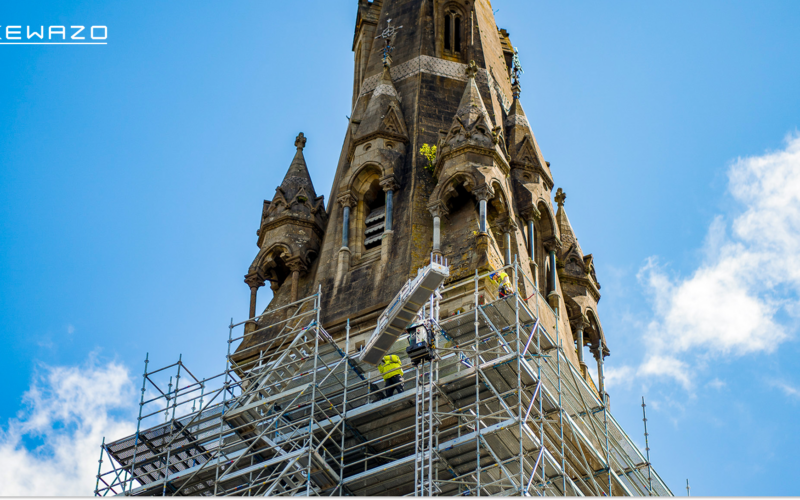
KEWAZO’s core product, LIFTBOT, is a battery-powered, fully wireless lifting robot designed for deployment at industrial sites where scaffolding assembly, maintenance turnarounds, insulation, and capital project work require the movement of heavy materials across multiple elevations. Before the system existed, crews on active industrial plants would manually pass up to five tonnes of materials per day from level to level in all weather conditions, a physically punishing and accident-prone process. LIFTBOT automates this vertical material flow, operates without crane infrastructure, and can be assembled and made operational in approximately 20 minutes. The company has claimed labour savings of up to 70 percent on scaffolding-intensive operations, which translates directly into shorter maintenance windows, lower contractor costs, and reduced site exposure for workers.
The system is already deployed at more than 20 industrial sites across North America and Europe, including refineries, chemical complexes, and power generation facilities. Named clients from earlier deployments include BASF, ExxonMobil, TotalEnergies, Dow, and Ineos, alongside major industrial service contractors Bilfinger and Altrad. These names matter for a simple reason: they represent the operational backbone of Western petrochemical and energy infrastructure, and their adoption of a relatively young German robotics platform speaks to genuine utility rather than experimental interest.

Why is Chevron Technology Ventures backing an industrial robotics startup focused on scaffolding and maintenance turnarounds?
Chevron Technology Ventures, which invests from its Core Venture Fund in high-growth startups with the potential to improve Chevron’s core operations or create new growth opportunities, has maintained a selective and technically focused portfolio. The fund has historically backed companies including Radiant Nuclear, ChargePoint, and Illumina before they reached public markets, averaging roughly three new investments per year. Its decision to back KEWAZO is analytically consistent with a major integrated energy operator’s need to reduce turnaround costs and improve safety outcomes at the kind of large, continuous-process industrial sites that define its global asset base. Maintenance turnarounds at refineries and chemical plants are among the most logistically complex and cost-sensitive operations in the energy sector, involving hundreds or thousands of contractor hours in compressed time windows where schedule overruns carry significant commercial penalties.
KEWAZO offers Chevron Technology Ventures something that generic automation investment does not: a demonstrably deployed system operating inside the specific physical environments where Chevron and its peers need efficiency gains most urgently. This is not a theoretical future technology. The commercial case is already being validated in live operational contexts, which substantially reduces the investment thesis risk and increases the probability of integration into Chevron’s own supplier ecosystem over time.
How does KEWAZO’s Physical AI platform turn jobsite data into a long-term competitive advantage and recurring revenue moat?
The investment narrative here runs well beyond a lifting robot. KEWAZO’s strategic thesis rests on the idea that physical presence inside high-barrier industrial environments, the kind that require safety certification, operational integration, and long-standing contractor relationships to access, generates structured operational data that cannot be replicated from outside. Each LIFTBOT deployment feeds the company’s ONSITE analytics platform, which processes site-level activity into real-time project management insights for customers. KEWAZO describes this as the foundation of its Physical AI platform, designed to introduce operational transparency at the data layer today and enable broader automation capabilities at the workflow layer tomorrow.
This data flywheel logic is important for two reasons. First, it gives KEWAZO a compounding commercial advantage: the more sites LIFTBOT is deployed on, the richer the proprietary dataset becomes, and the more defensible its AI applications will be against hardware-only competitors. Second, it gives the company a credible pathway to expand from single-workflow automation into multi-workflow orchestration at the same sites, without having to re-enter environments from scratch. KEWAZO’s CEO Artem Kuchukov has noted that many existing clients are already requesting expansion into additional workflows, which suggests the land-and-expand model is already generating organic pull rather than requiring heavy commercial push.
What does Asahi Kasei’s involvement signal about materials and chemicals industry appetite for automation and safety technology?
Asahi Kasei is a diversified Japanese industrial conglomerate spanning chemicals, housing, healthcare, and advanced materials. Its venture arm, Asahi Kasei Ventures, has historically invested in technologies addressing safety, efficiency, and operational performance in complex industrial and life sciences environments. The participation in this KEWAZO round reflects a strategic alignment that goes beyond financial return: chemicals and materials manufacturing sites share many of the same scaffolding-intensive maintenance challenges as refineries, and a portfolio investment in KEWAZO gives Asahi Kasei direct exposure to technology that could reduce turnaround windows and accident rates across its own production infrastructure globally.
More broadly, the Asahi Kasei backing underlines how appetite for pragmatic industrial robotics, not humanoid robots or speculative AI platforms, but physically deployed systems solving specific operational bottlenecks, is building steadily across the materials and chemicals sector. These industries have historically been among the slowest to automate field operations due to regulatory complexity, site hazard classifications, and contractor relationship lock-in. KEWAZO’s ability to convert site deployments at these facilities into client-requested expansion is a meaningful commercial proof point.
How does KEWAZO’s $35M total funding position the company competitively in industrial robotics as markets head toward a multi-billion dollar inflection?
The global industrial robotics market sits at approximately $37 billion in 2025 and is projected by multiple research firms to approach $97 billion by 2035, growing at roughly 10 percent per year. That growth is overwhelmingly driven by labor shortage demographics, rising wages across North America and Europe, and the accelerating adoption of Industry 4.0 frameworks that demand tighter data integration across physical operations. At the same time, the International Federation of Robotics recorded 4.66 million industrial robots in operational use globally in 2024, up 9 percent year-on-year, with European and North American adoption both growing despite some installation volatility.
KEWAZO is carving a specific niche within this broader trajectory: it is not trying to automate factory assembly lines or logistics warehouses, the two most crowded segments in industrial robotics, but instead targeting outdoor, variable-environment, safety-critical industrial maintenance workflows that are harder to automate and where the competitive field remains thin. At $35 million in total funding, the company is still early-stage relative to market size, but its operational footprint, named client relationships, and strategic investor backing from within the energy sector itself provide a cleaner go-to-market path than most peers at similar funding stages.
What are the execution risks and scaling constraints KEWAZO must navigate as it expands from 20 to hundreds of industrial site deployments?
Scaling a robotics hardware company into safety-critical industrial environments is structurally more complex than scaling software. Every new site deployment carries certification requirements, training obligations, and contractor protocol integration that software-only businesses can bypass. KEWAZO will need to invest heavily in deployment capacity, qualified field personnel, and regional logistics infrastructure as it moves beyond its current 20-plus site footprint. The new capital is explicitly intended to accelerate deployment capacity, but the speed at which the company can qualify new technicians and establish regional service networks across Gulf Coast, European, and Asia-Pacific industrial clusters will determine whether expansion velocity matches investor expectations.
There is also the question of workflow scope creep. KEWAZO’s stated ambition is to expand into additional workflows beyond vertical material movement, including insulation, painting, and mechanical work. Each new workflow requires hardware configuration, operational validation, and safety certification that is not trivially transferable from scaffold hoist applications. The Physical AI platform narrative is compelling in theory, but the company will need to demonstrate that it can convert ONSITE data into commercially deployed AI-driven automation across at least one additional workflow before the platform thesis becomes operationally validated rather than strategically aspirational.
How does KEWAZO’s Gulf Coast and energy sector strategy reflect the broader shift in industrial automation investment toward maintenance-intensive assets?
Benson Capital’s commentary on the Gulf Coast dimension of this investment reflects a real structural dynamic in the US industrial automation market. The Gulf Coast refining and petrochemical corridor represents one of the world’s densest concentrations of maintenance-intensive industrial infrastructure, with hundreds of sites running continuous-process operations that require regular scaffolding, inspection, and turnaround activities. Labor availability in this region, like most industrial markets globally, is tightening as the workforce ages and new entrants show declining interest in physically demanding field roles.
KEWAZO’s Houston presence is not incidental. It provides the company with a physical base inside the US energy capital from which to build contractor relationships, demonstrate operational performance, and develop the regulatory familiarity that petrochemical and refinery operators require before deploying novel technology on active process units. The energy sector is also politically sensitive about automation rhetoric, and KEWAZO’s framing of LIFTBOT as a tool that frees workers for higher-value roles rather than displacing them wholesale is a commercially astute positioning choice in this context.
Key takeaways: What KEWAZO’s $35M round means for industrial robotics, energy sector automation, and the Physical AI investment thesis
- KEWAZO has raised a total of $35 million, with the latest round backed by Chevron Technology Ventures and Asahi Kasei alongside lead investor Schooner Capital, marking a shift from construction-sector robotics to dedicated heavy-industry maintenance automation.
- Chevron Technology Ventures’ participation is a direct commercial validation signal: the investment comes from the operational and innovation arm of a major integrated energy company that has first-hand exposure to the maintenance turnaround challenges KEWAZO is solving.
- The LIFTBOT system is already deployed at more than 20 industrial sites across North America and Europe with named clients including BASF, ExxonMobil, TotalEnergies, Dow, and Ineos, providing a level of commercial proof that de-risks the investment thesis meaningfully at this stage.
- KEWAZO’s Physical AI platform strategy, using LIFTBOT deployments as data collection infrastructure inside otherwise inaccessible industrial environments, gives the company a compounding data advantage that hardware-only competitors cannot easily replicate.
- Labor shortage economics are the primary structural tailwind: the global industrial robotics market is projected to grow from roughly $37 billion in 2025 to nearly $97 billion by 2035, with maintenance and material handling among the segments with the clearest near-term adoption runway.
- Asahi Kasei’s backing signals that chemicals and materials conglomerates are beginning to move beyond passive interest in field automation and toward direct investment in deployable technologies that reduce turnaround windows and site safety exposure.
- The Gulf Coast strategic focus, supported explicitly by Benson Capital’s commentary, positions KEWAZO at the centre of the world’s most maintenance-intensive industrial corridor, where contractor labor supply is tightening and operators are under sustained pressure to compress turnaround timelines.
- Key execution risks include scaling deployment capacity without degrading site-level quality, expanding into additional workflows without diluting engineering focus, and converting the Physical AI platform narrative into commercially deployed automation before the current data advantage window closes.
- KEWAZO’s current differentiation lies in occupying a niche that larger industrial automation incumbents have not yet prioritised: variable-environment, outdoor, maintenance-cycle robotics at safety-critical sites rather than fixed-line factory automation.
- The company’s land-and-expand model, with existing clients already requesting additional workflow coverage, suggests genuine commercial pull exists at the site level, which is a stronger early indicator of long-term platform stickiness than investor-driven pipeline alone.
Discover more from Business-News-Today.com
Subscribe to get the latest posts sent to your email.


