




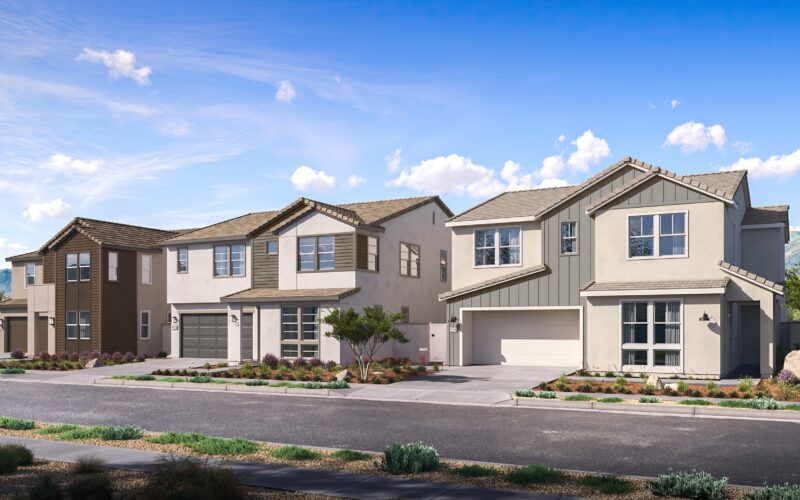
Lennar Corporation (NYSE: LEN) has launched Sutton and Hollis, two new single-family home collections at Valencia in the Santa Clarita Valley of northern Los Angeles County, California. The collections introduce six two-story designs, with homes ranging from 2,663 to 3,555 square feet and pricing beginning in the low $1 million range. Lennar scheduled the grand opening for August 8, 2026, extending its presence in the Valencia master-planned community as developers continue adding housing inventory across the project. The strategic significance is not simply the addition of another Lennar neighborhood, but the decision to target larger, higher-priced homes while mortgage affordability remains a major constraint on U.S. buyers. The immediate test will be whether Valencia’s location, amenities and scarcity of newer large single-family homes can support demand at pricing materially above Lennar’s broader western-region averages.
Sutton includes three plans spanning approximately 2,663 to 2,907 square feet, each offering four bedrooms and three bathrooms. Hollis moves further up the size curve, with homes ranging from roughly 3,154 to 3,555 square feet and four to five bedrooms. Lennar said the collections are positioned within a new enclave of Valencia near a recreation center under construction, while residents will also have access to trails, playgrounds and other community amenities.
The launch also adds another layer to Lennar’s existing Valencia portfolio. The broader masterplan already includes Lennar communities at lower price points, including Sunstone from the upper $600,000s and Sapphire from the low $700,000s, while competing builders including KB Home and Richmond American Homes are also selling within Valencia. Sutton and Hollis therefore broaden Lennar’s product ladder rather than representing an isolated expansion into the market.
That distinction matters because Lennar is currently managing its national business around affordability, incentives, construction efficiency and volume. In its fiscal second quarter ended May 31, 2026, the company delivered 20,519 homes, up 2% year over year, but its average sales price declined to $371,000 from $389,000 as Lennar continued adjusting prices and incentives to sustain sales. New orders fell 4% to 21,749 homes, while total revenue was $7.9 billion.
Why is Lennar launching million-dollar Sutton and Hollis homes while affordability remains difficult?
Sutton and Hollis sit at a considerably higher price point than the average home Lennar is currently selling nationally. Their starting prices in the low $1 million range are also substantially above the company’s fiscal second-quarter West segment average sales price of $567,000 for delivered homes and the $562,000 average price of new West-region orders.
That does not necessarily make the strategy contradictory. Lennar operates across multiple buyer categories and markets, meaning the company can simultaneously reduce pricing or use incentives in more affordability-sensitive communities while introducing larger homes in locations where household incomes, local supply constraints and buyer preferences support higher ticket values.
Valencia offers several characteristics that make such product segmentation possible. It is a large master-planned development in northern Los Angeles County where Lennar can offer buyers access to new construction, community facilities and comparatively large floorplans without requiring them to purchase deeper inside the Los Angeles urban core. Sutton and Hollis also provide the kind of four- and five-bedroom layouts that can appeal to move-up households seeking additional space.
However, the price point narrows the prospective buyer pool. The economics of financing a home above $1 million become particularly sensitive to mortgage rates, down-payment requirements and household income. Mortgage borrowing costs remained elevated through the summer of 2026, while U.S. housing data continued to show affordability pressure influencing both transaction volumes and pricing.
The national new-home market illustrates that tension. U.S. Census Bureau data showed new single-family home sales running at a seasonally adjusted annual rate of 628,000 in June 2026, up 1.6% from May but 5.6% below June 2025. The median new-home sales price fell to $398,300, while available new-home inventory represented approximately 9.3 months of supply at the prevailing sales rate.
For Lennar, that makes the Sutton and Hollis opening a localized demand test. Strong reservations and conversions would indicate that premium new construction in Valencia can remain relatively resilient despite national affordability pressures. A slower sales pace would potentially require the same combination of pricing flexibility, financing incentives and inventory discipline Lennar has been using elsewhere.

How do Sutton and Hollis fit into Lennar’s broader strategy for the Valencia community?
Valencia is not a Lennar-owned masterplan. Five Point Land, LLC, through The Newhall Land & Farming Company, is developing the Valencia mixed-use community in northern Los Angeles County, with Five Point Holdings, LLC controlling the relevant management structure. Lennar participates as one of the homebuilders purchasing or developing residential opportunities within the wider community.
Five Point Holdings’ latest operating numbers suggest that Valencia continues to produce measurable residential absorption. Builders sold 78 homes in Valencia during the second quarter of 2026 after recording 90 builder sales during the first quarter. Valencia recorded 238 builder home sales across 2025.
Sutton and Hollis expand Lennar’s ability to address the higher end of that demand spectrum. Sutton begins with 2,663-square-foot homes, while Hollis reaches 3,555 square feet. Current community listings place Sutton from around the low $1 million range, with Hollis similarly positioned above $1 million.
The product mix also gives Lennar a broader funnel inside the same masterplan. Buyers unwilling or unable to stretch toward Sutton or Hollis can encounter smaller Lennar offerings elsewhere in Valencia, while households seeking more bedrooms and larger lots do not necessarily have to migrate to a competing builder.
This kind of segmentation can be strategically valuable in a slower housing market because it allows a builder to respond to different affordability bands without relying on a single community format. The execution challenge is inventory discipline. Premium homes typically carry greater dollar exposure per unsold unit, so production pacing and demand visibility become particularly important if sales conditions soften.
Can the Valencia expansion help Lennar protect volume without adding further pressure to margins?
Lennar’s financial challenge in 2026 is increasingly about balancing volume against profitability. Second-quarter home-sale gross margin was 15.6%, down from 17.8% a year earlier, although it improved sequentially from 15.2% in the first quarter. The company attributed the year-over-year compression largely to lower revenue per square foot and higher land costs, partly offset by lower construction costs.
Management has deliberately used incentives and price adjustments rather than allowing volume to fall sharply. Lennar disclosed an average sales price of $371,000 in the second quarter, reflecting incentives of approximately 12.9%, while construction cycle time improved to 121 days and construction costs continued to decline. The company also reduced finished inventory per community and maintained its push toward an asset-light land model.
That operating model creates an interesting context for Sutton and Hollis. Premium pricing can potentially support stronger revenue per home, but only if the market accepts the product without requiring disproportionately large concessions. The useful indicator will therefore not simply be how many Sutton and Hollis homes sell, but whether Lennar can preserve effective pricing as those homes move through the sales pipeline.
The California launch also comes as Lennar moderates its overall growth expectations. Management reduced its fiscal 2026 delivery target to approximately 82,000 to 83,000 homes, citing pressure from interest rates and broader macroeconomic uncertainty. For the third quarter, Lennar expects approximately 20,500 to 21,500 deliveries and a home-sales gross margin of about 16%.
A successful launch at Sutton and Hollis would therefore contribute to Lennar’s wider effort to sustain sales velocity while gradually rebuilding margins. It would not materially alter group earnings on its own, but communities capable of supporting higher selling prices without excessive incentives are valuable in a portfolio where affordability-related pricing decisions have compressed profitability.
What does Lennar’s latest share-price performance say about investor sentiment toward the homebuilder?
Lennar Class A shares closed at $88.18 on August 7, 2026, rising 3.96% during Friday’s session. Importantly, Lennar’s Sutton and Hollis announcement was distributed at 8:30 p.m. Eastern Time, several hours after the stock market had closed, meaning Friday’s share-price gain cannot reasonably be attributed to the Valencia announcement.
The stock had nevertheless been recovering from recent lows. From its July 31 close of $82.35 to August 7, Lennar gained about 7.1%, based on historical closing prices. Compared with the July 8 close of $83.59, the shares were approximately 5.5% higher.
The longer-term picture remains considerably weaker. Lennar’s $88.18 closing price remained almost 39% below its 52-week high of $144.24 and only about 10% above the 52-week low near $79.83. The stock has therefore recovered from the bottom of its recent range without yet producing evidence of a sustained rerating.
That market position reflects the competing forces affecting the homebuilding sector. Lennar has substantial scale, relatively low homebuilding leverage, an increasingly land-light structure and demonstrated capacity to use incentives to maintain deliveries. Against those strengths, lower selling prices and elevated incentives have compressed margins, while mortgage affordability continues to constrain demand.
The Sutton and Hollis launch is unlikely to change institutional sentiment by itself. Its relevance is more incremental: the project offers another data point on whether Lennar can sell differentiated, higher-value homes while the company’s national strategy remains focused on affordability and production efficiency.
What will determine whether Sutton and Hollis become a successful expansion for Lennar in California?
The first measurable indicator will be the pace at which Lennar converts initial buyer interest into signed contracts. Because the announcement does not disclose the total number of homes planned for Sutton and Hollis, investors cannot yet calculate the potential revenue contribution or expected absorption period from the launch alone.
Pricing discipline will be equally important. Starting prices around $1 million place the communities well above Lennar’s companywide and West-region average selling prices. If demand supports those prices with limited concessions, Sutton and Hollis could provide a favorable mix contribution. If incentives increase quickly, the nominal starting prices will become less useful indicators of project economics.
Completion of the recreation center and continued development of the wider Valencia masterplan may also influence buyer demand. Master-planned communities generally derive part of their value proposition from amenities and the gradual creation of surrounding residential and commercial infrastructure, meaning Lennar’s individual collections are partly dependent on continued execution across the broader development.
Five Point Holdings’ reported Valencia builder sales provide another useful indicator. The masterplan recorded 78 builder sales in the second quarter after 90 in the first quarter, suggesting continuing transactions but also demonstrating why quarterly absorption should be monitored rather than assuming that California’s constrained housing supply automatically guarantees rapid sales.
For Lennar, the strategic objective is straightforward: keep expanding the number of attractive selling opportunities while limiting the capital trapped in land and unsold inventory. Sutton and Hollis can support that strategy if their premium positioning produces adequate sales velocity and margins. The risk is less about the attractiveness of the homes themselves and more about whether buyers can economically absorb their price point in the current financing environment.
Key takeaways from Lennar’s Sutton and Hollis launch at Valencia in Santa Clarita Valley
- Lennar Corporation has opened Sutton and Hollis at the Valencia master-planned community in northern Los Angeles County.
- The two collections contain six single-family floorplans ranging from approximately 2,663 to 3,555 square feet.
- Pricing begins in the low $1 million range, placing the homes well above Lennar’s companywide average selling price.
- Sutton offers four-bedroom plans, while Hollis reaches five bedrooms and 3,555 square feet.
- The expansion gives Lennar a higher-priced product tier alongside its existing lower-priced Valencia communities.
- Five Point Land is developing the broader Valencia masterplan, while Lennar operates as one of the participating homebuilders.
- Five Point Holdings reported 78 Valencia builder home sales during the second quarter of 2026 following 90 in the first quarter.
- Lennar’s national strategy remains focused on maintaining volume through pricing, incentives, construction efficiency and a land-light operating model.
- Lennar shares closed at $88.18 on August 7, but that day’s 3.96% gain occurred before the Sutton and Hollis announcement was released.
- The clearest proof point will be whether Lennar can maintain million-dollar pricing while producing sufficient sales velocity without significantly increasing buyer incentives.
Why Sutton and Hollis will ultimately be judged by sales velocity rather than their opening prices
Lennar’s Valencia expansion arrives at an unusual point in the housing cycle. The company is simultaneously working to make much of its national product more affordable while adding homes that begin around $1 million in one of California’s supply-constrained markets. That is not necessarily a conflict in strategy; it is an attempt to match different products to different buyer pools.
What has improved for Lennar is operational efficiency. Construction costs and cycle times have moved in the right direction, inventories are being managed more tightly, and second-quarter gross margin improved sequentially. What remains unresolved is whether those operational gains can overcome the margin pressure created by incentives and lower selling prices across a difficult housing market.
Sutton and Hollis provide a small but useful test of that equation. If larger homes at Valencia generate steady orders while retaining much of their advertised pricing, the collections could demonstrate that Lennar still has meaningful pricing power in selected California micro-markets even when national housing affordability is weak. If concessions have to rise materially to sustain sales, the launch will instead reinforce the broader message coming from Lennar’s results: volume remains achievable, but profitability depends increasingly on how efficiently that volume can be produced.
Discover more from Business-News-Today.com
Subscribe to get the latest posts sent to your email.
