
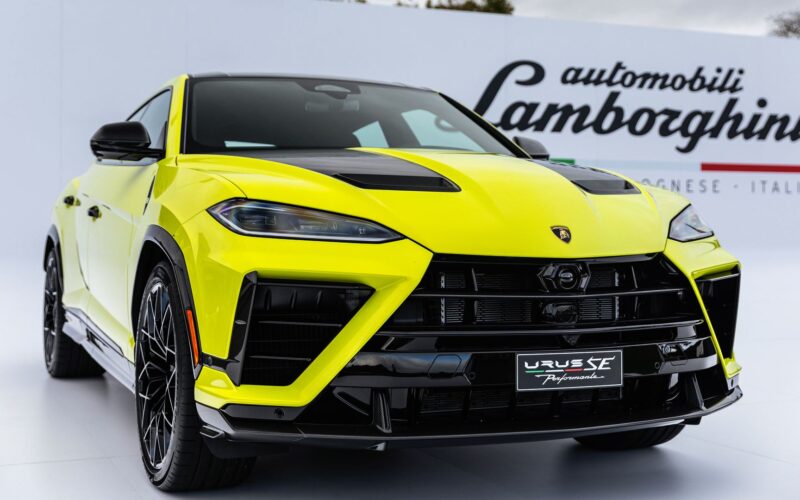
Automobili Lamborghini, the Sant’Agata Bolognese supercar subsidiary of Volkswagen AG (Xetra: VOW3), unveiled the Revuelto SV on August 14, 2026, positioning it as the fastest and most powerful production car in the brand’s history. The limited-run variant of the flagship Revuelto pairs a naturally aspirated 6.5-litre V12 with three electric motors for more than 1,050 horsepower, a 0-to-100 km/h time of 2.4 seconds, production capped at 1,963 units, and a starting price of $741,172. The unveiling arrives at a moment when the parent group is preparing large-scale job cuts, trimming its Traton stake, divesting Everllence, and warning that European plants may close, making the profit contribution from its luxury brands more, not less, strategically important. The commercial question is whether Lamborghini can keep monetising exclusivity and heritage at record price points while its own H1 2026 profit slipped and rival Ferrari widened its lead in the United States. The unveil is a confidence signal; the harder test is whether the SV halo can defend group luxury margins into 2027.
What did Lamborghini actually announce with the Revuelto SV and how does it slot into the existing lineup
The Revuelto SV is a track-focused evolution of the Revuelto, which launched in 2023 as Lamborghini’s first High-Performance Electrified Vehicle and the successor to the Aventador. The base Revuelto delivers 1,001 horsepower from the same 6.5-litre V12 plug-in hybrid architecture and starts at roughly $668,000 in the United States, so the SV commands a premium of about $70,000 to $130,000 over the standard car depending on trim, before the customary personalisation upcharges that push actual delivered prices meaningfully higher.
The SV nameplate is not new. It traces back 55 years to the Miura SV of 1971, and Lamborghini has since applied the designation to selected variants of the Diablo, Murcielago, and Aventador. Each iteration has functioned as a factory-sanctioned collector edition that carries higher list prices, benchmark performance figures for the model cycle, and tighter production caps than the base flagship. The 1,963-unit ceiling on the Revuelto SV is a deliberate reference to Lamborghini’s founding year and slots the car firmly into that lineage.
Beyond the additional 50-plus horsepower, the SV adds revised aerodynamics, a model-specific suspension calibration, a new carbon-ceramic braking system, a Pilota Mode for track-oriented driving parameters, and carbon-framed sport seats with an optional carbon-fibre monocoque seat upgrade. The engineering brief, in effect, is to preserve the naturally aspirated V12 experience while using electrification to extract incremental performance rather than to cut emissions.

Why does the launch matter to Volkswagen AG at this specific moment in the group cycle
Volkswagen AG is in the middle of a difficult restructuring phase. Q2 2026 came in below expectations, the group trimmed its full-year revenue guidance citing softness at Audi and in China, and press coverage during the week of the Revuelto SV unveil pointed to headcount reductions of up to 100,000 across the group, potential plant closures, disposal of the majority stake in Everllence to Bain Capital, and preparations to reduce the group’s holding in listed subsidiary Traton. The share price reflects that pressure. VOW3 closed at €73.72 on Xetra ahead of the announcement, roughly 29 percent lower year-to-date and 3.4 percent lower over the preceding five sessions, although the analyst consensus tracked by MarketScreener remained at outperform with an average price target of €105.31, implying roughly 43 percent upside from the reference close.
Within that group profile, Lamborghini has functioned as a disproportionate contributor to profit per vehicle, alongside Porsche and Bentley. Full-year 2025 revenue exceeded €3.20 billion on more than 10,000 deliveries, and the brand generated operating margins above 23 percent through most of that cycle. In an environment where the Volkswagen passenger car brand is fighting labour costs, Chinese competitive pressure, and the cost of transitioning to electric vehicles, the ability to keep repricing V12 flagships at seven-figure levels is one of the few remaining structural pricing levers the group has. The Revuelto SV, and the broader cadence of limited-edition variants around each flagship, is how that lever gets pulled.
How healthy is Lamborghini’s own commercial trajectory heading into the SV launch
The record set by Lamborghini in H1 2026 was on revenue, not on units or profit. The company reported first-half revenue of €1.74 billion, up 7.4 percent year on year, and confirmed that customer waiting lists across the lineup average around 12 months. Chairman and Chief Executive Officer Stephan Winkelmann described the result as evidence of resilience against a global luxury-auto segment that contracted 7.7 percent over the same period.
However, the picture below the top line was softer. Deliveries fell 4.6 percent to 5,422 units, reflecting US tariff changes, subdued demand in China, geopolitical uncertainty in the Middle East, and weakness in Europe. Operating profit declined 8.4 percent to €395 million, and the operating margin narrowed from prior levels to 22.7 percent. Industry commentary at the time of the H1 results also highlighted that Lamborghini’s United States registrations fell by approximately 20 percent while rival Ferrari’s US registrations rose by about 3 percent in the same window, a divergence that matters because the United States has been the single largest end market for both brands.
Against that backdrop, the Revuelto SV is a targeted intervention. A capped run of 1,963 cars at a starting price of $741,172 could add roughly $1.5 billion in aggregate list-price revenue over the model’s life before options and regional pricing, all of it at margin structures materially above the brand average. It also gives the dealer network a specific allocation-driven story to hold high-value clients through the balance of the Revuelto cycle.
Where does the Revuelto SV sit against Ferrari and the wider top-tier supercar peer set
Ferrari has been the sharper share-taker in the ultra-luxury coupe segment in recent quarters. It has repositioned its own top of range through the F80 hypercar, priced at a materially higher tier than the Revuelto SV, and has continued to grow US registrations while Lamborghini contracted. The F80 is a different competitive object, sold in far smaller volumes at price points around $3.9 million, but the direction of travel matters because Ferrari’s brand momentum sets the reference point for pricing power across the segment.
The Revuelto SV competes more directly with variants such as Ferrari’s V12 SP3 Daytona and 12Cilindri special editions, and with McLaren’s remaining V8 hybrids, than with true hypercars. On that comparison the SV’s power-to-price ratio is competitive, and the naturally aspirated V12 architecture is a genuine point of differentiation as most peers move toward smaller turbocharged or fully electric powertrains. The strategic risk is not one specific rival product but the cumulative effect of Ferrari extending its brand halo, McLaren repositioning under new ownership, and new-money entrants such as Rimac and Pagani competing for the same wallet share in a segment where each customer typically buys once every several years.
What is the read-across for the V12 hybrid franchise given emissions rules and the wider industry slowdown in pure electrification
Lamborghini has already fully hybridised its production range across the Revuelto, the Urus SE, and the newly launched Temerario, completing what the company described as the “Direzione Cor Tauri” transition. The Revuelto SV extends the commercial life of the V12 architecture well into the second half of the decade at a moment when several peers are re-examining the timing of their pure-electric supercar programmes.
That timing has commercial merit. Industry commentary consistently highlights that demand for ultra-luxury pure-electric performance vehicles has been slower to develop than manufacturers projected two years ago, while the plug-in hybrid V12 configuration preserves the acoustic signature that collectors have historically been willing to pay a premium for. However, the strategy is not without risk. European emissions rules and possible tightening in California create a fixed regulatory clock on internally combusted flagships, and the residual values of limited-edition V12 hybrids depend heavily on collector confidence that the powertrain will continue to be produceable and serviceable through the 2030s. Lamborghini has room to run the current strategy, but not indefinitely, and the SV should be read as a way of extracting maximum value from the V12 franchise while the window remains open.
What would confirm or challenge the Revuelto SV’s contribution to Volkswagen’s luxury margin defence
The near-term proof points are commercial rather than technical. The most direct signal will be whether allocations for the full 1,963-unit production run are absorbed by existing collector clients within a compressed window, which would validate the pricing and reduce the risk of open inventory pressuring later Revuelto variants. Secondary evidence will come from the H2 2026 and full-year 2026 results at both Lamborghini and Volkswagen’s premium division, where the mix contribution of higher-priced special editions should offset some of the tariff and currency drag that compressed H1 margins. A stabilisation or reversal of the US registration gap versus Ferrari would be a stronger structural signal, although one product line cannot correct that on its own.
The scenarios that would weaken the thesis are also identifiable. A material lengthening of the SV order-to-delivery cycle, evidence that early customers are trading out of the base Revuelto to fund the SV rather than adding to their existing configurations, or further deterioration in the US and Chinese luxury markets would each dilute the incremental margin contribution the launch is designed to secure. Volkswagen AG’s next scheduled earnings release on October 28, 2026, will provide the first quantitative marker for how the group’s luxury cluster is holding up against its mass-market pressures.
Key takeaways: Revuelto SV, Volkswagen luxury margin, Ferrari competition, and the V12 hybrid outlook
- Lamborghini has unveiled the Revuelto SV, its most powerful production car ever, with more than 1,050 horsepower, a 2.4-second 0-to-100 km/h time, production capped at 1,963 units, and a starting price of $741,172.
- The SV nameplate revives a lineage dating back 55 years to the Miura SV and slots into a limited-edition strategy that Lamborghini has used across the Diablo, Murcielago, and Aventador cycles.
- The launch lands as Volkswagen AG absorbs guidance cuts, prospective headcount reductions of up to 100,000, disposal of the Everllence majority stake to Bain Capital, and preparation to reduce its Traton holding.
- Lamborghini reported record H1 2026 revenue of €1.74 billion, up 7.4 percent, but operating profit fell 8.4 percent to €395 million, and deliveries declined 4.6 percent to 5,422 units.
- US registrations for Lamborghini were reported to have fallen roughly 20 percent in H1 2026 while Ferrari’s rose about 3 percent, tightening the competitive gap in the brand’s single largest market.
- The Revuelto SV extends the naturally aspirated V12 hybrid franchise at a moment when several peers are pulling back on pure-electric supercar timing.
- Aggregate list-price revenue from the SV run could approach $1.5 billion before options and regional pricing, at margin structures materially above the brand average.
- The near-term proof point is the speed at which allocations are absorbed by collector clients without diluting demand for the base Revuelto.
- The stronger structural signal would be a stabilisation of the US registration gap versus Ferrari across the balance of 2026 and into 2027.
- Volkswagen AG’s Q3 2026 earnings release, scheduled for October 28, is the next quantitative marker for how the luxury cluster is offsetting mass-market pressure.
Discover more from Business-News-Today.com
Subscribe to get the latest posts sent to your email.