

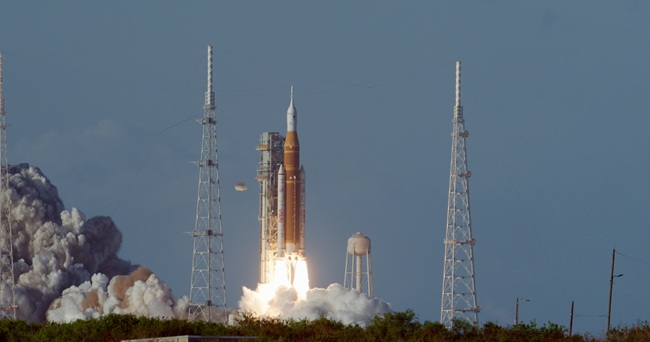
L3Harris Technologies (NYSE: LHX) emerged as the most critical industrial contributor to the Artemis II launch on April 1, 2026, supplying more than 100 separate mission elements including propulsion systems, avionics, and communications hardware for the first crewed journey to the vicinity of the Moon in over 50 years. The mission, which lifted off from Launch Complex 39B at NASA’s Kennedy Space Center in Florida, carried four astronauts aboard the Orion spacecraft atop the Space Launch System rocket in what NASA has designated a crewed test flight intended to validate life support systems and deep-space operations before a planned lunar landing attempt. For L3Harris, the successful liftoff represents the most visible single demonstration of its aerospace and defense capabilities in the company’s history, spanning propulsion technologies originally developed for the Space Shuttle program through to advanced avionics and audio systems engineered for the demands of cislunar spaceflight. LHX shares closed at $345.15 ahead of the launch, trading near their 52-week high of $379.23 reached on March 2, 2026, reflecting a stock that has more than doubled from its 52-week low of $195.72 as defense and space spending have accelerated.
What role did L3Harris Technologies play in powering the Artemis II Space Launch System rocket and Orion spacecraft?
The scale of L3Harris involvement in Artemis II is difficult to overstate. The company supplied four RS-25 engines for the SLS core stage, the same engine family that powered every Space Shuttle mission between 1981 and 2011 and that L3Harris has been modernising for expendable deep-space use. Those engines burned for approximately 500 seconds from liftoff, generating the thrust required to push the combined 5.75-million-pound vehicle off the launch pad and begin the climb toward orbit. Once the core stage separated, the Interim Cryogenic Propulsion Stage took over to push Orion into high Earth orbit, powered by an L3Harris RL10 engine and controlled by 12 L3Harris MR-106 thrusters that managed orientation and course corrections. The RL10 is one of the most flight-proven upper-stage engines in American rocketry, with a history stretching back to the early 1960s, and its role in the translunar injection burn placed particular importance on reliability given that the four crew members aboard Orion depended on it to begin the trajectory toward the Moon.
Beyond propulsion, L3Harris supplied 40 advanced avionics systems that controlled and monitored the SLS core stage, the Interim Cryogenic Propulsion Stage, and the solid rocket boosters throughout the ascent phase. The company also provided the Orion main engine responsible for the translunar injection burn, nine composite overwrapped pressure vessels supporting SLS operations, the jettison motor that separates the Launch Abort System from the Orion capsule, and the Orion audio system managing continuous crew communications throughout the mission. In total, the company counts 108 mission-critical elements across the Artemis II vehicle, a figure that frames L3Harris not as a component supplier but as a systems integrator operating at the heart of America’s human deep-space programme.
How does Artemis II validate L3Harris as a prime contractor for sustained lunar and deep-space missions beyond Earth orbit?
L3Harris has pursued what Morningstar and other analysts have described as a strategy to position itself as the sixth prime US defense and aerospace contractor, bidding for programmes that would previously have been inaccessible to a more specialised company. Artemis II provides the most credible proof point yet for that ambition. Having propulsion systems, avionics, and communications hardware perform flawlessly on the first crewed mission beyond low Earth orbit in 54 years is the kind of reference case that shapes future procurement decisions across NASA, the Space Force, and allied space agencies. The RS-25 programme in particular carries long-term significance because L3Harris is producing new RS-25 engines for missions beyond Artemis II, with engine 2048 already slated for Artemis III, which is currently targeting a lunar surface landing attempt in 2028. The RL10 engine faces a similar trajectory, with L3Harris’s development of the RL10C-X variant positioning the company for upper-stage work across multiple commercial and government launch vehicles beyond SLS.
The Artemis programme structure also provides L3Harris with a recurring revenue base that insulates the company from the project-to-project variability that affects smaller defence and space contractors. Each Artemis mission requires a fresh complement of RS-25 engines, RL10 engines, and associated avionics hardware, creating a pipeline that extends at minimum through Artemis IV and potentially further depending on NASA’s long-term lunar presence plans. That sustained production cadence matters particularly because L3Harris reported revenue of $5.65 billion for its most recent quarter and is targeting earnings per share of approximately $2.57 for the upcoming quarter, with analysts expecting approximately 6.6 percent growth year over year. The company’s Q1 2026 earnings call, scheduled for April 23, 2026, will likely give management the opportunity to frame the Artemis II mission as a commercial and strategic milestone.
What are the competitive and strategic implications of L3Harris’s dominance in NASA crewed spacecraft propulsion systems?
The propulsion and avionics infrastructure that L3Harris has built around SLS and Orion creates barriers to displacement that few aerospace companies can surmount quickly. The RS-25 engine’s development history is measured in decades, and the institutional knowledge required to certify a new crew-rated engine for deep-space missions represents a significant moat. Aerojet Rocketdyne, which L3Harris acquired in 2023, contributed the bulk of the propulsion heritage, and integrating that capability has been one of the more strategically transformative moves in the American aerospace industry over the past decade. Competitors including Northrop Grumman, which supplies the SLS solid rocket boosters, and Boeing, which serves as the SLS prime integrator, each have defined roles in the architecture, but neither sits as close to the critical propulsion chain as L3Harris across both the core stage and upper stage simultaneously.
The cancellation of the Lunar Gateway programme, confirmed in March 2026, removes one element from the Artemis architecture but does not diminish L3Harris’s position because the company’s contributions are tied to SLS and Orion rather than Gateway infrastructure. The more significant competitive question concerns the longer-term trajectory of NASA’s launch architecture. SpaceX’s Starship, if it achieves the flight cadence and reliability required for crewed lunar missions, could alter the SLS programme’s long-term economics. However, Starship requires its own propulsion and avionics supply chain, and L3Harris has been developing relationships with commercial launch operators alongside its NASA work. The company has also secured a C$1.1 billion contract with Canada and is expanding its international defence footprint in ways that reduce its dependence on any single government programme.
How does the Artemis II mission fit into the broader geopolitical context driving US investment in human lunar exploration?
The Artemis programme exists in a strategic context that extends well beyond scientific ambition. China’s National Space Administration has publicly committed to landing astronauts on the Moon by 2030, and US policymakers have framed the Artemis timeline in part as a response to that ambition. The successful Artemis II launch on April 1, 2026 represents concrete American progress toward reestablishing crewed lunar capability before a competitor achieves the same milestone. For the defence industrial base, this creates durable political support for sustained programme funding regardless of near-term budget pressures, a dynamic that benefits all prime contractors but L3Harris in particular given the depth of its propulsion dependency in the architecture.
The four crew members aboard Artemis II also carry symbolic weight that reinforces Congressional support. NASA astronaut Victor Glover becomes the first person of colour to travel beyond low Earth orbit; Christina Koch the first woman to reach the Moon’s vicinity; and Canadian Space Agency astronaut Jeremy Hansen the first non-US citizen to do so. The mission’s planned trajectory will carry the crew approximately 4,700 miles beyond the Moon, exceeding the distance record set during the Apollo 13 emergency in 1970, and will test the Orion heat shield at atmospheric reentry speeds approaching 25,000 miles per hour. Each of those milestones reinforces the political and public narrative that justifies the programme’s annual funding line and the industrial ecosystem surrounding it.
What execution risks and technical challenges remain for L3Harris as Artemis missions grow more complex beyond the initial test flights?
The Artemis II launch did not arrive without a difficult development history, and L3Harris carries a share of the programme-level delays that pushed the mission from a 2023 target to April 2026. The early 2026 attempts encountered liquid hydrogen leaks during wet dress rehearsals, a valve issue requiring retorquing on the Orion crew module hatch, and a helium flow problem that triggered a full rollback to the Vehicle Assembly Building in February 2026. While none of those issues were attributable specifically to L3Harris hardware, they reflect the complexity of operating at the edge of human spaceflight capability and the tight coupling between propulsion, avionics, and structural systems where failures in one domain cascade quickly into others.
The transition from Artemis II, a crewed flyby mission, to Artemis III, a crewed lunar landing attempt, increases technical complexity significantly. Artemis III requires Orion to rendezvous and dock in cislunar space with a pre-positioned SpaceX Starship Human Landing System, a manoeuvre that Artemis II is beginning to validate through a proximity operations demonstration with the Interim Cryogenic Propulsion Stage. L3Harris avionics and propulsion systems will need to perform across longer mission durations and more complex orbital profiles as the programme matures. Production scaling for new RS-25 engines also carries manufacturing risk, since L3Harris is building on a production base that was originally designed for a reusable programme and must now deliver expendable engines at a cadence and unit cost that satisfies both NASA budget constraints and the company’s own margin requirements.
What does LHX stock performance heading into Artemis II suggest about how institutional investors are pricing the space programme opportunity?
LHX shares closed at $345.15 on April 1, 2026, having reached an all-time high of $379.23 on March 2, 2026. The 52-week range from $195.72 to $379.23 reflects a period of significant rerating, driven by geopolitical factors including the ongoing conflict environment in the Middle East and accelerating NATO and allied defence spending, but the Artemis programme’s prominence has been a consistent background narrative in analyst coverage. The stock’s beta of approximately 0.47 suggests relatively low volatility compared to the broader market, consistent with a company whose revenue base is anchored in long-cycle government contracts rather than commercially cyclical businesses.
The market’s reaction to the Artemis II launch, if any, is likely to be modest given that the mission’s completion will occur over the subsequent ten days rather than producing an immediate financial event. The more meaningful catalyst is the April 23 earnings call, where management can translate the mission’s success into a commercial narrative around programme backlog, propulsion production ramp, and medium-term revenue visibility. With an adjusted earnings per share estimate of approximately $2.57 for Q1 2026, representing approximately 6.6 percent growth year over year, investors entering the Artemis news cycle will be looking to confirm that operational execution is keeping pace with the strategic symbolism of putting four astronauts on a trajectory toward the Moon.
Key takeaways: What the Artemis II launch means for L3Harris Technologies, its competitors, and the US aerospace industry
- L3Harris Technologies supplied 108 mission-critical elements for Artemis II, including RS-25 engines, the RL10 upper-stage engine, 40 avionics systems, in-space thrusters, and the Orion audio system, making it the single most deeply integrated industrial contributor to the mission.
- The RS-25 and RL10 propulsion programmes give L3Harris a recurring production pipeline extending through at least Artemis III and IV, with a planned crewed lunar landing in 2028 representing the next major milestone.
- Artemis II is the strongest proof point yet for L3Harris’s strategy to position itself as the sixth prime US defense and aerospace contractor, capable of bidding for large-scale human spaceflight programmes.
- The Aerojet Rocketdyne acquisition, completed in 2023, was the foundational move that gave L3Harris the propulsion heritage and certification history required to anchor NASA’s crewed deep-space architecture.
- China’s stated ambition to land astronauts on the Moon by 2030 provides durable political support for the Artemis programme’s funding regardless of near-term budget pressures, reducing the programme risk that would otherwise weigh on L3Harris’s long-term revenue visibility.
- The cancellation of the Lunar Gateway in March 2026 does not materially impair L3Harris because its contributions are tied to SLS and Orion rather than Gateway infrastructure.
- LHX shares entered the Artemis II launch near their all-time high of $379.23, reflecting a broader defence sector rerating rather than a specific Artemis premium, suggesting the stock has already absorbed much of the programme’s strategic value.
- Execution risk increases materially in the transition from Artemis II’s crewed flyby to Artemis III’s lunar landing attempt, which requires cislunar rendezvous, docking, and longer mission durations that will test L3Harris avionics and propulsion across a more demanding operational envelope.
- The April 23, 2026 Q1 earnings call is the immediate financial event where management can convert Artemis II’s mission success into guidance confidence and backlog commentary for institutional investors.
- Competitors including Northrop Grumman and Boeing hold defined roles in the SLS architecture but neither sits as deeply inside the critical propulsion chain across both core stage and upper stage simultaneously, giving L3Harris a structural advantage in the programme’s industrial hierarchy.
Discover more from Business-News-Today.com
Subscribe to get the latest posts sent to your email.