




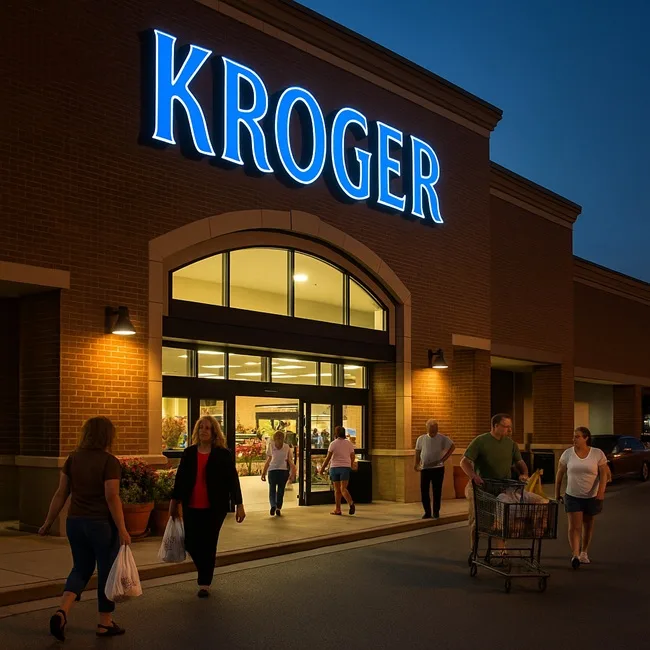
The Kroger Co. (NYSE: KR) has announced a major strategic reset of its eCommerce operations aimed at improving customer experience, expanding its delivery footprint, and turning online operations into a consistently profitable segment. As part of this transition, Kroger expects to generate approximately $400 million in eCommerce operating profit in 2026 by pivoting toward a hybrid fulfillment model that combines in-store capabilities, selective automation, and expanded partnerships with third-party delivery providers including Instacart, DoorDash, and Uber Eats.
The strategy includes the closure of three automated customer fulfillment centers located in Pleasant Prairie in Wisconsin, Frederick in Maryland, and Groveland in Florida. These closures, scheduled for January, are a response to underperformance in those locations relative to Kroger’s financial expectations. As a result of this shift, the American grocery chain will record approximately $2.6 billion in impairment and related charges in the third fiscal quarter of 2025. However, the company has indicated that these closures are not expected to have any material impact on identical sales excluding fuel.
This realignment marks a decisive evolution in Kroger’s approach to digital grocery, reflecting a move away from a capital-intensive automation-first model toward a flexible hybrid approach designed to scale with consumer demand, reduce costs, and better utilize the company’s substantial store network.
Why is Kroger moving away from fully automated fulfillment centers?
Kroger’s decision to shut down specific high-capital fulfillment centers comes after a comprehensive internal review of its logistics and eCommerce performance. Executives determined that these centers failed to meet return expectations, especially in markets where automation did not translate to proportional growth in order volumes or profitability. While some automated facilities will continue to operate in high-density geographies, the overall direction is shifting toward a leaner, more dynamic fulfillment model.
The updated model includes increased reliance on store-based fulfillment and piloting of capital-light automation initiatives embedded within high-volume store environments. These pilots are expected to improve order throughput, labor efficiency, and customer experience without the fixed overhead associated with large-scale standalone fulfillment hubs. Kroger stated that this hybrid model will allow it to better balance cost, convenience, and proximity in how it serves online customers across its geographic footprint.
From an investor perspective, this approach also enhances return on invested capital by focusing on assets that support both physical and digital channels, rather than segment-specific infrastructure that may face utilization challenges.
What new delivery experiences will Kroger offer through Instacart, DoorDash, and Uber Eats?
As it reshapes its eCommerce logistics architecture, Kroger is doubling down on partnerships with leading delivery platforms to extend its customer reach and diversify order channels. The company has expanded its long-standing relationship with Instacart, which will now act as Kroger’s primary delivery partner across both its website and mobile app. In a notable first, Kroger will also become one of the earliest retailers to integrate Instacart’s Cart Assistant, an AI-powered shopping assistant, into its iOS mobile app. The assistant is designed to streamline online grocery orders by offering smart suggestions, search personalization, and real-time list building.
Kroger is also deepening its ties with DoorDash. Through this expanded partnership, tens of millions of customers will now have access to on-demand grocery and household essentials via the DoorDash Marketplace. This integration is expected to drive incremental online traffic from users accustomed to food delivery but looking to consolidate orders for daily essentials.
In early 2026, Kroger will launch a new shopping experience on the Uber Eats Marketplace. This integration will allow customers to order groceries at the same time they place restaurant meal orders, fulfilling both baskets in a single checkout. This dual-purpose approach is designed to align with consumer behavior trends favoring convenience, bundle savings, and app consolidation.
These expanded partnerships are not only expected to increase the number of customer touchpoints but also to reduce Kroger’s last-mile delivery costs by leveraging the scale and infrastructure of third-party platforms.
How does Kroger plan to grow its retail media business alongside eCommerce?
Alongside its logistics strategy, Kroger is placing significant emphasis on the synergies between its digital sales channels and its fast-growing retail media network, Kroger Precision Marketing. With millions of new customer journeys now being channeled through third-party apps such as Instacart, DoorDash, and Uber Eats, Kroger has created new surfaces for consumer packaged goods brands to advertise and engage with shoppers.
This opens the door to high-margin media revenue, driven by first-party data insights and personalized advertising across digital carts. Executives noted that each incremental eCommerce trip through third-party platforms generates data that can be activated to increase the value of Kroger’s media offerings and boost brand relevance at the moment of purchase.
By focusing on fulfillment speed, value, and personalization, Kroger believes that its media business can play an outsized role in offsetting digital acquisition costs while building stronger brand affinity and loyalty among eCommerce shoppers.
What is the financial and market context behind Kroger’s strategy update?
The announcement comes during a period of heightened investor focus on the profitability of online grocery fulfillment. While Kroger has reported five consecutive quarters of double-digit growth in eCommerce sales, analysts have been vocal about the need to improve unit economics and rationalize underperforming fulfillment infrastructure. With competition intensifying from Amazon, Walmart, and regional grocery chains, efficient digital operations are increasingly seen as a prerequisite for maintaining market share.
On November 18, 2025, Kroger shares opened at USD 66.52 and rose to USD 66.70 by 11:17 am, reflecting a 0.91 percent intraday gain and a 2.77 percent increase over the past five trading sessions. The stock touched an intraday high of USD 67.60 and a low of USD 66.10, indicating stable sentiment following the announcement. Kroger’s current market capitalization stands at USD 44.6 billion, with a trailing P/E ratio of 16.88. The stock offers a dividend yield of 2.10 percent and pays a quarterly dividend of USD 0.35 per share.
Over the past 52 weeks, Kroger’s stock has traded between USD 57.08 and USD 74.90. Analysts tracking the stock have characterized it as range-bound with moderate upside potential, pending clarity on margin expansion and regulatory outcomes tied to its proposed merger with Albertsons Companies.
Market participants are also closely watching institutional activity, with fund managers reportedly favoring capital-light operating models that support both cost control and digital scalability. Kroger’s pivot appears to align with that sentiment, as the company reins in automation expenses and leans into proven fulfillment channels that improve customer stickiness and trip frequency.
What comes next as Kroger tests new fulfillment formats?
With closures of high-cost automated facilities set in motion, Kroger is expected to accelerate the rollout of pilot programs focused on store-based automation and integrated customer fulfillment models. The grocer will monitor remaining automated sites and continue to evolve its network based on regional demand patterns, profitability benchmarks, and delivery response times.
Executives emphasized that Kroger’s store footprint remains its most valuable asset in the digital era, offering fulfillment proximity, workforce agility, and community-level brand familiarity. By integrating automation into this existing footprint rather than building isolated warehouses, Kroger hopes to lower fulfillment costs, reduce out-of-stock incidents, and improve ROIC across the board.
While the full financial impact of the strategy will materialize in 2026, the roadmap reflects a clear shift in how traditional retailers are approaching eCommerce profitability. Kroger’s focus on AI-powered assistance, third-party partnerships, and fulfillment flexibility positions it to adapt to rapidly evolving consumer expectations without overextending its capital base.
Investors will look for updates in early 2026 on the effectiveness of store-based pilots, adoption rates for the Cart Assistant, and the revenue contribution from retail media as more trips originate outside Kroger’s owned platforms.
Key takeaways from Kroger’s $400 million eCommerce transformation
- Kroger Co. (NYSE: KR) expects to add $400 million in eCommerce operating profit in 2026 by overhauling its fulfillment strategy.
- The grocer is closing automated fulfillment centers in Wisconsin, Maryland, and Florida after they failed to meet financial expectations.
- A $2.6 billion impairment charge will be booked in Q3 FY2025 due to the closures, but the company expects a neutral impact on identical sales (excluding fuel).
- Kroger is shifting to a hybrid fulfillment model using in-store capabilities, lighter automation, and third-party platforms to reduce costs and increase order flexibility.
- Instacart will become Kroger’s primary delivery provider across its app and website, including a new AI-powered Cart Assistant feature for iOS users.
- The company has expanded relationships with DoorDash and Uber Eats to reach more customers and offer bundled grocery and meal orders.
- Increased traffic from delivery platforms is expected to boost Kroger Precision Marketing, the grocer’s retail media business.
- The company is piloting in-store automation in high-volume geographies to enhance ROI and operational efficiency.
- Kroger shares rose 0.91 percent intraday on November 18, with a 5-day gain of 2.77 percent, reflecting positive investor sentiment around the shift.
- Analysts are watching for proof points in profitability, ROIC improvement, and third-party traffic monetization as Kroger exits unprofitable automation investments.
Discover more from Business-News-Today.com
Subscribe to get the latest posts sent to your email.

