

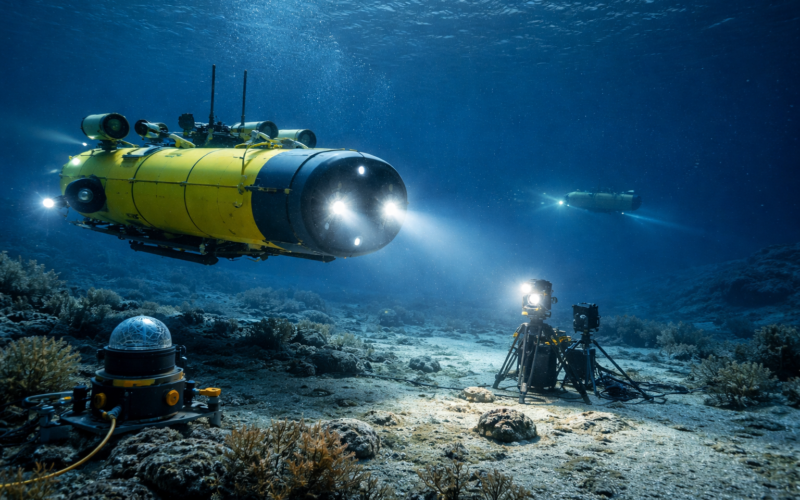
Canadian marine technology developer Kraken Robotics Inc. (TSX-V: PNG) has agreed to acquire Covelya Group Limited for $615 million, a transaction designed to significantly expand Kraken Robotics Inc.’s capabilities across underwater sensing, navigation, and maritime robotics systems used in defense, offshore energy, and scientific exploration. The company also announced plans to raise approximately $350 million through a bought-deal financing, alongside new debt facilities, to fund the acquisition and strengthen its balance sheet. The deal brings together Kraken Robotics Inc.’s expertise in synthetic aperture sonar, underwater robotics, and subsea batteries with Covelya Group Limited’s portfolio of navigation, imaging, and subsea communication technologies. If completed as expected in 2026, the acquisition will create one of the most diversified technology platforms in the rapidly growing global subsea robotics and maritime intelligence sector.
Why is Kraken Robotics Inc. acquiring Covelya Group Limited and what strategic capabilities will this combination unlock in underwater technology markets?
The acquisition reflects Kraken Robotics Inc.’s effort to evolve from a specialist provider of subsea imaging systems into a broader technology platform serving defense, offshore energy, and ocean research markets.
Kraken Robotics Inc. has built its reputation around synthetic aperture sonar systems and high-performance underwater robotic platforms used for seabed mapping, mine countermeasures, and subsea infrastructure inspection. These systems are increasingly deployed in autonomous underwater vehicles and remotely operated platforms that operate in complex marine environments.
Covelya Group Limited brings complementary capabilities that fill critical gaps in this ecosystem. Its operating companies develop technologies including subsea navigation systems, acoustic positioning networks, underwater imaging tools, environmental sensors, and subsea communication equipment.
Together, these technologies form the operational backbone of modern underwater robotics missions. Navigation accuracy, imaging resolution, and communication reliability determine whether autonomous vehicles can safely inspect offshore pipelines, detect naval mines, or map seabed terrain at scale.
By integrating Covelya Group Limited’s technologies with its own hardware platforms, Kraken Robotics Inc. will be able to offer integrated mission systems rather than individual components. This shift is important because defense agencies and offshore energy operators increasingly prefer suppliers capable of delivering complete operational systems rather than standalone sensors or software tools.
How does the $615 million transaction reshape Kraken Robotics Inc.’s scale and global presence in subsea robotics?
The acquisition significantly increases Kraken Robotics Inc.’s operational scale and geographic footprint.
Covelya Group Limited operates a network of technology companies focused on subsea sensing and monitoring solutions used in offshore industries and maritime defense programs. These businesses collectively employ hundreds of engineers and technical specialists across multiple global facilities.
Once integrated, the combined organization will operate research, engineering, and manufacturing facilities across North America, Europe, and Asia-Pacific. This international presence is particularly important for companies supplying maritime defense systems, where proximity to naval procurement programs and local support infrastructure can determine whether contracts are won or lost.
Kraken Robotics Inc. will continue to be headquartered in Canada while expanding operational capabilities in several strategic markets including the United Kingdom, Denmark, Germany, the United States, Singapore, and Australia.
These regions represent key clusters for offshore energy development, naval modernization programs, and oceanographic research funding. The expanded footprint therefore increases Kraken Robotics Inc.’s ability to compete for large international contracts.
How is Kraken Robotics Inc. financing the Covelya acquisition and what does the $350 million capital raise signal about its balance sheet strategy?
Kraken Robotics Inc. plans to finance the acquisition through a combination of equity issuance and new debt facilities.
The company announced a bought-deal public offering designed to raise approximately $350 million in capital. The financing will be structured through subscription receipts that convert into Kraken Robotics Inc. common shares once the acquisition closes and regulatory approvals are secured.
In addition to the equity financing, Kraken Robotics Inc. will secure a $150 million term credit facility to support the transaction. The remaining purchase price will be funded through a mix of existing cash resources and newly issued shares provided to the seller as partial consideration.

This financing structure allows Kraken Robotics Inc. to execute the acquisition without placing excessive strain on its balance sheet while maintaining sufficient capital to support post-merger integration and continued product development.
From a capital allocation perspective, the strategy indicates that Kraken Robotics Inc. views the Covelya Group Limited acquisition as a transformative platform investment rather than a tactical bolt-on purchase.
What industry forces are driving consolidation in the global subsea robotics and maritime technology sector?
The acquisition highlights broader structural changes underway in underwater technology markets.
Global demand for subsea robotics and marine sensing technologies is rising sharply due to several converging forces. Governments are investing heavily in maritime surveillance capabilities to protect critical underwater infrastructure such as energy pipelines, fiber-optic cables, and offshore wind farms. At the same time, offshore oil and gas operators increasingly rely on autonomous underwater vehicles to inspect and maintain subsea assets in deepwater environments.
These trends are accelerating the development of integrated underwater systems capable of operating for extended periods without human intervention.
Companies that once specialized in single product categories such as sonar sensors or navigation beacons are increasingly merging into broader platforms that can provide complete subsea mission capabilities.
Kraken Robotics Inc.’s acquisition of Covelya Group Limited reflects this shift. The combined portfolio will cover a wide spectrum of technologies required for underwater robotics missions including imaging systems, navigation networks, acoustic communications, environmental monitoring sensors, and robotic platforms.
This breadth allows the company to compete for larger multi-system procurement programs in defense and offshore energy markets.
What operational and integration risks could shape the success of Kraken Robotics Inc.’s expansion strategy?
While the acquisition offers clear strategic benefits, execution risks remain significant.
Integrating multiple technology businesses across several countries presents operational complexity. Kraken Robotics Inc. must align engineering teams, product roadmaps, manufacturing operations, and customer support networks across a broad portfolio of technologies.
There is also the challenge of maintaining innovation momentum while integrating corporate structures. Many specialized marine technology companies thrive because of tight engineering cultures focused on niche technical problems. Large-scale consolidation can sometimes dilute this focus if not carefully managed.
Another risk lies in the cyclical nature of offshore energy markets. Although subsea robotics demand is rising, portions of the market remain tied to offshore drilling investment cycles, which can fluctuate based on global energy prices.
Defense spending may provide some insulation from these cycles. Many of Covelya Group Limited’s technologies are used in naval systems and maritime surveillance programs, which often operate under multi-year procurement budgets.
How could the Kraken Robotics Inc.–Covelya Group Limited combination reshape competition in subsea robotics and underwater sensing technologies?
If successfully integrated, the combined company could emerge as a significant competitor in the global subsea technology landscape.
The underwater robotics ecosystem currently includes specialized equipment manufacturers, large defense contractors, and emerging robotics startups focused on autonomous marine vehicles. Few companies offer a comprehensive portfolio spanning sonar imaging, navigation systems, communication networks, and robotic platforms.
Kraken Robotics Inc.’s strategy appears aimed at filling that gap.
A vertically integrated product portfolio could make Kraken Robotics Inc. a more attractive partner for defense agencies seeking integrated maritime intelligence systems. It may also strengthen the company’s position in offshore energy markets, where operators increasingly deploy fleets of autonomous underwater vehicles to monitor pipelines, subsea wells, and offshore wind installations.
In effect, the acquisition could transform Kraken Robotics Inc. from a technology supplier into a systems integrator capable of supporting large-scale subsea robotics deployments.
What does this deal suggest about the future direction of autonomous ocean technologies?
The Covelya Group Limited acquisition underscores the growing importance of autonomous systems in ocean industries.
The next generation of underwater exploration, energy production, and maritime security operations will rely heavily on fleets of autonomous vehicles capable of operating for long durations without direct human supervision.
These vehicles require sophisticated sensor networks, navigation tools, and communication systems to function effectively. Companies capable of delivering integrated solutions across these domains will likely dominate the sector.
Kraken Robotics Inc. appears to be positioning itself within this emerging ecosystem. By combining sonar imaging, subsea batteries, navigation networks, and communication systems, the company is assembling a technology stack designed to support increasingly autonomous maritime operations.
Whether this strategy succeeds will depend on the company’s ability to integrate the acquired technologies and translate them into commercially viable mission systems.
What are the key takeaways on what Kraken Robotics Inc.’s Covelya acquisition means for subsea robotics markets and maritime technology competition?
- Kraken Robotics Inc.’s $615 million acquisition of Covelya Group Limited represents a major consolidation move in the subsea robotics and marine technology sector.
- The combined company will offer a broader portfolio spanning sonar imaging, navigation systems, communication networks, environmental sensors, and underwater robotics platforms.
- Raising $350 million through a bought-deal financing signals Kraken Robotics Inc.’s willingness to significantly scale its balance sheet to support long-term expansion.
- The transaction expands Kraken Robotics Inc.’s global footprint across Europe, North America, and Asia-Pacific, improving access to defense and offshore energy markets.
- Integrated underwater technology platforms are becoming increasingly important as maritime surveillance, offshore infrastructure monitoring, and autonomous ocean exploration expand.
- The acquisition strengthens Kraken Robotics Inc.’s ability to compete for large multi-system contracts in naval and offshore energy markets.
- Integration complexity remains a key risk, particularly as the company merges engineering teams and product lines across multiple international subsidiaries.
- Defense spending growth and offshore energy infrastructure monitoring are likely to drive sustained demand for subsea robotics technologies.
- If successfully executed, the acquisition could position Kraken Robotics Inc. as a systems integrator rather than a niche sensor manufacturer.
- The deal signals a broader industry shift toward vertically integrated platforms capable of supporting autonomous ocean technologies.
Discover more from Business-News-Today.com
Subscribe to get the latest posts sent to your email.