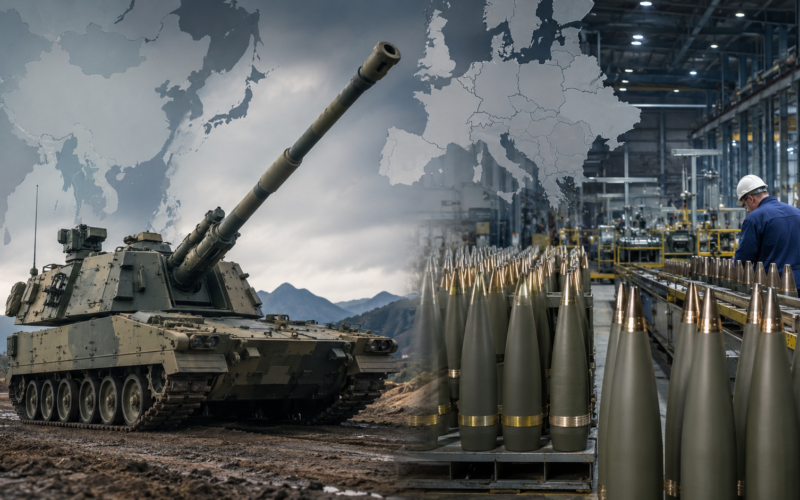
Hanwha Aerospace (KRX: 012450) has become the second-largest arms supplier to European NATO members behind the United States, with cumulative K9 self-propelled howitzer exports passing 14.34 trillion won and more than 1,560 units sold across at least ten countries. Rheinmetall AG (ETR: RHM) has lifted 155mm shell capacity from roughly 70,000 rounds in 2022 to a planned 1.1 million rounds in 2027, with a stretch target of 1.5 million by 2030 that would exceed the entire stated US Department of Defense national output goal. The contest framed publicly as “Europe versus Asia-Pacific” in artillery dominance is not a contest at all. It is a structural division of the value chain in which Korean platforms have captured the howitzer market while European industry has retaken the ammunition layer that sustains it, and the strategic, financial, and geopolitical consequences of that split are only beginning to be priced into the sector.
Why is South Korea outselling every European howitzer manufacturer combined in the NATO market?
Hanwha Aerospace’s K9 Thunder is now operational or under contract in six NATO member states, Turkiye, Poland, Finland, Estonia, Norway, and Romania, with Spain’s 280-unit Indra-Hanwha co-production agreement worth approximately 4.55 billion euros adding a seventh and pulling the platform decisively into Western Europe. Finland’s April 2026 follow-on order for 112 additional K9 units, valued at roughly 546.8 million euros, brought the Finnish fleet to 208 systems and made Helsinki the third NATO operator above 200 units alongside Warsaw and Ankara. South Korea’s industrial advantage is not technological superiority over Germany’s Panzerhaubitze 2000 or France’s CAESAR. It is throughput, unit economics, and delivery cadence. UPI’s analysis of industry estimates places one Panzerhaubitze 2000 at a cost equivalent to more than two K9 howitzers including ammunition and support, and Hanwha Aerospace has consistently delivered large batches within months rather than years, a capability European primes lost during three decades of post-Cold War demand suppression.
The competitive implication is that European armies needing artillery now are buying Korean, while European armies needing artillery in 2030 are buying European. The risk for Rheinmetall, KNDS, and BAE Systems is that K9 fleets generate two-decade sustainment, training, and ammunition compatibility ecosystems that lock in Korean platform dominance even as the European industrial base rebuilds. Romania has already agreed to host a Hanwha Armoured Vehicle Centre of Excellence to manufacture K9 and K10 ammunition resupply vehicles on European soil, replicating the localisation playbook that turned Poland’s PGZ partnership into a permanent Korean industrial bridgehead inside the European Union.
How has Rheinmetall captured the artillery ammunition market that Korea cannot supply?
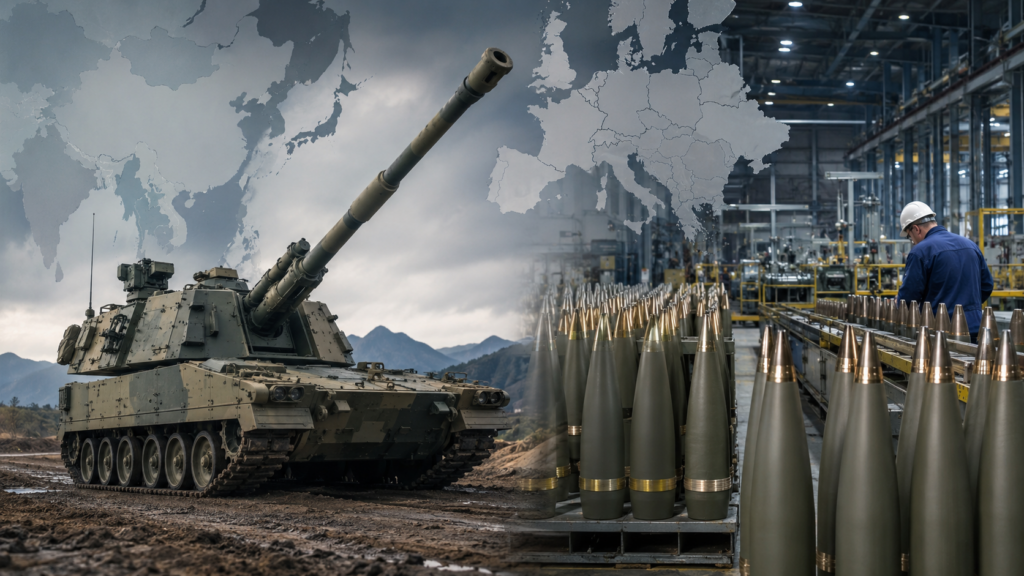
The shell economy is where Europe is winning, and the scale of the reversal is the single most underappreciated industrial development in the Western defence sector. Rheinmetall AG has secured more than 130 million euros from the European Union’s Act in Support of Ammunition Production scheme, more than a quarter of the 500 million euros disbursed in the first ASAP tranche, and is now operating or building new artillery and propellant plants in Germany, Spain, Hungary, Bulgaria, Lithuania, Latvia, Romania, and Ukraine. The Unterluess facility in Lower Saxony, inaugurated in September 2025, is targeting 350,000 shells per year on its own, against an originally announced 200,000. Rheinmetall’s Spanish subsidiary Expal is scaling to roughly 450,000 shells annually, positioning the Iberian operation as the single largest artillery ammunition site in Europe.
NATO Secretary General Mark Rutte stated at the Unterluess inauguration that European annual artillery ammunition capacity is now six times its 2023 level and on track to reach two million rounds in 2025, with Rheinmetall accounting for the largest share of that growth. When BAE Systems’ Glascoed expansion in Wales, targeting 500,000 shells per year, is added to Nammo AS output in Norway, French Forges de Tarbes capacity, and Ukrainian-localised Rheinmetall-Ukroboronprom production, combined European Union, United Kingdom, and Ukrainian output is projected at between 2.8 million and 3 million 155mm shells per year by end-2026. Russian wartime artillery output, supplemented by North Korean shipments estimated at four to six million rounds since 2023, is the only larger consolidated production base in the world.
The second-order consequence for the artillery market is that Europe has effectively become the indispensable ammunition supplier for the K9 howitzer fleets that South Korea has sold into NATO. Hanwha Aerospace does not manufacture 155mm ammunition at the scale required to sustain a regional ground war, and the propellant, RDX explosive, and projectile body production networks now being built across Germany, Hungary, Romania, and the Baltic states are calibrated to NATO Modular Artillery Charge System standards that work across European, Korean, and American howitzers alike. The Korean platform victory and the European ammunition victory are not competing outcomes. They are co-dependent components of a single Western artillery system.
Where does China fit into the Asia-Pacific artillery picture, and why has Beijing failed to export at Korean scale?
China’s artillery industrial base is substantial in domestic terms but globally marginal as an export force. China North Industries Group Corporation, known as Norinco, has fielded the PLZ-05 and PLZ-52 tracked self-propelled howitzers and the wheeled SH-15, the latter sold to Pakistan in batches sufficient to equip three artillery regiments. The PLZ-52 offers a stated maximum range of 50 kilometres with extended-range base-bleed rounds, comparable to current K9 and Rheinmetall platforms on paper, but Norinco’s export footprint outside Pakistan, Saudi Arabia, and a handful of African and Middle Eastern customers remains limited.
The structural reason is twofold. NATO interoperability requirements exclude Chinese 155mm systems from the largest spending bloc, and Beijing’s own export discipline has prioritised domestic People’s Liberation Army modernisation over commercial volume. Global Market Insights data place Hanwha Aerospace at over 12.5 percent of the global artillery systems market in 2025 and identify the company as the single market leader, with BAE Systems, Rheinmetall, Lockheed Martin Corporation, and General Dynamics Corporation rounding out a top five that collectively held 46.3 percent share. Norinco does not appear in the top five despite producing larger absolute volumes for the People’s Liberation Army. The competitive read is that China’s artillery industry serves a single buyer at scale and a handful of strategic clients, while Korea has built a genuine global platform business and Europe has built a genuine global ammunition business.
What do official European Union and member-state filings actually disclose about the artillery production build-out?
The European Commission’s Act in Support of Ammunition Production, formally adopted as Regulation EU 2023/1525, allocated 500 million euros in its first funding tranche specifically to scale 155mm artillery ammunition, propellant, and explosive precursor production across the bloc. European Commission disclosures confirm Rheinmetall AG’s European subsidiaries received the largest single share at over 130 million euros across six projects spanning Germany, Hungary, Romania, and Spain. The successor instrument, the European Defence Industry Reinforcement through common Procurement Act and the broader Security Action for Europe loan facility worth up to 150 billion euros, has extended the financing architecture into 2030, with Romania publicly confirming that the Victoria propellant plant investment of 535 million euros is being routed through the EU-SAFE mechanism.
National defence ministries have corroborated the scale independently of corporate disclosure. The Finnish Ministry of Defence confirmed the April 2026 K9 contract value at 546.8 million euros with deliveries from 2028 onward. The Spanish Ministry of Defence published the 4.55 billion euro budget allocation for the tracked self-propelled artillery programme that Indra and Hanwha Aerospace will jointly execute. The German Bundestag has authorised multi-year ammunition framework contracts with Rheinmetall AG valued at approximately 10.1 billion euros under the special defence fund established in 2022. The convergence of corporate guidance, NATO operational statements, and member-state budget disclosures around the same production trajectory removes much of the uncertainty that typically attaches to single-source defence sector forecasting.
What is the financial scale of the global artillery market and where is the capital actually flowing?
Global Market Insights values the global artillery systems market at 22.4 billion US dollars in 2026, rising to 36.2 billion US dollars by 2035 at a compound annual growth rate of 5.5 percent. Artillery ammunition adds a separate parallel market, with Mordor Intelligence sizing it at 5.70 billion US dollars in 2026 and Fortune Business Insights placing the broader ammunition category at 9.35 billion US dollars in 2026, growing to 14.76 billion US dollars by 2034 at a CAGR of 5.88 percent. North America remained the largest single regional consumer market in 2025, but Asia-Pacific is now the fastest growing region in every segment of the artillery value chain, driven by Chinese, Indian, South Korean, Japanese, and Australian procurement programmes.
The capital flow pattern reveals where institutional investors should be looking. Rheinmetall AG sales rose 36 percent in 2024 to 9.75 billion euros, with operating profit up 61 percent and a 55 billion euro order backlog. The company’s chief executive Armin Papperger has guided to approximately 40 percent revenue growth in 2026 with turnover of 14 to 15 billion euros, and has publicly stated he does not expect the order surge to slow before 2034 to 2040. Hanwha Aerospace’s cumulative K9 export book has crossed 14.34 trillion won and the company is now pursuing Spain’s tracked artillery contract, the US Army’s Extended Range Cannon Artillery replacement programme through an Alabama production proposal, and Nordic expansion in Sweden and Denmark. The forward visibility on both sides of the Atlantic-Pacific axis is the longest the Western defence sector has seen since the early 1980s.
What does the artillery production race signal about NATO’s strategic posture for the next decade?
The institutional read from publicly accessible sources is that NATO has decisively abandoned the post-Cold War assumption that the United States would serve as the industrial backstop for allied ammunition supply. Conflict Capital analysis cited in European reporting indicates that under the current US administration, contributions of new contracted artillery shells to Ukraine have effectively halted, and US production cost inflation driven by tariffs on steel, copper, aluminium, and intermediate materials is likely to keep American shell output stagnant or declining. Europe, by contrast, is building production redundancy across at least eight countries with sovereign EU funding through the Act in Support of Ammunition Production and the European Union Support for Ammunition Production financing mechanism.
The medium-term geopolitical signal is that Western artillery sustainment is now structurally European, while Western artillery platform supply has become structurally Korean for any customer that cannot wait the four to seven years a European howitzer programme requires. The risk for European primes is that the Korean foothold becomes permanent through localisation deals in Romania, Poland, and prospectively Spain. The risk for Korean primes is that European ammunition production capacity becomes leverage in future platform negotiations, with the European Union potentially conditioning ammunition supply on European content in artillery system contracts. Neither outcome is priced into current equity valuations of Hanwha Aerospace, Rheinmetall AG, BAE Systems plc, or KNDS.
Key takeaways: What the global artillery market battle actually looks like in 2026
- Hanwha Aerospace controls the global self-propelled howitzer platform market with over 12.5 percent share in 2025 and is the single market leader, with cumulative K9 exports above 14.34 trillion won and more than 1,560 units sold to at least ten countries
- Rheinmetall AG has scaled 155mm artillery shell capacity from approximately 70,000 rounds in 2022 to a planned 1.1 million in 2027 and a stretch 1.5 million by 2030, exceeding the entire stated US Department of Defense annual production target
- Six NATO member states, Turkiye, Poland, Finland, Estonia, Norway, and Romania, operate the K9 Thunder, and Spain’s 4.55 billion euro Indra-Hanwha co-production deal will add a seventh major Western European customer
- Europe’s combined artillery ammunition production, including the United Kingdom, France, Germany, Spain, Hungary, Bulgaria, the Baltic states, and Ukrainian co-production, is projected at 2.8 to 3 million 155mm shells annually by end-2026
- The Korean platform victory and the European ammunition victory are co-dependent rather than competing, with NATO-standard 155mm rounds from Rheinmetall, BAE Systems, and Nammo AS sustaining Hanwha Aerospace’s K9 fleets across the continent
- China’s Norinco produces large absolute artillery volumes for the People’s Liberation Army but has failed to break into NATO markets due to interoperability barriers and limited export commercial focus, leaving Pakistan, Saudi Arabia, and select Middle Eastern customers as its primary external clients
- India is running a parallel artillery modernisation through K9 Vajra-T localised production with Larsen and Toubro, the Defence Research and Development Organisation Advanced Towed Artillery Gun System, and the Dhanush programme, positioning the Indian Army as a hybrid Korean-indigenous artillery force
- Global artillery systems market is valued at 22.4 billion US dollars in 2026 and forecast to reach 36.2 billion US dollars by 2035 at a 5.5 percent CAGR, with the separate artillery ammunition market adding 9.35 billion US dollars in 2026
- Rheinmetall AG order backlog stood at 55 billion euros at end-2024 with management guiding to 40 percent revenue growth in 2026 and sustained demand through 2034 to 2040, the longest forward visibility in the Western defence sector since the early 1980s
- The strategic divide that European industry should watch is whether the European Union conditions future ammunition supply on European content in artillery platform contracts, which would shift leverage back toward Rheinmetall, KNDS, and BAE Systems against Korean primes
Discover more from Business-News-Today.com
Subscribe to get the latest posts sent to your email.