KIOXIA Holdings Corporation (TYO: 285A) has launched its EG7 Series client solid-state drives, a new QLC-based lineup aimed at PC OEMs building slim laptops, mainstream notebooks, and desktop systems. The move matters because it pushes KIOXIA’s eighth-generation BiCS FLASH technology into the value end of the client market without openly conceding on performance, a balance that has long determined whether cheaper NAND can win broad OEM adoption. The announcement also arrives at a moment when KIOXIA’s stock has been on a sharp run since its 2024 listing, suggesting investors are already treating the company as more than just another commodity memory name. In practical terms, EG7 is not just a new SSD family, it is a statement about where KIOXIA thinks the next volume fight in PC storage will be won.
Why is KIOXIA Holdings Corporation pushing QLC SSDs into the PC OEM market right now?
The timing says quite a bit. PC makers are still under pressure to deliver more capable systems at lower price points, especially in commercial notebooks and thin consumer laptops where storage speed is expected but bill-of-materials discipline remains unforgiving. KIOXIA is trying to exploit that pressure by pitching QLC not as a compromise tier, but as a practical answer to mainstream workload demands.
That matters because QLC has often carried a reputation problem. It is cheaper and denser than TLC, but buyers and integrators have historically worried about endurance, sustained write behavior, and whether the lower cost eventually shows up as a worse real-world user experience. KIOXIA’s message with EG7 is essentially that, for common client workloads, those objections no longer need to be deal-breakers. When a supplier says a QLC drive can deliver TLC-like performance in everyday PC use, the real target is not enthusiasts. It is procurement teams.
There is also a broader strategic angle. NAND manufacturers do not simply need better technology, they need better segmentation. By moving QLC more decisively into client systems, KIOXIA can preserve higher-value positioning elsewhere while still competing aggressively for unit volume in the mass-market PC segment. In memory, density is only half the story. The other half is where you can monetize it without crushing margins.
How important are the EG7 Series specifications for commercial and consumer notebook makers in 2026?
The headline specifications are strong enough to make the product commercially relevant. KIOXIA says the drives can deliver up to 7,000 MB/s sequential reads, up to 6,200 MB/s sequential writes, and random read and write performance of up to 1,000 KIOPS. On paper, that places the EG7 well within the range that OEMs can market as premium-feeling storage, even if the product is intended for value-oriented systems.
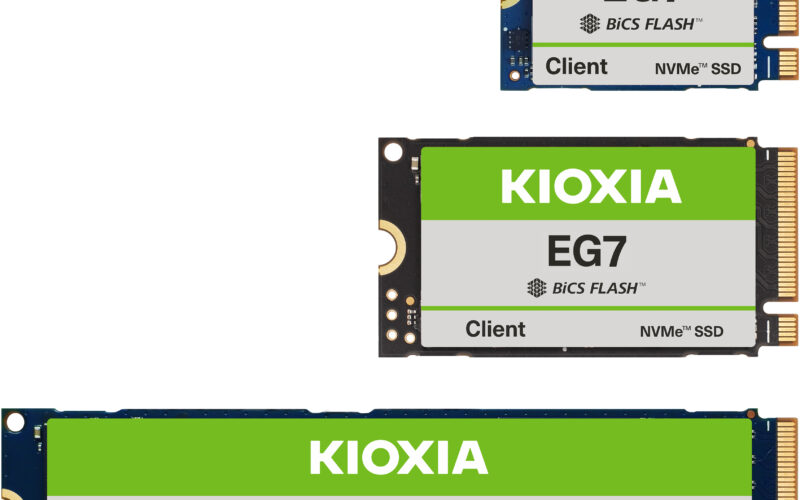
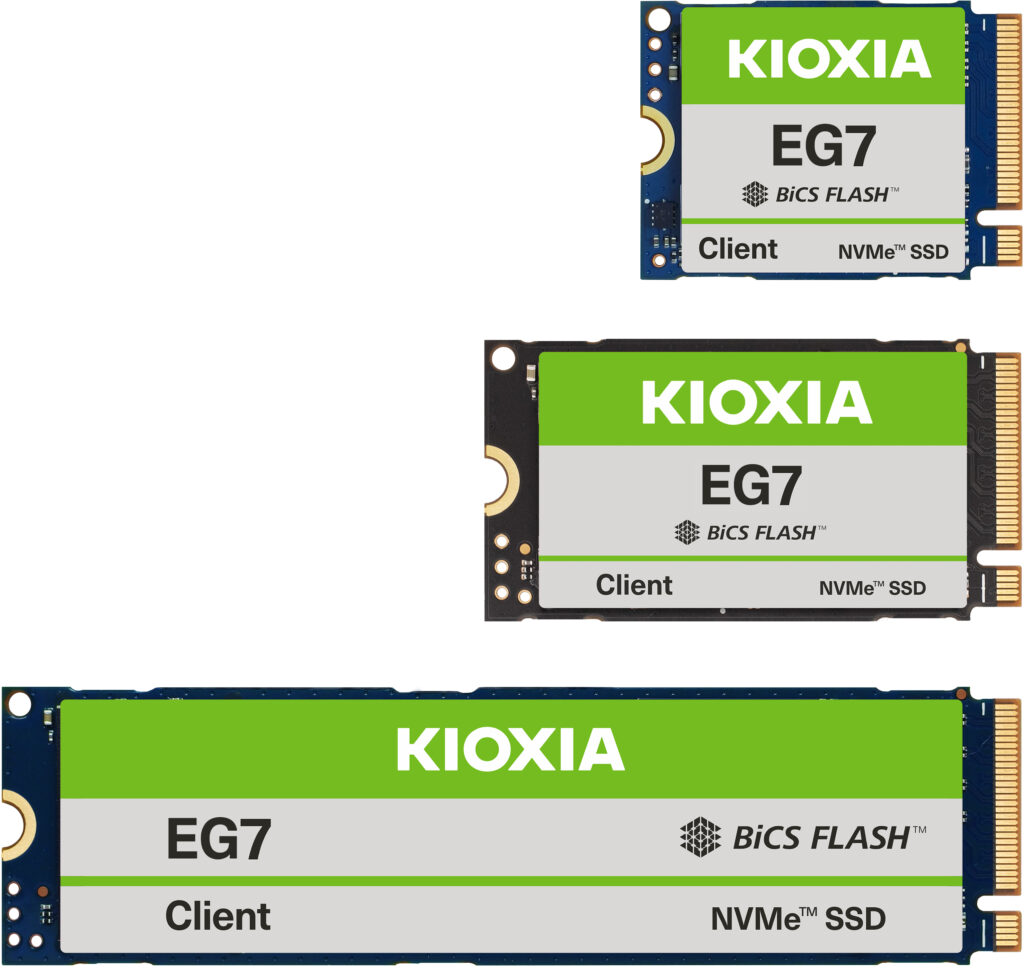
The form factor flexibility is arguably just as important as the top-line speed claims. By offering M.2 2230, 2242, and 2280 formats, KIOXIA is positioning the EG7 for a broad range of chassis designs, from compact ultrathin machines to more conventional notebooks and desktops. That helps the company sell a platform idea, not just a part number. OEMs prefer suppliers that can support multiple design tiers with fewer architecture changes.
The decision to go DRAM-less while relying on Host Memory Buffer technology is another commercial tell. It helps reduce component cost and power draw, which fits the budget-conscious notebook market, but it also means KIOXIA is leaning on a now-mature design approach that OEMs already understand. This is not a moonshot architecture. It is a deliberately manufacturable one. Storage launches rarely come with fireworks, but procurement managers tend to appreciate boring competence.
What does the KIOXIA EG7 launch signal about the future of QLC NAND in mainstream PCs?
The bigger signal is that QLC is moving from niche acceptance to strategic normalisation in the client segment. If KIOXIA can convince OEMs that mainstream computing workloads do not require paying the TLC premium, the market could shift faster than brand-conscious consumers realise. Notebook buyers rarely ask what kind of NAND sits under the hood. They notice price, responsiveness, battery life, and boot speed. That creates room for a supplier to change the economics quietly.
This is where KIOXIA’s use of generation 8 BiCS FLASH matters. The company is not merely saying QLC is cheaper. It is arguing that newer process and architecture improvements have made the old trade-offs less painful for mainstream systems. In effect, KIOXIA wants OEMs to think of QLC not as the budget alternative, but as the right-fit architecture for volume PCs.
If that argument sticks, competitors will not have much choice but to follow aggressively. Samsung Electronics, Micron Technology, SK hynix and Solidigm, and Western Digital all operate in a market where price-performance positioning can shift quickly once OEM qualification starts to favor one memory mix over another. Storage, after all, is not a place where branding alone rescues a weak cost curve.
Could KIOXIA Holdings Corporation gain a stronger competitive edge against Samsung, Micron, and Western Digital?
Potentially yes, but the edge would come from execution, not from the launch itself. The SSD market is crowded with technically credible vendors, and any claim that a new client drive offers value without sacrifice will be tested quickly by OEM design teams. KIOXIA’s challenge is to turn the EG7 from a sampling announcement into repeat design wins across multiple PC cycles.
The company does have a credible narrative. KIOXIA sits at the intersection of NAND supply, controller optimisation, and OEM relationships, which gives it room to compete on both technology and economics. That matters more in client SSDs than flashy consumer branding does. The customer deciding whether EG7 succeeds is more likely to be an OEM platform planner than a gamer on a forum.
Still, there are risks. If write endurance concerns resurface in independent testing, or if competing TLC drives narrow the price gap more than expected, the pitch becomes less compelling. Likewise, if broader PC demand softens or OEMs stay conservative with platform changes, qualification cycles could stretch. In semiconductors, “sampling now, shipping in the second quarter” is a decent milestone, but it is not the same thing as proving attach-rate momentum at scale.
Why does this KIOXIA product launch matter for investors watching TYO: 285A after its surge?
For investors, the launch matters less as a revenue event on day one and more as evidence of product-market discipline. KIOXIA’s shares have had a dramatic rise since the company’s December 2024 listing, and the stock was added to the Nikkei index effective April 2026, reinforcing the sense that the market is repricing the company as a strategically relevant memory player rather than a post-IPO leftover story. Around April 21, the stock sat well above its IPO level, even after a recent pullback from its 52-week high.
That backdrop makes product announcements more important than they might look at first glance. Investors want proof that KIOXIA can do more than benefit from cyclical memory pricing. They want to see that it can shape demand, defend relevance across segments, and move technology down the cost curve in ways that expand addressable volume. EG7 fits that narrative better than a routine spec refresh would.
The caution is obvious. A hot stock can make even sensible launches look more transformative than they are. EG7 does not instantly rewrite the PC storage market, and client SSDs remain exposed to pricing pressure and OEM bargaining power. But when a newly public memory company pairs a strong share run with a product aimed squarely at mainstream adoption economics, investors are right to pay attention. The market seems to be betting that KIOXIA is learning how to tell a better growth story than “NAND prices went up again.” Convenient, if true.
What happens next if KIOXIA’s EG7 sampling converts into broad OEM adoption this year?
The immediate next test is whether sampling converts into shipping platforms in the second quarter of 2026 as planned. If it does, KIOXIA could begin strengthening its position in value-oriented client devices just as OEMs look for ways to preserve margins in a competitive PC cycle. Success would also validate the idea that QLC can handle more of the mainstream notebook market than many buyers once assumed.
A wider implication is that the launch could put fresh pressure on pricing architecture across the client SSD segment. Once one major supplier demonstrates that high-density, lower-cost flash can be sold without visibly degrading everyday experience, rival vendors are forced to respond. That can accelerate commoditisation, but it can also reward the manufacturers with the best vertical integration and supply efficiency. KIOXIA clearly wants to be seen in that group.
Failure would be instructive too. If OEM uptake stays narrow, the message would be that the market still prefers TLC for a broader slice of notebooks than vendors hoped, especially in systems where durability perception matters more than a small cost saving. In that case, EG7 would still fill a portfolio gap, but it would not become the market-shaping bridge product KIOXIA seems to want. Either way, the launch gives a useful read on where the next pricing and technology battle in client storage is heading.
What are the key takeaways on what KIOXIA’s EG7 launch means for the company, rivals, and the PC SSD market?
- KIOXIA is using EG7 to push QLC further into the mainstream PC market, not just into niche low-cost devices.
- The real pitch is economic efficiency with acceptable user experience, which is exactly what OEM procurement teams want.
- Strong headline performance helps KIOXIA reposition QLC as a practical client-storage choice rather than a second-tier option.
- Multiple M.2 form factors improve design flexibility and raise the odds of wider OEM qualification.
- The DRAM-less plus Host Memory Buffer approach shows KIOXIA is optimizing for scalable notebook economics, not enthusiast branding.
- If EG7 wins meaningful design slots, competitors may need to respond with more aggressive value positioning in client SSDs.
- The announcement supports the idea that KIOXIA wants to be seen as a strategic product company, not only a memory cycle beneficiary.
- For investors, the launch adds product-level evidence to a stock story already supported by strong post-listing momentum.
- The main risk is execution, especially whether sampling turns into durable OEM volume without endurance or pricing concerns resurfacing.
- The broader market implication is clear: mainstream PC storage is increasingly becoming a contest over who can make cheaper flash feel premium enough.
Discover more from Business-News-Today.com
Subscribe to get the latest posts sent to your email.