

Keysight Technologies Inc. (NYSE: KEYS) has introduced the AresONE 1600GE, a testing and emulation platform designed to validate next-generation AI data center fabrics operating at 1.6 terabit Ethernet speeds. The system is intended for network equipment manufacturers, semiconductor designers, hyperscalers, and AI data center operators who must verify that new high-speed networking hardware can support increasingly demanding artificial intelligence workloads. The platform combines physical layer validation, traffic testing, and realistic AI workload emulation in a single system to help engineers test infrastructure before deployment and optimize performance once it is operational. The launch reflects the accelerating transition toward faster networking architectures as AI training clusters grow larger and more complex.
The new platform arrives at a moment when AI computing demand is reshaping the design of data center networks. Modern AI models require massive clusters of graphics processing units and specialized accelerators that must exchange data continuously during training and inference operations. The speed and efficiency of those connections increasingly determine whether a data center can scale economically. As a result, networking technology is moving rapidly from 400-gigabit and 800-gigabit Ethernet toward 1.6-terabit systems capable of supporting significantly higher throughput and port density.
Keysight Technologies explained that the AresONE 1600GE platform is designed to emulate real-world AI workloads so engineers can evaluate network behavior before hardware enters production environments. The system integrates with the company’s AI Data Center Builder software, which reproduces communication patterns commonly used in distributed AI training such as collective operations across multiple nodes. By simulating these workloads, developers can identify congestion issues, validate performance isolation between workloads, and analyze how networking conditions affect job completion times.
The ability to simulate realistic AI workloads is becoming increasingly important because conventional network testing approaches often fail to reproduce the complex traffic patterns generated by large-scale machine learning clusters. AI training workloads involve synchronized communication across thousands of processors, producing bursts of data traffic that can expose weaknesses in switching fabrics or congestion control mechanisms. Platforms capable of reproducing these patterns allow network engineers to test systems under conditions that closely resemble production AI deployments.
Why are AI data centers shifting toward 1.6T Ethernet networking architectures?
The transition toward 1.6-terabit Ethernet represents one of the most significant changes in data center networking in more than a decade. AI workloads are growing at a pace that is outstripping the capabilities of existing networking architectures. Each new generation of graphics processing units and AI accelerators generates more data during training cycles, increasing the pressure on network infrastructure to move information quickly and reliably between nodes.
Industry analysts have indicated that the shift toward 1.6T networking could become one of the fastest technology upgrade cycles in the history of data center infrastructure. The demand for higher bandwidth is being driven not only by AI training models but also by inference workloads and emerging agent-based systems that require rapid coordination across distributed computing environments. These workloads require networks capable of scaling both in speed and in the number of ports supported by each switch.
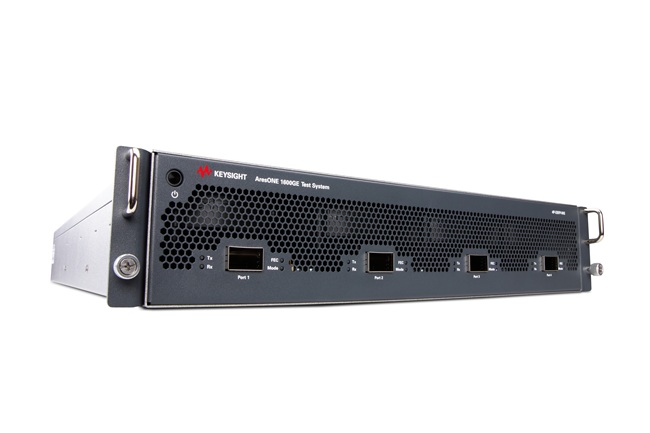
Keysight Technologies noted that the new testing platform supports four OSFP 1600 ports that can be configured in multiple ways, including 1600-gigabit, 800-gigabit, 400-gigabit, or 200-gigabit configurations. This flexibility allows engineers to test multiple networking scenarios within the same system. The architecture uses 224-gigabit electrical lanes, a critical technology that underpins the next generation of Ethernet standards.
The platform also supports link validation across optical and electrical interfaces and can test forward error correction behavior and physical coding mechanisms. These features allow engineers to examine the full networking stack, from signal integrity at the hardware layer through higher-level network protocols and application-level performance.
How AI workload emulation could reduce risk in hyperscale infrastructure deployments
Testing AI networking infrastructure before deployment has become a major challenge for hyperscalers and semiconductor companies. Deploying new networking architectures without comprehensive validation can expose operators to operational risk, including network congestion, reduced training efficiency, and unpredictable performance during peak workloads.
Keysight Technologies believes that integrating AI workload emulation into the testing process can help address these risks. The AresONE 1600GE platform allows developers to emulate GPU clusters and run networking tests that replicate large-scale AI compute environments. By simulating thousands of nodes communicating simultaneously, engineers can evaluate how networking equipment performs under realistic conditions.
The system also provides detailed data analytics that enable engineers to identify performance bottlenecks and optimize network configurations before production deployment. This capability may reduce the cost of infrastructure rollouts by allowing companies to detect and resolve issues earlier in the development cycle.
For hyperscale operators building massive AI data centers, the ability to validate networking infrastructure in advance could have significant financial implications. AI clusters often represent multi-billion-dollar investments in hardware and facilities. Ensuring that networking infrastructure performs reliably at scale is essential for maximizing utilization of expensive compute resources.
What the AI networking boom could mean for the broader data center ecosystem
The introduction of advanced testing platforms such as AresONE 1600GE also reflects a broader shift occurring across the data center ecosystem. AI is driving unprecedented investment in networking infrastructure, optical interconnects, and silicon technologies capable of supporting higher bandwidth.
Industry analysts expect the global market for AI networking infrastructure to grow dramatically over the next several years. The rise of large-scale AI training clusters and distributed inference systems is increasing demand for high-capacity switches, high-speed optical modules, and networking architectures capable of scaling across thousands of compute nodes.
Keysight Technologies positions itself within this ecosystem as a provider of validation and testing tools that help companies bring new networking technologies to market more quickly. By enabling earlier testing of emerging Ethernet standards and AI workloads, the company aims to accelerate product development cycles for network equipment manufacturers and semiconductor designers.
The company has indicated that it will demonstrate the new platform at the Optical Fiber Communication Conference in Los Angeles, where vendors across the optical networking and data center industries are expected to showcase new technologies supporting higher-speed Ethernet infrastructure.
What investors may watch as Keysight Technologies expands its AI infrastructure strategy
Keysight Technologies has historically focused on test and measurement equipment used across telecommunications, aerospace, semiconductor design, and industrial electronics. However, the rapid expansion of AI infrastructure has created a new opportunity for the company to position its testing technologies within one of the fastest-growing segments of the technology sector.
Demand for AI data center infrastructure continues to rise as cloud providers, research organizations, and enterprise customers expand their use of machine learning systems. Networking technology is becoming a central component of this expansion because it determines how efficiently compute clusters can scale.
If the shift toward 1.6T Ethernet networking accelerates as expected, testing and validation tools could become increasingly critical for companies developing next-generation networking hardware. Platforms capable of emulating real AI workloads may play an important role in reducing development risk and improving product readiness before large-scale deployments.
For investors, the broader question is whether the AI infrastructure cycle will produce sustained demand for testing technologies over the next decade. If the networking upgrade cycle continues to accelerate alongside AI model growth, companies positioned at the intersection of AI computing and network validation may benefit from a prolonged wave of infrastructure investment.
Key takeaways: What the AresONE 1600GE launch signals for AI networking and data center infrastructure
- Keysight Technologies introduced AresONE 1600GE to validate next-generation AI networking infrastructure operating at 1.6-terabit Ethernet speeds.
- The platform combines AI workload emulation, physical layer validation, and traffic testing in a single system.
- Demand for AI infrastructure is driving the transition from 800G networking to faster 1.6T Ethernet architectures.
- AI training clusters require high-speed communication across thousands of processors, increasing pressure on data center networks.
- Realistic workload simulation can help identify congestion issues and optimize network performance before deployment.
- Hyperscalers and semiconductor designers may use such platforms to test AI networking equipment under real-world conditions.
- The broader AI networking market could approach hundreds of billions of dollars as infrastructure investment accelerates.
- Testing and validation technologies may become increasingly critical as data center networks grow more complex.
- Keysight Technologies is positioning itself within the AI infrastructure ecosystem by focusing on networking validation tools.
Discover more from Business-News-Today.com
Subscribe to get the latest posts sent to your email.