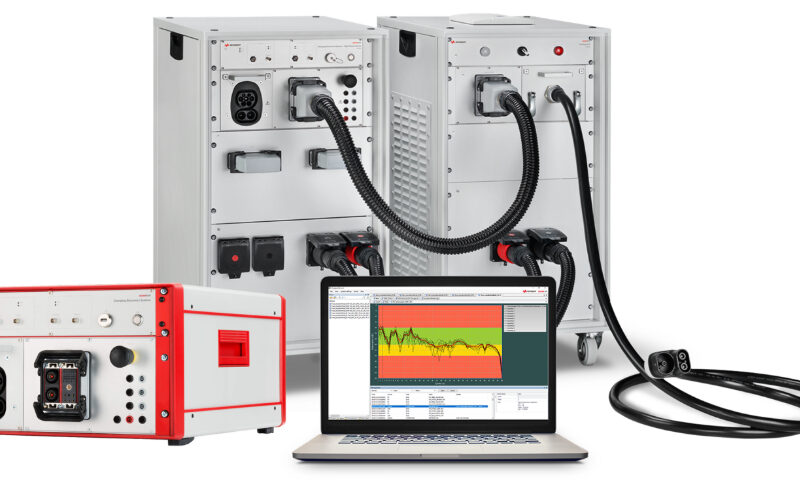
Keysight Technologies Inc. (NYSE: KEYS) has expanded its strategic collaboration with the China Automotive Technology and Research Center New Energy Vehicle Inspection Center (CATARC) by establishing a Joint Innovation Laboratory focused on charging test technologies, a move that directly targets one of the most complex bottlenecks in the global electric vehicle ecosystem. The partnership deepens technical cooperation around validation, compliance, and interoperability as automakers face increasingly fragmented charging standards across regions. This development is strategically relevant because charging compatibility is emerging as a critical constraint on EV adoption, especially as power levels increase and cross-border vehicle deployment accelerates. By aligning with one of China’s most influential automotive testing authorities, Keysight Technologies is positioning itself at the center of both domestic Chinese standards evolution and global compliance frameworks.
At a surface level, this looks like another industry collaboration. At a deeper level, it reflects a shift in where value is being created in the EV supply chain. Battery chemistry and vehicle design still matter, but the ability to ensure vehicles can reliably charge across different infrastructure environments is becoming equally critical.
Why EV charging interoperability and compliance are becoming the next global bottleneck for automakers
The global EV market is no longer constrained primarily by consumer demand or vehicle availability. Instead, the friction is moving downstream into infrastructure compatibility and regulatory alignment. Automakers now face a fragmented ecosystem where China’s national standards, Europe’s Combined Charging System, and North American frameworks are evolving in parallel but not always converging.
This creates three layers of complexity. First, higher power charging introduces new safety risks and thermal management challenges, which require more rigorous validation. Second, interoperability failures can directly impact user experience, making reliability a commercial differentiator. Third, regulatory compliance across jurisdictions adds cost and delays product launches.
The collaboration between Keysight Technologies and the China Automotive Technology and Research Center effectively targets all three issues. By focusing on conformance testing and validation, the partnership addresses not just technical performance but also certification pathways. That matters because certification is increasingly becoming a gatekeeper for market entry.
There is also a timing element. As China prepares to implement updated national standards, often referred to as the next generation of domestic charging protocols, global manufacturers will need to align their platforms quickly. Missing that window could delay entry into the world’s largest EV market.

How Keysight Technologies is positioning itself as infrastructure enabler rather than just a test equipment provider
Keysight Technologies has historically operated in measurement and validation solutions across multiple industries. In the EV space, however, its role is evolving into something closer to infrastructure enabler. Testing is no longer a back-end function. It is becoming embedded in the design, certification, and deployment lifecycle.
The joint laboratory with the China Automotive Technology and Research Center reinforces this transition. By co-developing testing frameworks and participating in standards development, Keysight Technologies is moving upstream into influencing how those standards are defined in the first place.
This is strategically significant because standards often determine long-term market structure. Companies that shape standards tend to benefit from ecosystem lock-in and recurring demand for compliance solutions. In effect, Keysight Technologies is positioning itself not just as a vendor, but as a participant in the rule-making process.
There is also a geographic dimension. China’s automotive regulatory environment has increasing influence globally, especially as Chinese EV manufacturers expand into Europe and other markets. Aligning closely with a domestic authority like the China Automotive Technology and Research Center gives Keysight Technologies visibility into how these standards may evolve and how they could influence international frameworks.
What the joint innovation laboratory reveals about China’s role in shaping global EV charging standards
China is no longer just the largest EV market. It is increasingly a standards-setting force. The establishment of a joint laboratory between Keysight Technologies and the China Automotive Technology and Research Center highlights how technical validation is becoming a strategic lever in that influence.
The China Automotive Technology and Research Center plays a central role in testing, certification, and regulatory alignment within China’s automotive ecosystem. By integrating Keysight Technologies’ global expertise with domestic regulatory insight, the partnership effectively creates a bridge between Chinese standards and international compliance requirements.
This has two implications. First, it could accelerate the harmonization of testing methodologies across regions, even if the standards themselves remain different. Second, it positions China as a key node in the global EV validation ecosystem, not just a manufacturing hub.
For automakers, this creates both opportunity and risk. Access to a unified testing framework can reduce development timelines and costs. However, dependence on specific testing ecosystems could also introduce strategic exposure, particularly if standards diverge further rather than converge.
Why charging test technology is becoming a competitive advantage in EV platform development cycles
In traditional automotive development, testing was largely about validation after design. In the EV era, testing is becoming iterative and integrated. Charging systems interact with battery management, software, thermal systems, and grid interfaces. That complexity requires continuous validation across multiple scenarios.
Keysight Technologies’ vehicle-to-charger conformance testing solutions, now adopted by the China Automotive Technology and Research Center, are designed to simulate these interactions in controlled environments. This allows manufacturers to identify compatibility issues early in the development cycle.
The competitive implication is straightforward. Companies that can validate faster can launch faster. Companies that can ensure interoperability can expand globally with fewer modifications. Companies that can meet multiple regulatory standards simultaneously can optimize platform economics.
There is also a second-order effect. As testing becomes more sophisticated, it creates a barrier to entry for smaller players who may not have access to advanced validation infrastructure. This could reinforce consolidation in the EV market, where scale and technical capability become prerequisites.
What this collaboration means for global EV supply chains and cross-border vehicle deployment
The partnership between Keysight Technologies and the China Automotive Technology and Research Center is not just about testing. It is about enabling cross-border deployment of EV platforms. As manufacturers aim to sell the same vehicle across multiple regions, they need assurance that charging systems will function reliably in each market.
This requires alignment across hardware interfaces, communication protocols, and safety standards. The joint laboratory is positioned to address these requirements by developing testing frameworks that account for regional differences while maintaining a degree of interoperability.
From a supply chain perspective, this could reduce fragmentation. Suppliers that align with validated standards can integrate more easily into global platforms. However, it could also create dependencies on specific testing ecosystems, which may influence supplier selection.
There is also a geopolitical layer. As EV adoption becomes a strategic priority for governments, standards and compliance frameworks can become tools of industrial policy. Partnerships like this one sit at the intersection of technology, regulation, and geopolitics.
How the broader EV ecosystem is evolving from hardware competition to systems-level integration
The expansion of this collaboration underscores a broader shift in the EV industry. Competition is moving from individual components, such as batteries or motors, to systems-level integration. Charging infrastructure is a critical part of that system.
Testing and validation sit at the center of this integration. Without reliable validation, systems cannot scale. Without interoperability, ecosystems remain fragmented. Without compliance, market access is restricted.
Keysight Technologies’ strategy reflects this reality. By focusing on charging test technologies, it is targeting a layer of the value chain that connects vehicles, infrastructure, and regulation. The partnership with the China Automotive Technology and Research Center amplifies this positioning by embedding it within one of the most influential EV markets.
For the industry, this signals that the next phase of competition will be defined less by who builds the best car and more by who builds the most reliable and scalable ecosystem.
Key takeaways on what this Keysight Technologies and CATARC collaboration means for EV markets and charging infrastructure
- Keysight Technologies is shifting from equipment provider to ecosystem enabler by embedding itself in EV charging standards development
- Charging interoperability is emerging as a critical bottleneck, potentially more limiting than battery innovation in the near term
- The partnership strengthens China’s influence over global EV testing and compliance frameworks
- Automakers will face increasing pressure to meet multiple regional charging standards simultaneously
- Advanced testing infrastructure is becoming a competitive advantage that can accelerate product launches
- The collaboration may help reduce development risk and shorten certification timelines for global EV platforms
- Suppliers aligned with validated testing frameworks could gain preferential access to international EV supply chains
- Fragmentation of standards remains a risk, even as testing methodologies become more aligned
- The move reflects a broader industry shift toward systems-level competition rather than component-level differentiation
- Long term, control over testing and validation ecosystems could translate into strategic influence over EV market structure
Discover more from Business-News-Today.com
Subscribe to get the latest posts sent to your email.