




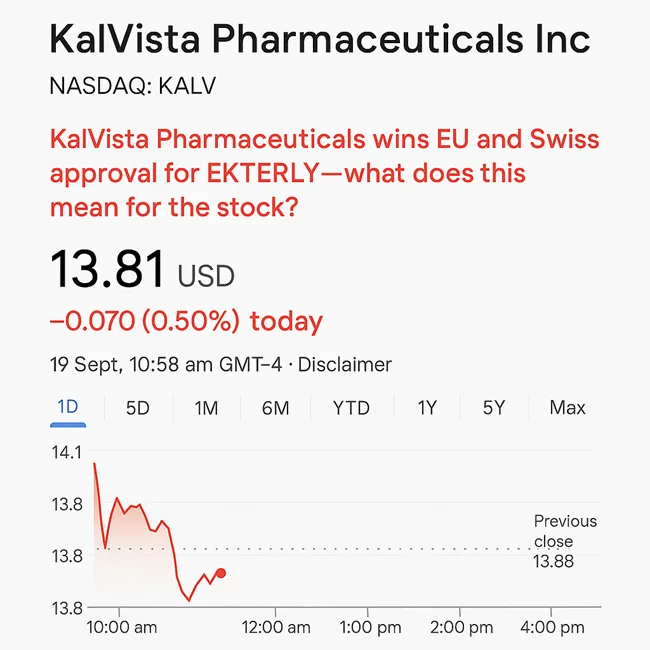
KalVista Pharmaceuticals, Inc. (NASDAQ: KALV) entered September 19, 2025, with a double-edged narrative: on one hand, a groundbreaking regulatory win in Europe and Switzerland for its flagship drug EKTERLY (sebetralstat), and on the other, a stock market reaction that was cautious rather than euphoric. Shares traded at $13.81, down 0.50% intraday, after closing the previous session at $13.88. The slight pullback highlights the measured approach investors are taking toward biotech companies even when transformative news emerges.
The company’s announcement confirmed that both the European Commission and Swissmedic had approved EKTERLY, making it the first and only oral on-demand treatment for hereditary angioedema (HAE). The achievement not only strengthens KalVista’s scientific credibility but also positions it to compete with entrenched players in the rare disease treatment space. Yet the muted trading response underscores the challenges that lie ahead in converting approvals into commercial success.
Why did KalVista Pharmaceuticals secure regulatory wins in Europe and Switzerland now?
The timing of these approvals was largely driven by the strength of clinical data from the KONFIDENT Phase 3 trial, the largest ever conducted in hereditary angioedema. Published in the New England Journal of Medicine in 2024, the trial enrolled 136 patients across 20 countries and demonstrated that EKTERLY achieved rapid and reliable symptom relief with a safety profile comparable to placebo. The study reinforced EKTERLY’s potential to change the treatment paradigm by moving beyond injectables and giving patients an oral option to address attacks early and discreetly.
For European regulators, the approval reflects the need to expand treatment options in a disease space where therapy innovation has historically lagged. Until now, most approved drugs required subcutaneous injections, which often created barriers to adherence. The regulatory nods in the European Union and Switzerland thus reflect a recognition that oral therapy can significantly improve both outcomes and quality of life for patients.
How important is EKTERLY for hereditary angioedema patients in Europe?
Hereditary angioedema is a rare but severe genetic condition marked by unpredictable episodes of swelling in the skin, airways, and gastrointestinal tract. Depending on the location of the swelling, the condition can range from disabling to life-threatening. Standard-of-care guidelines recommend early treatment of attacks to prevent escalation, but the injectable route has historically delayed intervention for many patients who hesitate to self-administer.
EKTERLY changes that calculus. As an oral kallikrein inhibitor, it allows patients to treat an attack the moment symptoms appear without needing injection equipment or clinical supervision. Patient advocacy groups have emphasized how this innovation could normalize disease management, reduce stigma, and empower adolescents as well as adults. The European approval therefore carries not just medical significance but also psychological and social impact for the HAE community, which has long advocated for less invasive options.
How will KalVista Pharmaceuticals roll out EKTERLY across Europe and Switzerland after approval?
KalVista Pharmaceuticals has outlined a phased launch strategy, beginning with Germany in the fourth quarter of 2025. Germany, with its relatively faster reimbursement frameworks and large rare disease patient base, is often chosen as the first EU launchpad by biotech firms. Following this entry point, the company plans to expand across other EU member states, navigating country-by-country reimbursement assessments.
In Switzerland, EKTERLY is expected to become available in the second half of 2026, subject to finalization of pricing and reimbursement agreements. KalVista is engaging with health technology assessment bodies and payers to accelerate access. Importantly, the European Medicines Agency has confirmed that EKTERLY retains orphan drug designation in the EU, ensuring 10 years of market exclusivity. That exclusivity not only protects KalVista from immediate competition but also strengthens its negotiating position with insurers and national health services.
Why did KalVista Pharmaceuticals’ stock dip despite winning European and Swiss approval for EKTERLY?
Despite the milestone, KalVista’s share price dipped by 0.50% in early trading. This muted reaction can be interpreted through the lens of broader biotech sector sentiment. In 2025, mid-cap biotech firms have faced pressure as institutional investors shifted allocations toward large-cap pharmaceutical companies with diversified pipelines and stronger cash flows.
For KalVista, the news de-risks its clinical narrative but does not instantly translate into revenues. Investors appear to be waiting for proof of uptake in real-world markets before assigning a higher valuation. The intraday trading volume did not suggest panic selling, but rather a wait-and-see approach, reflecting cautious optimism paired with short-term profit-taking.
What does investor sentiment and institutional trading activity indicate about KalVista Pharmaceuticals’ stock after EKTERLY approval?
Institutional flows in the biotech sector have become highly selective, with a preference for companies that can demonstrate near-term cash generation. KalVista’s approval story positions it well, but funds are wary of the long timelines and capital intensity required to commercialize orphan drugs across multiple geographies.
Buy-side analysts see the science as validated, but their outlooks vary on how quickly KalVista can monetize its advantage. Some institutional investors are maintaining positions, believing that exclusivity and first-mover advantage in oral HAE treatments will eventually pay off. Hedge funds, meanwhile, may view current price levels as an entry point for medium-term trades, particularly given the scarcity value of EKTERLY in the HAE treatment landscape.
How does KalVista’s EKTERLY oral therapy stack up against injectable hereditary angioedema treatments from Takeda and CSL Behring?
The hereditary angioedema treatment market is dominated by injectable products such as Takeda’s lanadelumab (Takhzyro) and CSL Behring’s icatibant (Firazyr). Both are effective but require subcutaneous administration, which is less convenient for patients and caregivers.
EKTERLY represents the first oral alternative, which could reset patient and physician preferences. Its potential lies in capturing those patients who might otherwise delay or avoid treatment due to needle aversion. If pricing and reimbursement are favorable, EKTERLY could carve out a significant share of the global HAE market, estimated at more than $2 billion annually. Analysts believe oral convenience could give KalVista an edge in a sector where differentiation has been limited primarily to dosing intervals and delivery formats.
What is the future outlook for KalVista Pharmaceuticals after the EKTERLY approval?
The approval in Europe and Switzerland gives KalVista a four-continent regulatory footprint, with authorizations already in the United States and the United Kingdom. Looking ahead, the company will pursue reimbursement decisions in key EU markets through 2026, while preparing for the Swiss launch in the second half of the year.
Pipeline development remains central to KalVista’s strategy. The company is running pediatric trials under the KONFIDENT-KID program to expand eligibility to children aged two to 11. Additional studies under KONFIDENT-S aim to reinforce long-term safety and efficacy data. These ongoing efforts, combined with the exclusivity period in Europe, suggest a multi-year revenue trajectory if execution aligns with expectations.
Analysts also point to potential partnerships with larger pharmaceutical companies as a way to accelerate commercialization, particularly outside Europe and North America. Licensing agreements or co-commercialization deals could de-risk the capital requirements while expanding EKTERLY’s reach into Asia-Pacific and Latin America.
Is KalVista Pharmaceuticals’ stock a buy, sell, or hold after EKTERLY’s approval in Europe and Switzerland?
At $13.81, KalVista’s market capitalization reflects both the promise of EKTERLY and the risks of execution. For long-term investors, the approval represents a validation of years of clinical development and offers exposure to a first-mover product in a niche but high-value market. Short-term traders may see volatility tied to early launch results and reimbursement decisions, making the stock a potential swing trade rather than a buy-and-hold.
Institutional investors remain cautiously optimistic, neither rushing to accumulate shares nor abandoning positions. The company’s future valuation will hinge on the speed of uptake in Germany and other EU states, as well as the eventual expansion into pediatric use. For now, KalVista remains a speculative but promising bet in the rare disease biotech space.
KalVista’s achievement demonstrates that small and mid-cap biotech companies can still deliver first-in-class therapies despite the capital challenges of drug development. EKTERLY’s journey from discovery to multinational approval underscores the importance of patient advocacy, clinical rigor, and regulatory persistence. For investors and patients alike, the story is still unfolding, with the coming year set to test whether KalVista can turn scientific validation into commercial momentum.
Discover more from Business-News-Today.com
Subscribe to get the latest posts sent to your email.