



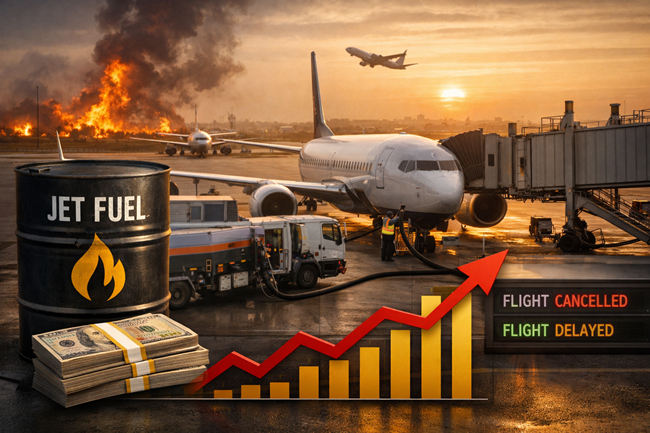
Several airlines across Asia and Europe raised fares, imposed fuel surcharges or revised flight schedules on Tuesday, 10 March 2026, as the escalating conflict in the Middle East drove jet fuel costs sharply higher and disrupted critical air corridors connecting Europe, Asia and the Pacific. The moves marked one of the most significant commercial responses by the global aviation industry since the coronavirus pandemic of 2020, as carriers from Australia to Scandinavia confronted a fuel price environment transformed almost overnight by geopolitical events.
Australia’s Qantas Airways, Scandinavia’s SAS and Air New Zealand were among the carriers announcing direct price increases. Hong Kong Airlines and Air India also moved to raise fuel surcharges. Cathay Pacific announced additional flights on Asia-Europe routes to capture demand displaced by airspace closures. Several other airlines warned that the crisis could threaten fuel supplies or force further schedule adjustments in the weeks ahead.
How did the Middle East conflict cause jet fuel prices to rise so sharply for airlines globally?
Jet fuel prices stood at approximately 85 to 90 United States dollars per barrel before United States-Israeli strikes on Iran commenced on 28 February 2026. Those prices soared to between 150 and 200 United States dollars per barrel within days. Air New Zealand cited this spike when it suspended its financial outlook for 2026, citing uncertainty over the conflict’s duration and its impact on global aviation operations.
The Strait of Hormuz, the narrow waterway between Iran and Oman, carries approximately 15 to 20 percent of the world’s daily oil supply. Threats to this corridor, whether through direct military action or the withdrawal of marine insurance coverage, trigger near-immediate reactions in global energy markets because traders respond to potential supply disruption ahead of any physical shortage materialising. The conflict also affected Kuwait, a major jet fuel exporter to north-west Europe, which experienced production cuts. Several international maritime insurers cancelled war risk coverage for vessels operating in the Gulf, compounding disruption to regional fuel supply chains and contributing directly to the acceleration in jet fuel prices for airlines worldwide.
Fuel accounts for between 20 and 30 percent of an airline’s total operating costs, making it the second-largest expense category after labour. The International Air Transport Association, in its economic forecast for 2026, had estimated a net operating margin of 6.9 percent and a net margin of only 3.9 percent for the world’s airlines, leaving the industry with minimal capacity to absorb a sustained fuel price increase of this scale.
Why are the Middle East airspace closures affecting Asia-Europe and Pacific routes so severely?
Airspace restrictions imposed across parts of the Middle East since late February 2026 severely disrupted traffic through three of the world’s busiest aviation hubs: Dubai International Airport, Abu Dhabi’s Zayed International Airport and Doha’s Hamad International Airport. Emirates, Qatar Airways and Etihad Airways collectively account for approximately one-third of passenger traffic between Europe and Asia, and carry more than half of all passengers from Europe to Australia, New Zealand and nearby Pacific Islands, according to aviation data firm Cirium. Disruption to these Gulf carriers therefore had cascading effects across long-haul travel globally.
Qatar Airways confirmed that its regular scheduled operations remained temporarily suspended, with Hamad International Airport in Doha effectively at a standstill for normal commercial traffic. Only a very limited number of special services, including repatriation flights, were operating. British Airways cancelled all flights to and from Doha, Amman, Bahrain and Dubai until later in March 2026, while services to and from Abu Dhabi were suspended until at least later in the year.
European airlines were already operating on extended routes due to restrictions on Russian airspace resulting from the war in Ukraine, which began in 2022. With Middle Eastern airspace now also restricted, carriers described an increasingly constrained global aviation environment. Flight detours of one to two hours on long-haul routes can increase fuel burn by 15 to 20 percent per service. A Tokyo-to-London diversion, for example, burns approximately 5,600 extra gallons of fuel per flight, adding around 20,000 United States dollars in fuel costs per service. Across hundreds of flights daily, these additional costs accumulate rapidly into hundreds of millions of dollars industry-wide if disruption persists.
Which airlines raised fares or imposed fuel surcharges in response to the Middle East crisis?
A spokesperson for SAS said increases of the current magnitude made it necessary for the airline to react in order to maintain stable and reliable operations. The Scandinavian carrier confirmed it had implemented a temporary price adjustment. SAS had no fuel consumption hedged for the following 12 months, having adjusted its hedging policy in 2025 due to uncertain market conditions, making it among the most exposed carriers in Europe to the current fuel price environment.
Qantas raised international fares and reported that its flights to Europe were running at more than 90 percent capacity in March, well above seasonal norms, as passengers sought alternative routing away from the Middle East. The Australian flag carrier was also exploring the redeployment of capacity to European routes to meet elevated demand. Air New Zealand raised fares across domestic, short-haul and long-haul routes and warned that further price or schedule changes might follow if jet fuel costs remained elevated.
Hong Kong Airlines announced fuel surcharge increases of up to 35.2 percent from 12 March 2026. Air India confirmed a phased surcharge increase across domestic and international routes beginning 12 March 2026. Under Air India’s schedule, a surcharge of 399 Indian rupees would apply to domestic routes and routes serving South Asian Association for Regional Cooperation nations. Routes to West Asia and Middle Eastern destinations that previously carried no surcharge would see an increase of 10 United States dollars. Southeast Asia surcharges would rise from 40 to 60 United States dollars, while Africa surcharges would increase from 60 to 90 United States dollars.
Cathay Pacific announced additional flights to London and Zurich in March 2026 to capture displaced demand as airspace closures created capacity shortfalls on Asia-Europe routes. IAG, the parent company of British Airways, said it was well hedged for the near term and had no immediate plans to adjust fares. Some European carriers also indicated they saw no immediate need to raise prices.
How does fuel hedging determine which airlines face the greatest financial exposure to this crisis?
Fuel hedging allows airlines to lock in a portion of their fuel purchases at pre-agreed prices, providing a buffer against sudden market spikes. Ryanair had hedged fuel at approximately 67 United States dollars per barrel for the coming year, insulating it significantly from the current price surge. Lufthansa also maintained active hedging arrangements. Finnair, with more than 80 percent of its first-quarter 2026 fuel purchases hedged, was relatively protected in the short term but warned that a prolonged crisis could affect not only price but the availability of fuel itself.
A Finnair spokesperson said a prolonged crisis could affect not only the price of fuel but also its availability, at least temporarily, while confirming the airline had not yet observed this occurring. SAS, which had no hedging in place, stood at the opposite end of the exposure spectrum among European carriers. Most major United States carriers, including Delta Air Lines, United Airlines and American Airlines, no longer hedge their fuel costs, unlike their European and Asian counterparts that maintain active hedging programmes. Shares in the three United States carriers fell between 1 and 2 percent on Tuesday, 10 March 2026.
European airline shares rose between 4 and 7 percent on the same day after oil prices retreated to approximately 90 United States dollars a barrel from a peak of 119 United States dollars the previous day, following public remarks by United States President Donald Trump indicating the conflict could end soon. United States Gulf Coast jet fuel prices had reached 4.12 United States dollars per gallon as of early March 2026, a four-year high.
What is the projected financial and tourism impact of the Middle East aviation crisis on global travel?
Some economists estimated that the combined impact of higher fuel prices, flight rerouting and interrupted passenger and cargo services could exceed one billion United States dollars for the global aviation industry if the disruption persisted. Industry groups warned that as long as airspace closures remained in place across the Gulf and parts of the Levant, airlines would face higher fuel bills, reduced schedules and intense operational complexity, with passengers bearing the brunt in the form of longer journeys, missed connections and limited rebooking options.
Rerouting costs extended beyond fuel. Airlines operating detoured routes faced the need to add additional crew members or schedule crew changes when flight times exceeded legal duty-hour limits. Hotels, crew positioning, ground handling fees and refuelling stops added to the cost base. Extended flight times also reduced the number of daily rotations each aircraft could perform, lowering fleet efficiency. Airlines additionally faced the costs of rebooking and compensating passengers whose itineraries were disrupted.
For the tourism economies of Dubai and Abu Dhabi, the timing of the disruption was particularly damaging. Visitor numbers to the United Arab Emirates had reached record levels in 2025, with hotels entering 2026 carrying strong forward bookings. Occupancy forecasts were being hastily revised downward as new arrivals slowed and tens of thousands of prospective visitors deferred or cancelled travel plans in the face of heightened safety warnings and acute uncertainty over flight availability.
Flight tracking service Flightradar24 reported on its social media account that planes arriving in Dubai were briefly placed in a holding pattern on Tuesday due to a potential missile attack, before eventually landing. Corporate travel managers were already revising itineraries to avoid routings that depended heavily on Middle Eastern airspace. Travel advisors indicated that passengers should prepare for elevated fares and limited seat availability in the coming weeks, even if some corridors reopened. With no firm timeline established for a full restoration of normal air traffic across the Gulf, carriers and regulators urged passengers with upcoming journeys touching the region to monitor their bookings closely and maintain flexible travel plans.
What this development means for airlines, energy markets, and global travel demand
- Jet fuel prices surged from 85-90 United States dollars per barrel to 150-200 United States dollars per barrel following United States-Israeli strikes on Iran on 28 February 2026, forcing several airlines including Qantas Airways, SAS, Air New Zealand, Hong Kong Airlines, and Air India to raise fares or impose new fuel surcharges.
- Airspace closures across the Gulf region severely disrupted operations at Dubai International Airport, Abu Dhabi’s Zayed International Airport and Doha’s Hamad International Airport, with Qatar Airways temporarily suspending scheduled services and British Airways cancelling flights to multiple Gulf destinations.
- Airlines without fuel hedging arrangements, particularly SAS, faced the greatest immediate financial exposure, while carriers such as Ryanair and Lufthansa with active hedging programmes were partially insulated from the price surge. Most major United States carriers, which do not hedge fuel costs, saw share price declines of 1 to 2 percent on 10 March 2026.
- Economists estimated the total financial impact on the global aviation industry could exceed one billion United States dollars if airspace disruptions persisted, factoring in higher fuel costs, extended flight detours, crew expenses, and lost passenger and cargo revenue.
- The United Arab Emirates tourism economy faced downward revisions to hotel occupancy forecasts as tens of thousands of visitors deferred or cancelled travel plans, compounding the commercial impact of Gulf aviation disruption on a regional economy that had recorded record visitor numbers in 2025.
Discover more from Business-News-Today.com
Subscribe to get the latest posts sent to your email.