

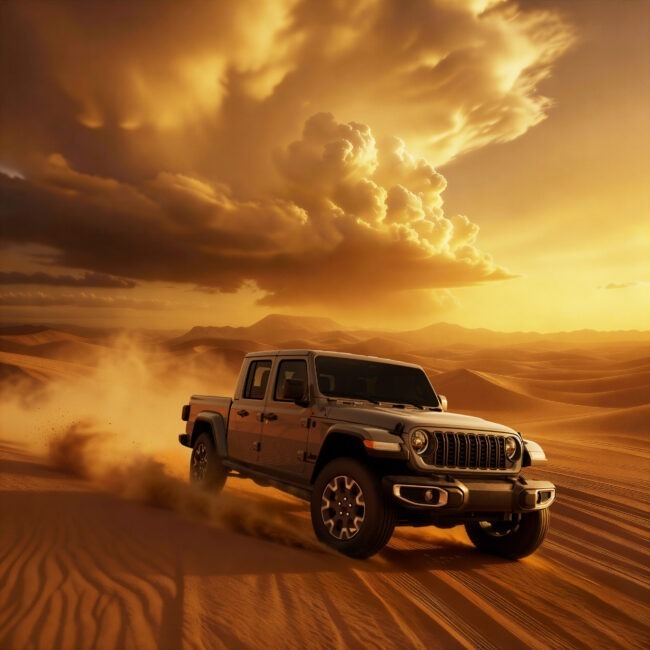
Stellantis N.V. (NYSE: STLA) has expanded the Jeep Gladiator lineup by introducing the Sahara trim for the first time, blending the rugged utility of a midsize pickup with premium comfort features traditionally reserved for upscale SUVs. The move aligns with the company’s strategy to increase margin per unit through high-content variants while retaining Jeep’s off-road identity.
Available for order at a starting price of $47,125 excluding destination charges, the 2026 Jeep Gladiator Sahara positions itself as a lifestyle play designed to appeal to urban buyers who want everyday comfort without compromising on trail-ready capability. The trim includes over $4,600 in additional features at a $2,210 premium to the Sport S trim—representing a 53 percent value gain based on Jeep’s internal pricing metrics.

Why is Jeep launching a Sahara trim for the Gladiator now—and who is the target buyer?
The Sahara trim is not new to the Jeep brand—it has long been a staple in the Wrangler lineup, synonymous with a more road-friendly, comfort-forward configuration. By bringing this nameplate to the Gladiator for the first time, Stellantis is explicitly signaling its intent to widen the truck’s appeal beyond traditional overlanders and recreational utility buyers.
The Gladiator Sahara’s design cues reinforce this shift. Its body-color three-piece hardtop and matching fender flares depart from the matte-black ruggedness of lower trims, offering a sleeker and more urban aesthetic. The inclusion of 18-inch aluminum wheels with all-season tires—along with the option to switch to all-terrain tires at no added cost—further illustrates the dual-market intention.
Inside, the Sahara trim is fitted with McKinley leather-trimmed heated seats, a heated steering wheel, and upgraded displays including a 7-inch driver information cluster and a 12.3-inch touchscreen infotainment system. These enhancements directly target buyers cross-shopping mid-luxury midsize SUVs and lifestyle pickups like the Ford Ranger Lariat, Toyota Tacoma Limited, and Honda Ridgeline RTL-E.
In effect, Jeep is using the Sahara badge to bridge capability with comfort, hoping to capture a growing segment of buyers who want off-road credibility packaged in a premium daily driver.
How does the Sahara trim align with Stellantis’ broader Gladiator and Jeep strategy?
The timing of the Sahara launch is deliberate. Stellantis has already confirmed a mid-cycle refresh of the Jeep Gladiator for the 2024–2026 model years, and this trim expansion serves as a tactical lever to both maintain showroom buzz and protect transaction prices in a highly competitive midsize pickup segment.
Jeep sales in North America have faced mounting pressure in recent quarters due to EV transition noise, shifting incentives, and the aging of core products. Adding the Sahara trim is a low-cost, high-margin maneuver that leverages the existing Wrangler architecture and production lines while generating incremental revenue.
This plays into Stellantis CEO Carlos Tavares’ well-documented playbook of “value over volume,” wherein the company aggressively trims cost across platforms while selectively investing in high-return variants. The Gladiator Sahara, with its $47,000+ price tag and premium finishes, is emblematic of that strategy.
Additionally, Stellantis is reinforcing brand continuity across nameplates. The use of consistent trims—Sport, Rubicon, Mojave, and now Sahara—across Wrangler and Gladiator simplifies the buying experience for returning Jeep customers while reinforcing a coherent brand architecture.
Could this trim dilute the Jeep Gladiator’s rugged image or confuse the value proposition?
There is always a risk when a brand synonymous with “trail-rated” performance begins leaning harder into creature comforts. The Gladiator Sahara introduces features that some core Jeep purists may interpret as cosmetic or superfluous—especially in a vehicle known for its utility-first ethos.
However, Jeep has consistently demonstrated that it can thread this needle. The Wrangler Sahara has coexisted for decades with the Rubicon and Willys trims, often outselling them in urban markets. If anything, the Gladiator Sahara may help the brand capture “adjacent” customers: those who admire the Jeep brand but were previously put off by its utilitarian interiors or manual-heavy configurations.
From a packaging perspective, the new trim does not reduce capability. The Gladiator Sahara still includes Jeep’s Command-Trac 4×4 system and retains core off-road geometry, while also offering the option to upgrade to all-terrain tires at no extra cost. The net result is a lifestyle truck that retains enough performance credentials to justify the badge.
How does the Gladiator Sahara compare to segment competitors in pricing and positioning?
The midsize truck market has grown increasingly crowded, with several models now targeting the upper-$40K and lower-$50K bands once reserved for full-size trucks. Against this backdrop, the Gladiator Sahara attempts to differentiate itself by bundling standard tech, premium interiors, and heritage styling without climbing into luxury-truck territory.
The Ford Ranger Lariat and Toyota Tacoma Limited both hover in a similar price range but lean more on tech-forward interiors and advanced driver assistance systems than brand identity. The Honda Ridgeline RTL-E arguably offers more road comfort but lacks the trail-rated cachet of a Jeep.
What sets the Gladiator Sahara apart is the illusion of uncompromised capability with increased lifestyle appeal. In a market where buyers are willing to pay for identity as much as performance, this variant could outperform its mid-pack competitors on perception alone.
What happens next—and how will Stellantis measure success for this launch?
Early indicators of success will include average transaction prices, dealer uptake, and regional performance in key lifestyle markets such as California, Colorado, and the Northeast. If the Sahara trim demonstrates pricing resilience and brings in conquest buyers from crossovers or more premium SUVs, Stellantis could apply this trim playbook to other nameplates across the Jeep portfolio.
There is also the broader roadmap to consider. Stellantis is navigating a staggered transition to hybrid and all-electric drivetrains, and each profitable trim level like Sahara buys the company more financial headroom to invest in next-generation platforms such as STLA Large and STLA Frame.
If the Gladiator Sahara becomes a recurring best-seller, expect similar high-content variants to follow in other midsize and compact models, possibly including the electrified Jeep Recon or the upcoming Ram Rampage in global markets.
For now, this trim is less about reinvention and more about refinement—an acknowledgment that buyers want their utility with a side of comfort, and that identity remains a profitable currency in the automotive world.
What are the key takeaways from Jeep’s 2026 Gladiator Sahara launch?
- Stellantis has introduced the Sahara trim to the Jeep Gladiator for the first time, targeting premium buyers with a blend of comfort and off-road capability.
- The trim includes over $4,600 in features from the Sport S variant but carries only a $2,210 MSRP premium, presenting a calculated 53 percent value advantage.
- The Gladiator Sahara’s design and interior features appeal to urban and lifestyle customers who prioritize comfort but want to retain the Jeep brand identity.
- Strategically, the launch aligns with Stellantis’ value-over-volume model and supports margin expansion amid competitive pressures in the midsize truck segment.
- The move helps Jeep build brand continuity with the Wrangler lineup and introduces trim architecture coherence for returning buyers.
- Segment rivals like the Ford Ranger Lariat and Toyota Tacoma Limited offer similar pricing but differ in brand perception and off-road credibility.
- Execution risks include potential dilution of the Gladiator’s rugged appeal, though the core 4×4 capabilities remain intact.
- If successful, the Sahara trim strategy could extend to future electrified Jeep models and even influence premium packaging in Stellantis’ Ram and Dodge portfolios.
Discover more from Business-News-Today.com
Subscribe to get the latest posts sent to your email.