

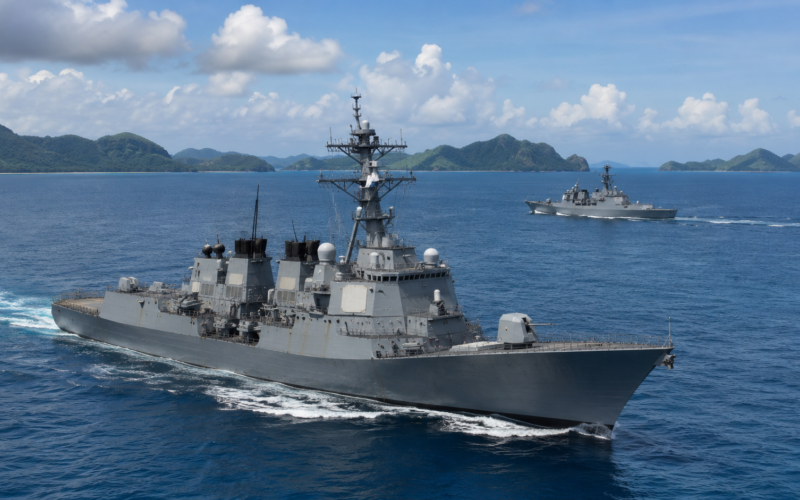
Japan and Indonesia have begun working-level discussions on the possible transfer of used Japan Maritime Self-Defense Force Asagiri-class destroyers to the Indonesian Navy. The talks mark a significant step in Japan’s evolving defence export policy and Indonesia’s effort to strengthen maritime security across one of the world’s most complex archipelagic operating environments. The potential transfer matters because second-hand warships can offer faster fleet reinforcement than new-build procurement, especially for countries facing expanding patrol, surveillance and anti-submarine requirements. The discussions also show how Indo-Pacific naval partnerships are moving beyond symbolic exercises into practical capability transfers that can reshape regional maritime balance.
Why do Japan and Indonesia’s Asagiri-class destroyer talks matter for Indo-Pacific naval strategy?
Japan and Indonesia’s Asagiri-class destroyer talks matter because they sit at the intersection of maritime geography, defence diplomacy and industrial pragmatism. Indonesia is the world’s largest archipelagic state, with thousands of islands, critical sea lanes and overlapping security pressures across the Indian Ocean, South China Sea and western Pacific approaches. A navy responsible for that geography needs hull numbers, endurance, sensors, crew training and sustainment capacity, not just a few prestige platforms that look impressive during fleet reviews.
For Japan, the talks represent another sign that Tokyo is becoming more willing to use defence equipment transfers as a strategic policy instrument. Japan has traditionally maintained a cautious posture around arms exports, but the regional security environment has changed. China’s maritime assertiveness, North Korea’s missile activity and the growing demand for partner capacity in Southeast Asia have pushed Tokyo to think more actively about how its retired or retiring assets can support friendly navies.
The Asagiri-class discussion therefore matters beyond the ships themselves. It reflects a wider Indo-Pacific trend in which older but still useful platforms are being repurposed to help partners fill urgent gaps. Not every navy can wait ten years for brand-new ships. Sometimes the strategic value lies in getting capable vessels into service quickly, then using training, maintenance and upgrade packages to make them operationally relevant.

How could Asagiri-class destroyers strengthen Indonesia’s naval capability across its archipelagic waters?
Asagiri-class destroyers could strengthen Indonesia’s naval capability by adding larger multi-mission surface combatants with better endurance and sensor capacity than many patrol-focused vessels. The class was designed as a general-purpose escort for the Japan Maritime Self-Defense Force, with roles spanning surface warfare, anti-submarine missions and fleet support. Even if transferred ships require refurbishment, their size and baseline configuration could give the Indonesian Navy more reach for maritime security and presence operations.
Indonesia’s naval challenge is unusually demanding because its maritime domain is not one theatre. It includes chokepoints, island chains, commercial shipping routes, fisheries zones, offshore energy interests and areas exposed to regional competition. A larger escort-type vessel can support longer patrols, training missions, maritime domain awareness and presence operations in areas where smaller patrol ships may be limited by endurance or sea state.
The operational value would depend heavily on condition, upgrades and support. Used warships are not magic coupons for naval power. They come with age, maintenance demands, spare-parts questions and training requirements. If Indonesia can secure a coherent package covering crew education, sustainment, weapons systems, sensors and dockyard support, the Asagiri-class could provide meaningful capability. If the transfer is treated mainly as a ship handover, the strategic upside would be much smaller.
Why is Japan using retired destroyers as part of a broader defence diplomacy shift?
Japan’s willingness to discuss used destroyer transfers reflects a broader shift in how Tokyo views security partnerships. For decades, Japan’s defence posture was constrained by legal, political and historical caution. That caution has not disappeared, but Japan is now operating in a regional environment where passive support is no longer enough. Defence equipment cooperation gives Tokyo a way to strengthen partners without immediately moving into the most sensitive forms of military alignment.
Used platforms can be especially useful for this purpose. They allow Japan to support partner capacity while managing domestic sensitivities around new weapon exports. A retired destroyer transfer can be framed as practical maritime cooperation, especially if the ships are used for patrol, training, surveillance or defensive missions. This makes the policy more politically manageable than exporting newly built high-end offensive systems.
The Asagiri-class talks also fit Japan’s strategic interest in Southeast Asia. Indonesia is a central maritime actor, sits astride vital sea lanes and maintains a non-aligned diplomatic tradition. By supporting Indonesia’s naval capacity, Japan can deepen security ties without demanding bloc-style alignment. That is a careful form of influence, and in Southeast Asia, careful usually travels better than loud.
What does the potential transfer say about Indonesia’s naval modernisation constraints?
The potential transfer says that Indonesia’s naval modernisation is shaped by urgency, geography and budget discipline. Jakarta needs to improve naval reach, surveillance and deterrence, but it must do so while balancing economic priorities, domestic industrial ambitions and multiple defence procurement demands. Used warships can offer a shortcut, particularly when new-build programmes are costly, slow or limited by local shipbuilding capacity.
Indonesia has been pursuing a mix of new vessels, foreign partnerships and domestic shipbuilding initiatives, but its maritime requirements are vast. The country needs patrol vessels, frigates, submarines, maritime aircraft, unmanned systems and coastal surveillance networks. In that context, acquiring used Asagiri-class destroyers could be a practical bridge while longer-term fleet plans mature.
The risk is that second-hand acquisitions can create sustainment complexity. Each additional class of ship brings its own training, spare parts, maintenance routines and weapons integration issues. Indonesia must ensure that any Asagiri-class transfer does not become another isolated fleet type that is difficult to support. The ships must fit a broader force structure, otherwise the acquisition could solve a near-term hull problem while creating a long-term logistics headache. Navies, like websites, do not scale well when every new addition needs a custom plugin.
How could the Asagiri-class talks affect China’s calculations in Southeast Asian waters?
The Asagiri-class talks are unlikely to change China’s maritime posture by themselves, but they contribute to a broader pattern that Beijing will notice. Japan is becoming more active in helping Southeast Asian partners improve maritime security, while Indonesia is looking for ways to strengthen naval presence without entering a formal alliance structure. That combination adds friction to any assumption that regional maritime pressure will go unanswered.
For Indonesia, the strategic value is defensive signalling. A stronger surface fleet improves the country’s ability to patrol, monitor and respond in contested or sensitive areas. Indonesia has its own complex relationship with China, including economic engagement and maritime tensions around the North Natuna Sea. Better naval capacity gives Jakarta more room to manage that balance from a position of confidence.
For Japan, the transfer talks show that it can support regional deterrence indirectly. Tokyo does not need to deploy its own ships everywhere to influence the maritime balance. Helping partners improve their own capacity can create a distributed deterrence effect. It is less dramatic than carrier deployments, but arguably more sustainable over time.
Why would used Japanese destroyers be attractive despite their age and sustainment burden?
Used Japanese destroyers may be attractive because they can offer a combination of size, seaworthiness, training value and operational utility at a faster timeline than new construction. The Asagiri-class ships were built as capable multi-mission escorts, and even older vessels can remain useful if their core systems are serviceable and their mission set is realistic. For Indonesia, the appeal may lie in getting larger combatants into service without waiting for an entirely new class to be designed, built and commissioned.
The training value could be especially important. Larger destroyers can help crews develop skills in anti-submarine warfare, formation operations, damage control, command procedures and complex shipboard maintenance. Even if the ships are not equipped with the newest systems, they can still support professionalisation and operational depth. A navy grows not only by buying platforms, but by building crews that can operate them.
The sustainment burden is the obvious counterweight. Older warships require careful inspection, refurbishment and spare-parts planning. Indonesia would need clarity on hull condition, remaining service life, weapons compatibility, sensor upgrades and maintenance costs before any transfer becomes strategically sound. A cheap ship can become expensive very quickly if it spends most of its time waiting for parts. The sticker price is only the opening line of the naval procurement novel.
What role could the Asagiri-class play alongside Indonesia’s future frigates and submarines?
The Asagiri-class could play a bridging and complementary role alongside Indonesia’s future frigates and submarines. The ships could support patrol, escort, training, maritime surveillance and anti-submarine exercises while newer platforms enter service. This would help Indonesia maintain operational tempo without placing excessive strain on its most modern assets.
In a layered naval structure, older destroyers do not need to perform every high-end mission. They can operate in lower-risk areas, support training pipelines, escort task groups or contribute to maritime presence. That can free newer frigates or submarines for more demanding roles. The value lies in assigning the right ship to the right mission rather than expecting every vessel to be a front-line showpiece.
The class could also help Indonesia strengthen interoperability with Japan and other partners. If the transfer includes training and maintenance cooperation, Indonesian crews could gain deeper exposure to Japanese naval procedures and standards. That could support future exercises, capacity-building programmes and technical cooperation. The ships may therefore carry diplomatic value as well as operational value.
Could this transfer become a template for Japan’s future defence exports?
The Asagiri-class talks could become a template if Japan can manage the transfer in a way that is politically acceptable, operationally useful and strategically credible. A successful deal would show that Japan can use retired platforms to support partner capacity without triggering excessive domestic controversy or regional backlash. That could open the door for future transfers involving patrol vessels, surveillance systems, training equipment or other defensive assets.
The template would likely depend on careful packaging. Japan would need to combine hardware with training, maintenance support, spare parts and clear mission framing. Simply handing over older vessels would not be enough. The success of the transfer would be judged by whether Indonesia can operate the ships effectively and whether the arrangement strengthens long-term defence cooperation.
For the broader defence market, this matters because Japan is gradually becoming a more consequential player in regional security assistance. Japanese companies and government agencies may find new opportunities in maintenance, ship upgrades, maritime surveillance, communications systems and training support. The shift will not turn Japan into a conventional arms exporter overnight, but it could make Tokyo a more active defence partner across Southeast Asia.
What execution risks could derail the Japan-Indonesia destroyer transfer talks?
The first execution risk is technical condition. Asagiri-class destroyers are older vessels, and any transfer would require careful assessment of hull life, propulsion systems, combat systems, sensors and weapons. If the ships require expensive refurbishment, the business case could weaken. Indonesia will need to know whether the ships can deliver useful service years without consuming disproportionate maintenance resources.
The second risk is sustainment. Warships require steady spare parts, trained maintainers, dockyard capacity and technical documentation. If Indonesia cannot support the ships efficiently, availability could suffer. A transfer that looks strategically attractive on paper could lose value if operational readiness remains low.
The third risk is political and diplomatic. Japan’s defence export policy remains sensitive, and Indonesia will need to balance the transfer against its non-aligned posture and wider relationships. China may object, while domestic critics in either country may question cost, purpose or strategic alignment. The talks may be working-level for now, but turning them into a signed and executed transfer will require more than naval enthusiasm.
Key takeaways on what Japan and Indonesia’s Asagiri-class talks mean for Indo-Pacific naval strategy
- Japan and Indonesia’s talks on a possible Asagiri-class destroyer transfer show how used warships are becoming practical tools of Indo-Pacific defence diplomacy.
- Indonesia could gain larger multi-mission surface combatants faster than through new-build procurement, supporting maritime presence across a vast archipelagic domain.
- Japan’s willingness to discuss retired destroyer transfers reflects a wider shift toward more active defence equipment cooperation with Southeast Asian partners.
- The potential transfer would strengthen bilateral security ties without forcing Indonesia into a formal alliance structure, which fits Jakarta’s preference for strategic autonomy.
- The operational value for Indonesia would depend on hull condition, remaining service life, sensor upgrades, weapons compatibility and sustainment support.
- The Asagiri-class could serve as a bridge while Indonesia pursues longer-term frigate, submarine and maritime surveillance modernisation plans.
- The talks send a regional signal that Japan can support maritime deterrence indirectly by helping partner navies improve their own capacity.
- Sustainment risk is the biggest practical challenge because older warships can become costly if spare parts, training and maintenance pathways are weak.
- A successful transfer could become a model for future Japanese defence exports involving retired platforms, training packages and maritime security support.
- The broader strategic lesson is that Indo-Pacific naval competition is not only about new ships. It is also about how quickly partners can convert available assets into credible presence.
Discover more from Business-News-Today.com
Subscribe to get the latest posts sent to your email.