

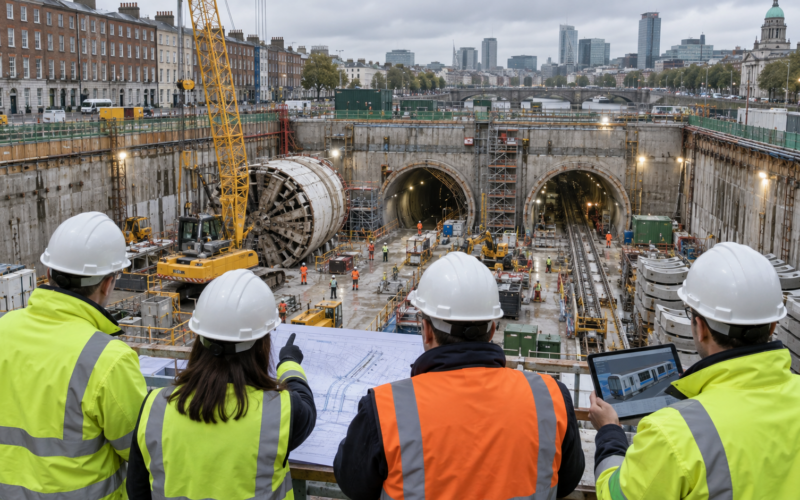
Jacobs Solutions Inc. (NYSE: J) and AECOM (NYSE: ACM) have been appointed jointly as programme delivery partner for Dublin MetroLink, giving the two US engineering groups a central coordination role as Ireland’s first metro moves from planning toward full-scale delivery preparation.
The appointment does not mean Jacobs and AECOM have won the principal tunnelling, railway-systems or operating contracts. Their joint venture will instead integrate with Transport Infrastructure Ireland’s MetroLink organisation and help manage procurement, programme governance, engineering oversight, risk, schedule, construction integration and commissioning across a project containing multiple major contracts.
MetroLink is planned as a roughly 19-kilometre high-capacity railway connecting north Dublin, Dublin Airport and the city centre. The scheme is expected to have 16 stations at opening, carry up to 53 million passengers annually and provide peak service as frequently as every 90 seconds.
Its scale makes programme management a substantial commercial opportunity even without a disclosed value for the Jacobs-AECOM appointment. MetroLink is one of Ireland’s largest planned infrastructure investments, with major civil and systems packages already entering procurement and thousands of construction jobs expected once physical delivery accelerates.
Why is MetroLink appointing a programme delivery partner before the biggest contracts are awarded?
Megaprojects are rarely delivered through one construction contract. MetroLink will use multiple packages covering tunnelling, stations, civil structures, railway systems, rolling stock, signalling, power, maintenance facilities and long-term operations, creating interfaces that can become major sources of cost and delay.
The programme delivery partner sits above many of those individual packages and helps the sponsoring authority coordinate them. Jacobs and AECOM will support Transport Infrastructure Ireland as contracts are procured, construction sequences are integrated and engineering risks are managed across the entire scheme.
That role becomes particularly important when two contractors need to deliver adjacent tunnel sections or when station civil works must be ready before signalling, power and track systems can be installed. A delay in one package can propagate through several others unless schedules and interfaces are managed centrally.
MetroLink therefore provides Jacobs and AECOM with less visible but strategically important work. They may not be pouring the concrete for every tunnel themselves, but programme-management decisions can determine whether the entire project reaches commissioning coherently.
How large is Dublin MetroLink’s current procurement programme?
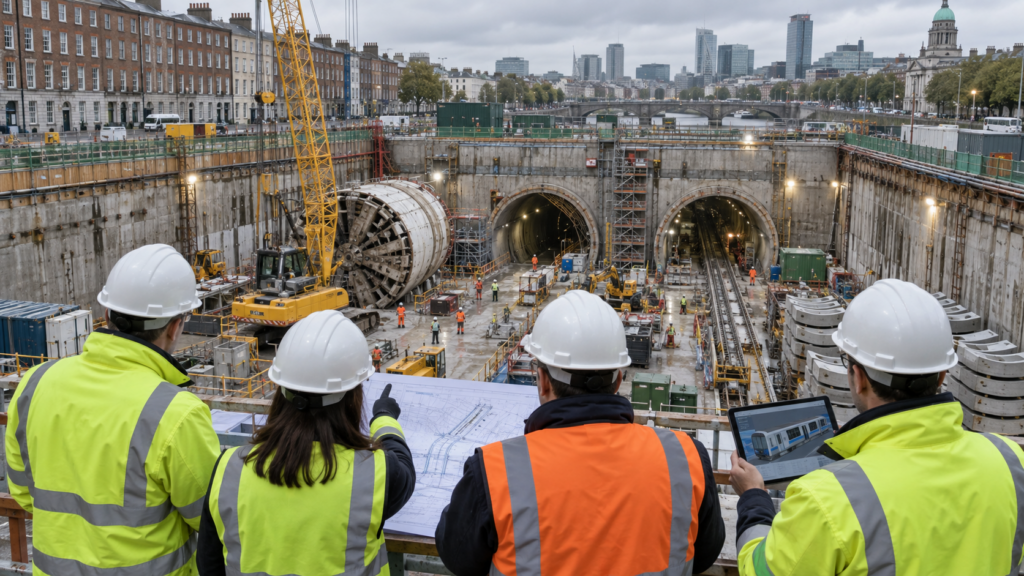
Transport Infrastructure Ireland began procurement during 2026 for two major civil packages known as M401 and M402. Together, the procurement notices carry an estimated contract value of approximately €3.347 billion excluding VAT and cover heavy tunnelling, stations, track-alignment preparation, bridges, viaducts and associated structures.
A separate M500 package covers rolling stock, rail systems, station fit-out, signalling, depot infrastructure, operations and maintenance under a Design, Build, Finance, Operate and Maintain structure. TII has described the M500 notice using an estimated €7.3 billion net-present-value figure based on preliminary construction, financing, operating and lifecycle assumptions.
Those numbers should not simply be added together and presented as MetroLink’s total construction cost because they describe different procurement structures and valuation bases. TII has also cautioned that its older €9.5 billion P50 capital estimate dates from an earlier business case and is currently being reassessed after inflation and additional project requirements.
The more defensible conclusion is that MetroLink is a multibillion-euro megaproject whose final cost will become clearer only as competitive procurement advances. Jacobs and AECOM are entering at precisely the stage when those package-level estimates begin turning into actual tenders and contractual commitments.
What will MetroLink change for Dublin Airport and the wider transport network?
The project is designed to cut travel time between Dublin Airport and the city centre to around 20 minutes while creating high-frequency links to Swords and other communities in north Dublin. It will also interchange with Irish Rail, DART, Luas and bus services, making the metro part of a wider public-transport network rather than a standalone airport railway.
Capacity is expected to reach up to 20,000 passengers per hour in each direction, while annual ridership could reach approximately 53 million. Those figures would make MetroLink one of the most consequential additions to Irish public transport in decades.
The airport connection is especially important because Dublin Airport currently lacks direct heavy or metro rail access. Travellers depend mainly on road-based public transport, taxis and private vehicles, exposing journeys to traffic congestion and creating additional pressure on road capacity as passenger volumes grow.
A high-capacity metro can therefore deliver economic benefits beyond fares. Faster airport access, improved labour mobility and reduced congestion can affect business productivity, housing development and the attractiveness of sites around stations.
Why is MetroLink commercially relevant to both Jacobs and AECOM?
Jacobs entered the award with record backlog of $28.9 billion at the end of its fiscal third quarter, up 27% year over year. Infrastructure & Advanced Facilities was one of its strongest operating areas, with transportation contributing to broad-based organic growth alongside data centres, semiconductors, energy and water.
Programme-management work is attractive because large infrastructure schemes can generate recurring professional-services revenue over many years without requiring the engineering adviser to finance or physically own the underlying asset. MetroLink is expected to proceed through procurement, construction, systems integration and commissioning over a long period.
AECOM follows a similarly asset-light model focused on design, programme management and infrastructure advisory services. Joining forces also gives the MetroLink authority access to combined global experience rather than relying on one engineering group to cover every aspect of a project unprecedented in Ireland.
Neither company has disclosed the financial value of its share of the programme delivery partner appointment. Investors should therefore avoid treating the entire MetroLink capital estimate as contract revenue available to Jacobs or AECOM.
How much employment could Dublin MetroLink create once construction accelerates?
Transport Infrastructure Ireland has estimated the wider programme could support approximately 8,000 direct construction jobs annually, alongside another 2,750 indirect roles through the supply chain. Those figures demonstrate the scale of labour and procurement coordination required as the project moves from design into physical delivery.
The construction programme will need tunnelling specialists, civil engineers, station contractors, systems engineers, safety personnel, architects, equipment suppliers and a wide range of support services. Coordinating that workforce becomes another part of the programme delivery partner’s responsibility.
MetroLink also creates long-term operational employment after construction because the system requires drivers or automated operations teams, station staff, maintenance personnel, control-centre operators and engineering support throughout its service life.
The economic impact therefore extends beyond the engineering fees earned by Jacobs and AECOM. The joint venture has been placed near the centre of a project intended to reshape how capital, contractors and labour are deployed across Ireland’s infrastructure sector for years.
What are the next milestones after the Jacobs-AECOM appointment?
Award of the major M401 and M402 civil packages will provide the clearest indication of construction economics and contractor appetite. Progress on the M500 systems-and-operations procurement will then determine who supplies trains, signalling and long-term operating capability.
Updated cost information will also be closely watched because the €9.5 billion P50 estimate predates several years of construction inflation and design development. TII has explicitly acknowledged that the project’s cost model is being re-examined rather than presenting the old figure as a definitive current budget.
For Jacobs and AECOM, the commercial opportunity will deepen as procurement converts into active construction and the complexity of coordinating contractors increases. The award therefore matters less because of an undisclosed immediate contract value than because the joint venture has secured a position spanning the delivery lifecycle of Ireland’s first metro.
MetroLink is finally entering the phase where planning documents must become tunnels, stations and functioning railway systems. Jacobs and AECOM will be judged on whether the management architecture around that construction proves strong enough to keep one of Ireland’s largest infrastructure programmes coordinated as physical delivery accelerates.
Discover more from Business-News-Today.com
Subscribe to get the latest posts sent to your email.