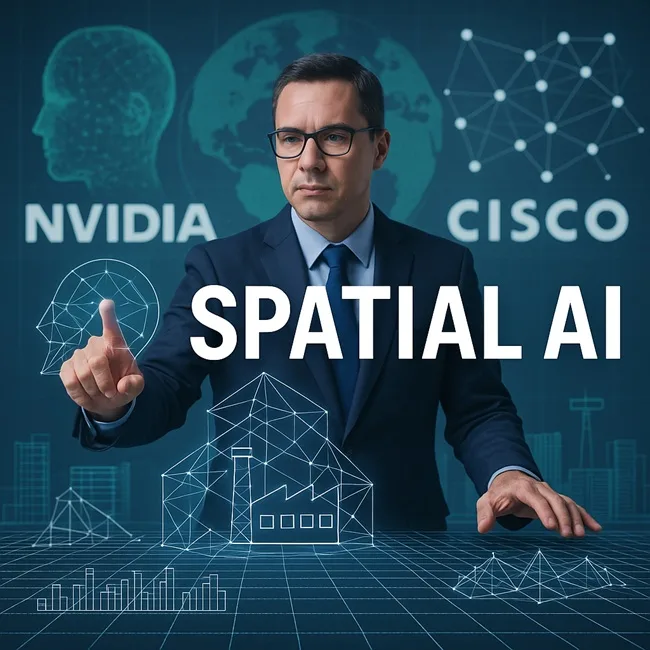
Spatial intelligence is emerging as the next foundational layer in artificial intelligence, shifting enterprise attention from language-based models to AI that can perceive, interact with, and reason about the 3D physical world. From Cisco Systems Inc. (NASDAQ: CSCO) investing in World Labs to NVIDIA Corporation’s (NASDAQ: NVDA) deepening Omniverse stack, a growing number of infrastructure players and venture-backed startups are converging around the belief that spatial AI will reshape robotics, digital twins, and enterprise simulation.
How is spatial intelligence redefining the enterprise tech stack and why now does it matter for infrastructure?
The past five years have been defined by the rapid enterprise adoption of large language models. These tools unlocked new automation layers for support, document summarization, search, and task execution. But while language was a major leap, it is inherently two-dimensional. Spatial intelligence represents the next frontier, where machines not only understand language but also see, navigate, and reason in the physical world.
This shift is not purely theoretical. Cisco Systems Inc., the legacy networking and infrastructure giant, has made a strategic investment in World Labs Technologies Inc., a startup co-founded by AI luminary Fei-Fei Li. World Labs is building what it calls “Large World Models” or LWMs, capable of understanding, simulating, and interacting with real-world 3D environments. The implications for enterprise AI systems, from robotics to digital twins, are profound.
Cisco’s investment underscores its broader strategy: not to build foundation models, but to power the infrastructure that enables them. In this new spatial paradigm, networks must support real-time data from 3D sensors, simulation inputs, AR/VR layers, and edge AI agents. That demand lands squarely within Cisco’s domain of scalable, secure, enterprise-ready infrastructure.
What role are Cisco Systems and NVIDIA Corporation playing when spatial AI meets enterprise deployment?
While Cisco Systems Inc. is staking its claim as the infrastructure backbone for spatially aware AI, NVIDIA Corporation has already embedded itself deeper in the stack. NVIDIA’s Omniverse platform enables the creation of persistent, high-fidelity virtual environments, including digital twins of factories, cities, and machines that are essential for training and deploying embodied AI agents.
The Omniverse stack combines physics-based simulation, 3D rendering, GPU acceleration, and real-time collaboration, making it a natural platform for spatial intelligence development. NVIDIA has also integrated generative AI into Omniverse workflows, allowing AI agents to generate 3D content and reason within simulated environments.
Together, Cisco and NVIDIA represent the boundary between hardware and software in spatial AI infrastructure. Cisco powers the connective tissue, including switches, fabric, and edge routers, while NVIDIA accelerates the data processing and visualization stack. As enterprise adoption picks up, their complementary strengths may converge in customer workflows spanning logistics, smart manufacturing, healthcare, and energy.
Why are investors tracking startups such as World Labs Technologies as part of the spatial intelligence wave?
World Labs Technologies Inc. may be a young company, but its ambition is large-scale. The firm is developing foundational models that perceive, generate, and reason about the 3D world, similar to how LLMs work with text. Its first product, Marble, generates spatially consistent 3D environments from prompts such as a video clip or text description. The ability to create digital spaces from scratch, with embedded physics and persistency, opens up use cases in robotics training, architecture, simulation, and even entertainment.
The startup’s co-founder and CEO, Fei-Fei Li, previously led AI research at Google Cloud and Stanford and is one of the most cited scholars in computer vision. Other co-founders include Justin Johnson, Christoph Lassner, and Ben Mildenhall with each bringing deep expertise in graphics, neural rendering, and generative models.
Andreessen Horowitz (a16z), an early investor in World Labs, has publicly backed the vision that spatial intelligence is the next leap in AI’s evolution. Cisco’s strategic investment now adds the enterprise credibility and infrastructure channel to scale such capabilities.
For venture capitalists and public market investors alike, startups like World Labs signal that generative AI is not limited to chat or code—spatial generative models may offer the next decade’s breakout category.
Which enterprise use-cases promise traction for spatial AI and where could value really emerge?
Spatial AI applications are particularly resonant in industries where the physical and digital worlds intersect. Robotics, logistics, urban planning, construction, automotive design, and field service are all seeing early experimentation with spatially intelligent AI.
In warehouse automation, for instance, embodied agents require not only navigation abilities but also real-time scene understanding, object manipulation, and adaptive behavior. In construction and real estate, spatial AI can be used to simulate and optimize designs before breaking ground, improving efficiency and reducing cost overruns.
Digital twins are among the most commercially mature examples. Enterprises are now using AI-driven simulations of buildings, factories, and supply chains to test changes, monitor performance, and train agents. Spatial intelligence enhances these twins by making them not just visual replicas but interactive, reasoning environments.
In consumer-facing enterprise applications such as AR/VR and the metaverse, spatial AI underpins everything from realistic avatars to mixed-reality navigation systems. Unity Technologies and Autodesk are also integrating spatial modeling and simulation capabilities into their enterprise platforms, offering designers and engineers the ability to co-create with AI.
What are the risks and execution hurdles ahead for enterprise spatial AI and how are institutional investors gauging them?
Despite the promise, several execution risks remain. Spatial AI systems are compute-intensive, requiring significant GPU resources and high-bandwidth networking. The upfront costs for simulation, modeling, and real-world capture can be prohibitive. Model accuracy in complex environments is still a challenge, especially when translating simulated reasoning into physical action.
From a monetization standpoint, the biggest hurdle is deployment complexity. Many enterprise buyers lack the in-house expertise to build, train, or integrate spatial AI models into legacy systems. That creates a bottleneck for startups and a consulting opportunity for infrastructure firms like Cisco and cloud vendors like Amazon Web Services and Microsoft Azure.
Public market investors are currently treating spatial AI as a long-duration play. Cisco Systems Inc. shares have fallen 2.29% over the past five sessions, even after announcing the World Labs investment. The stock closed at $76.10 on November 21, with analysts maintaining a neutral stance due to limited short-term earnings impact.
NVIDIA Corporation shares, by contrast, continue to trade at premium multiples due to its role in powering not just LLMs but now the spatial stack as well. While high beta makes it volatile, its GPU dominance gives it direct exposure to both training and deployment phases of embodied AI.
What should enterprise and tech investors watch next in the transition from generative AI to spatial AI?
For investors looking to gauge the momentum behind spatial intelligence, a few signals matter. First is enterprise adoption—watch for announcements of spatial AI modules being deployed in large organizations or embedded into enterprise SaaS platforms. Cisco, Unity, Siemens, and NVIDIA are key tickers to track.
Second is venture capital deal flow. More funding into startups building 3D generative models, embodied AI agents, or simulation platforms would indicate confidence in a long-term opportunity. Startups to watch beyond World Labs include Covariant, VoxelSensors, Synthesia, and Tractable.
Third is industry-specific uptake. Manufacturing, logistics, and construction could be early enterprise adopters given their real-world complexity and existing reliance on digital twin platforms.
Finally, government and defense spending on simulation, training, and autonomous systems will be a tailwind. The U.S. Department of Defense and DARPA have already supported embodied AI research, and national strategies across Europe and Asia are starting to reflect spatial AI as a core pillar of innovation.
Whether spatial AI becomes the next foundational enterprise platform will depend not just on the models themselves, but on the infrastructure, trust, and ROI pathways that surround them. Cisco’s investment in World Labs may be one of the first big signals that the enterprise stack is beginning to evolve accordingly.
What are the key takeaways from the rise of spatial AI in enterprise infrastructure?
- Spatial intelligence is emerging as the next platform shift in artificial intelligence, focusing on 3D reasoning and physical-world interaction.
- Cisco Systems Inc. has invested in World Labs, a startup co-founded by Fei-Fei Li building Large World Models for embodied AI.
- NVIDIA Corporation continues to expand Omniverse as a platform for real-time simulation and spatially aware AI workflows.
- Use-cases range from robotics and logistics to digital twins, simulation, and immersive enterprise applications.
- Risks include compute cost, deployment complexity, and slow monetization timelines for early-stage startups.
- Institutional sentiment remains mixed, with CSCO showing recent stock softness while NVDA maintains AI leadership premium.
- Enterprise adoption milestones, venture funding signals, and defense sector uptake will shape the next growth phase.
Discover more from Business-News-Today.com
Subscribe to get the latest posts sent to your email.