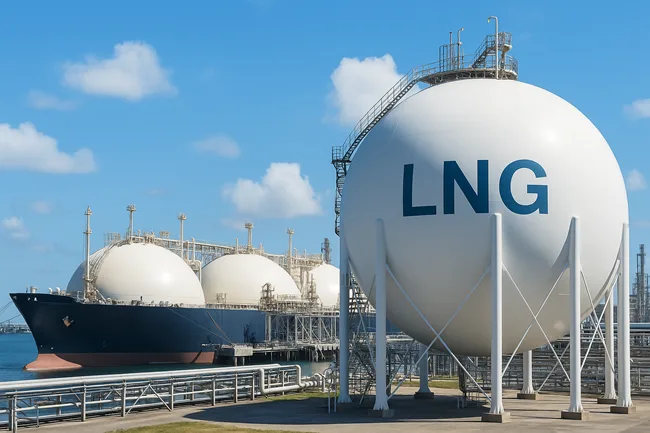
In a notable vote of confidence for the United Kingdom’s liquefied natural gas (LNG) infrastructure, National Grid Ventures has secured a long-term capacity agreement with an undisclosed major LNG market participant at its Grain LNG terminal in Kent. This 10-year deal, which is expected to generate £400 million in revenue, marks one of the largest commercial LNG agreements in the UK since the 2022 energy crisis. Yet beyond the headline figures, the transaction is reigniting debate about the long-term ESG alignment of gas infrastructure in an era of decarbonisation pressure, especially as policymakers prepare for the COP29 climate summit later this year.
Grain LNG is the largest LNG import terminal in Europe by tank capacity, and the eighth largest globally. The facility plays a pivotal role in the United Kingdom’s energy security, offering peak-shaving capacity and serving as a strategic gas entry point during periods of high demand. The new agreement, announced by National Grid on December 5, 2025, extends access to regasification, storage, and other midstream services starting in January 2029, suggesting that both the operator and counterparty expect gas to remain central to the energy mix for the foreseeable future.
From an investment and ESG lens, the deal signals a form of pragmatic alignment with what many institutional investors now call “transition infrastructure.” While traditional fossil fuel assets have fallen out of favour among many ESG funds, long-lived gas infrastructure like Grain LNG is increasingly being positioned as a necessary enabler of system reliability, particularly during the volatile ramp-down of coal and nuclear assets.
How this contract reflects changing views of LNG in energy transition portfolios
Institutional appetite for midstream gas assets had cooled after 2021, driven by ESG divestment pressures and regulatory risk. However, Russia’s invasion of Ukraine in early 2022 shifted the narrative dramatically. European Union member states, including Germany and France, scrambled to secure floating storage and regasification units to compensate for lost pipeline supply. The result was a resurgence in LNG import infrastructure demand across Europe, which subsequently buoyed the asset class in investor models.
The Grain LNG announcement is one of the clearest UK-based indicators that this momentum is sustaining into the second half of the decade. National Grid described the counterparty only as a “leading international LNG market participant,” but the fact that the agreement stretches into the late 2030s adds credibility to forecasts that gas demand will persist—albeit in a more flexible, potentially decarbonised form through carbon capture or hydrogen blending.
For ESG-minded investors, this presents a conundrum. Natural gas is not a zero-carbon fuel, but it does emit significantly less carbon dioxide than coal per unit of energy. It also provides backup power for intermittent renewables. As such, LNG infrastructure can be framed as transitional rather than stranded, especially when it includes retrofitting options or links to future decarbonised gas networks.
What does this mean for ESG funds, pension strategies, and net zero timelines?
Many large institutional funds, including sovereign wealth vehicles and pension managers, have updated their ESG frameworks to allow for “transition-aligned” investments. In practical terms, this means assets that may not be net-zero today but are expected to contribute to emissions reduction trajectories or energy system stability.
The Grain LNG contract reinforces this line of thinking. The facility itself has invested heavily in reducing its carbon footprint, including electrifying operations and improving boil-off gas recovery. Moreover, National Grid Ventures has signalled a broader intent to enable hydrogen-ready pipelines and cross-border gas resilience projects, especially in conjunction with European partners. For funds navigating fiduciary duty alongside climate commitments, this hybrid profile of cash flow reliability and transition-aligned credibility is becoming harder to ignore.
In this context, the distinction between “clean” and “aligned” is crucial. While ESG purists may continue to exclude all fossil fuel infrastructure categorically, a growing number of analysts and credit rating agencies are recognising the role of natural gas infrastructure in enabling system-level decarbonisation. This includes supporting renewable integration, enhancing grid flexibility, and reducing coal dependence.
How does the Grain LNG deal influence the United Kingdom’s credibility on net zero as governments prepare new climate commitments ahead of COP29?
With COP29 slated for November 2025 in Baku, Azerbaijan, the optics of long-term gas infrastructure deals are politically sensitive. The United Kingdom has been vocal about its net zero targets and ambitions to become a global leader in offshore wind and hydrogen. At the same time, it remains heavily reliant on natural gas for heating and peak electricity demand, especially during winter.
The Grain LNG deal lands at a time when European governments are under pressure to demonstrate credible decarbonisation strategies without triggering energy insecurity. For the United Kingdom, extending the life and relevance of LNG infrastructure could be framed not as a fossil fuel lock-in, but as a pragmatic hedge against supply shocks. The fact that the deal begins in 2029, not immediately, may also reflect an attempt to manage both political timelines and infrastructure delivery constraints.
What is less clear is how these mixed signals will be received by ESG rating agencies and global green bond markets. While some jurisdictions are moving toward more inclusive taxonomies that acknowledge transition assets, others are doubling down on exclusion criteria. This could impact the cost of capital for companies like National Grid, which straddle the line between traditional utilities and energy transition infrastructure providers.
Are investors warming up to fossil fuel infrastructure again as long-term certainty trumps ESG caution in 2025?
Recent data from infrastructure-focused private equity funds and sovereign wealth portfolios suggests a shift away from greenfield renewables toward brown-to-green infrastructure strategies. This includes upgrades to existing natural gas pipelines, LNG terminals, and power generation assets that can be progressively decarbonised. The Grain LNG contract fits neatly into this trend, offering yield visibility with optionality around future transition alignment.
While the counterparty to the contract remains unnamed, industry analysts speculate it may involve a major European utility or a large Asian LNG buyer seeking UK market access. Regardless, the length and scope of the agreement underline the durability of LNG import infrastructure as a key node in the global energy map.
For listed infrastructure funds and energy transition ETFs, the news could prompt a reassessment of asset exposure assumptions. Firms that had written off LNG-related assets as legacy infrastructure may now find themselves revisiting their risk models. This could open the door for re-ratings or fresh capital deployment in midstream gas assets that are ESG-compliant under revised frameworks.
Discover more from Business-News-Today.com
Subscribe to get the latest posts sent to your email.