




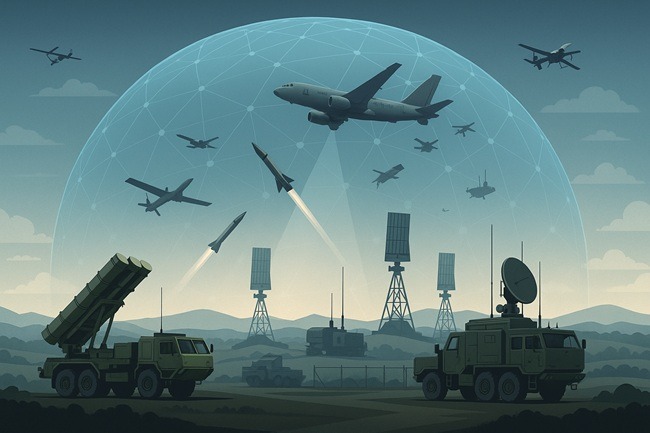
As threats multiply across cyber, air, land, sea, and space, Europe’s top defence contractors are rapidly moving away from traditional single-domain platforms toward integrated ecosystems designed for simultaneous, cross-domain conflict. The unveiling of Leonardo S.p.A.’s Michelangelo Dome in Rome marked a clear turning point, signaling that homeland defence in Europe is entering a new phase where modularity, artificial intelligence, and data fusion sit at the core of national security architecture.
The Michelangelo Dome, presented by Leonardo Chief Executive Officer Roberto Cingolani, is not just a missile defence system. It is a dynamic architecture combining terrestrial, naval, aerial, space-based, and cyber capabilities under one AI-coordinated command layer. It is capable of tracking hypersonic projectiles, neutralizing drone swarms, and identifying network-based threats before kinetic action begins. With this move, Leonardo joins a growing cohort of European defence giants who are reimagining their offerings not as standalone assets but as adaptive, integrated defence environments.
Why are European defence firms moving beyond traditional military platforms?
For much of the 20th and early 21st century, defence procurement in Europe was driven by hardware platforms such as aircraft, tanks, ships, and sensors, procured in isolation by domain and by nation. Today, however, the battlefield is converging. Conflicts in Ukraine, the Middle East, and the Indo-Pacific have made clear that a coordinated strike could include cyber intrusions, decoys, drones, and space jamming before the first conventional missile is launched.
European firms have responded by embedding systemic thinking into their product development pipelines. Thales Group has expanded its work in sovereign cloud cybersecurity and battlefield digital twins through its Nexium ecosystem, while Saab AB has pushed forward with integrated sensor networks and command solutions linked to its GlobalEye platform. Rheinmetall AG has evolved from an armoured vehicle supplier into a key partner in electronic warfare, air defence, and unmanned systems integration, including its work on Germany’s future short-range air defence projects.
At the centre of this pivot is the understanding that homeland defence is no longer about repelling invasions. It is about maintaining real-time situational awareness, threat anticipation, and countermeasure agility across all domains, especially in dense urban environments where civilian infrastructure and military targets are tightly interwoven.
How does the Michelangelo Dome embody the shift toward modular defence ecosystems?
Leonardo’s Michelangelo Dome serves as a case study in what next-generation homeland security may look like. Designed as a modular, scalable system, it connects layers of land, air, naval, and space sensors to AI-driven fusion engines that interpret signals, forecast probable threats, and assign the optimal effector to neutralize them within seconds.
Cingolani positioned the Dome not as a product, but as a platform architecture that nations can tailor based on infrastructure geography, national threat models, or NATO interoperability requirements. Leonardo has said the system is capable of defending against everything from hostile drones and hypersonic missiles to underwater sabotage and cyber infiltration.
The system’s strength lies in its ability to act as a node in a broader European or NATO command framework. Its open standards allow it to integrate into multinational joint operations while still enabling sovereign deployment decisions. This positions it as a competitive alternative to U.S.-led defence stacks, especially in countries looking to develop independent or hybrid defence strategies.
Why are NATO and EU member states prioritising multi-domain readiness?
The European Union has significantly increased defence funding through programs such as the European Defence Fund and Permanent Structured Cooperation, while NATO has been accelerating multi-domain exercise formats to test interoperability across national command structures. The shift is not merely conceptual. Russia’s electronic warfare tactics in Ukraine, China’s expanding space presence, and drone-based incursions in the Middle East have all pressured European states to redefine what national defence entails.
Recent defence white papers from France, Germany, and the Nordic bloc now explicitly reference multi-domain response capabilities as critical infrastructure. This includes layered radar networks, AI-enabled command platforms, autonomous underwater vehicles, and secured military cloud networks that must all speak to each other.
Saab’s 2025 updates to its GlobalEye airborne early warning and control aircraft, including its integration into cloud-linked ground command stations, reflect this urgency. Thales’ push into sovereign defence cloud capabilities also addresses this shift, as governments seek digital infrastructure that can survive cyber conflict and support kinetic decisions in real-time.
How are European firms using modularity to scale defence exports?
Beyond homeland deployment, modularity is also a strategy for export scalability. Traditional defence contracts often required long procurement cycles, geopolitical clearance, and maintenance footprints that only large powers could afford. With modular, software-defined architectures, firms like Leonardo, MBDA, and Hensoldt are now able to offer subsystem packages such as sensor suites, command modules, or cyber-integrated radar systems that can be adapted to regional needs.
This is particularly visible in Leonardo’s recent joint venture milestone with EDGE Group in the United Arab Emirates. That agreement, structured to allow EDGE 51 percent ownership and control over local manufacturing, will license components of Leonardo’s broader defence technology stack, including elements seen in the Michelangelo Dome. Products will be tailored to regional operational needs and export ambitions, with local development, training, and intellectual property customisation included.
Rheinmetall has followed a similar pattern through its partnerships in Hungary and Australia, allowing for on-site armoured vehicle assembly and integration of third-party sensor systems. These ecosystem-style engagements allow European original equipment manufacturers to remain competitive against turnkey American or Israeli packages by offering buyers more sovereignty and local value capture.
What technologies are defining the new multi-domain architecture race?
A few critical technologies are acting as cornerstones across the ecosystem race. First is AI-powered sensor fusion, which allows operators to derive a single situational picture from disparate data streams including radar, sonar, optical, signals intelligence, and cyber telemetry. Second is distributed, cloud-secured command and control, which permits decision-making to continue even when centralised networks are degraded.
Third is the rise of scalable effectors, which are weapons and countermeasures that can be software-swapped or mission-adapted in real-time. These include soft-kill counter-drone systems, electronic jammers, loitering munitions, and hypersonic interceptors. Finally, the ecosystem model is increasingly leaning on open architecture principles so that allies or coalition partners can integrate legacy systems into new response models.
Leonardo, for example, emphasised that Michelangelo Dome uses predictive algorithms to automate effector selection. Saab and Thales are both investing in tactical cloud overlays and deployable battlefield edge compute nodes to manage latency and threat prioritisation.
What does rising institutional interest mean for Europe’s modular defence strategies?
Investor sentiment across the European defence sector has shifted toward favouring companies that can anchor long-term strategic programs instead of relying on isolated platform wins. Analysts have repeatedly highlighted that systems like the Michelangelo Dome or the Future Combat Air System next-generation fighter programs offer not just visibility into future revenues, but lock-in opportunities across support, upgrade, and export lifecycles.
Leonardo S.p.A. has seen steady momentum throughout 2025, with its shares outperforming sector benchmarks. Institutional investors have praised its pivot from traditional airframes toward system-level integration. Thales and Rheinmetall have similarly attracted attention for their multiyear defence digitisation contracts and NATO alignment.
As geopolitical risk remains elevated and procurement budgets continue to rise across Europe, multi-domain defence ecosystems are now viewed not only as operational imperatives but as durable industrial strategies.
What’s next for Europe’s multi-domain defence vision?
Looking ahead to 2026, most of Europe’s leading defence firms are expected to consolidate research and development pipelines around modularity, real-time data fusion, and AI-enabled command frameworks. This includes further push into space-based intelligence, undersea warfare capabilities, and cyber resilience infrastructure.
The European Defence Agency has signaled that upcoming pan-European exercises will include ecosystem integration trials, with multi-nation command handoffs, AI-coordinated response drills, and edge compute deployments across combat domains.
Leonardo, Saab, and Thales are also expected to compete for new European Union homeland defence projects tied to critical infrastructure protection, port surveillance, and drone threat mitigation in civilian airspace. The Michelangelo Dome, GlobalEye updates, and Thales’ battlefield cloud stack are likely to be centrepieces of these bids.
Ultimately, Europe’s pivot from platforms to ecosystems is not just about keeping pace with adversaries. It is about redefining what sovereignty and deterrence mean in an age where the battlefield is everywhere and the next attack could come from land, sea, space, or code.
Discover more from Business-News-Today.com
Subscribe to get the latest posts sent to your email.