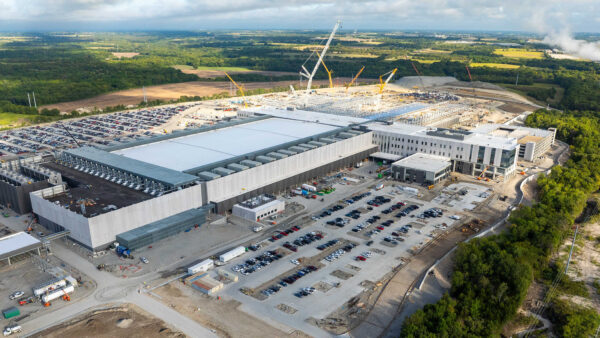
Global Infrastructure Partners, the BlackRock-owned infrastructure investment giant, is in advanced negotiations to acquire Aligned Data Centers from Macquarie, in a transaction that could value the data center operator at around $40 billion. According to sources cited by Reuters, the discussions remain ongoing and no final agreement has yet been signed, but the scale of the potential acquisition underlines how data centers have become central to the global infrastructure race driven by artificial intelligence and cloud computing.
If completed, the deal would rank among the largest private data center acquisitions ever attempted, putting GIP in direct competition with sovereign wealth funds, private equity players, and hyperscale operators that are aggressively building capacity to meet rising AI workloads. The talks are also notable for the involvement of Abu Dhabi-based MGX, an artificial intelligence investment vehicle backed by Mubadala Investment Company and G42, which could participate in the deal as an investor.
Why does the Aligned Data Centers deal matter for the future of AI infrastructure?
The appeal of Aligned lies in its role as a rapidly expanding data center platform designed for high-density computing. Headquartered in Texas, the company operates close to 80 data centers and campuses across the United States, Canada, and Latin America. It has built a reputation for advanced cooling technologies, scalable designs, and customer focus on AI-driven enterprises and cloud platforms.
Industry observers have long noted that Aligned’s facilities cater to next-generation workloads, with power and space specifically designed for graphics processing units (GPUs) and large-scale machine learning infrastructure. Its clients reportedly include Lambda, an AI computing firm that specializes in training models at scale, which highlights how the company is directly embedded in the AI supply chain.
For GIP, acquiring such a platform would provide exposure to one of the most dynamic infrastructure classes in the world. Traditional infrastructure assets like airports, toll roads, and pipelines continue to attract capital, but digital infrastructure—particularly data centers—has emerged as the defining growth story of the decade. With global AI demand expected to triple data center power needs by 2030, the race to secure capacity is already reshaping investment strategies.
How the potential GIP–Aligned $40 billion deal stacks up against other recent mega transactions in the global digital infrastructure sector
At an estimated $40 billion, the Aligned transaction would eclipse many of the recent headline-grabbing deals in the data center sector. It comes just months after KKR and Global Infrastructure Partners jointly pursued other high-value assets in telecom and fiber networks. Blackstone, Brookfield, and EQT have also been actively competing for hyperscale data center platforms across North America and Europe.
What distinguishes this deal is not only its size but also the convergence of private infrastructure investors with sovereign funds and AI-focused entities like MGX. The involvement of Mubadala underscores how Middle Eastern capital is positioning itself at the center of the AI infrastructure buildout. Sovereign wealth funds in the Gulf have moved rapidly into digital infrastructure, both to diversify away from hydrocarbons and to secure a role in technologies underpinning the AI economy.
If the GIP–Aligned deal closes, it would rival the largest private infrastructure acquisitions globally and set a new benchmark for valuations in the sector. The reported valuation also indicates how aggressively investors are pricing in long-term AI demand, even as questions persist about oversupply and the sustainability of hyperscale growth.
What role could MGX and Middle Eastern capital play in the transaction?
Reuters reporting indicated that MGX, the AI-focused investment firm backed by Mubadala and Abu Dhabi’s G42, may take part in the Aligned deal. This adds another layer of geopolitical and financial significance. Mubadala already holds a minority stake in Aligned, which means its exposure would deepen if the new consortium structure materializes.
The participation of MGX also reflects a broader strategy by Abu Dhabi to establish itself as a global hub for AI investment. By linking sovereign wealth capital with AI-specific vehicles, the region has positioned itself as a critical partner for Western firms seeking both capital and access to energy-rich, geopolitically stable environments.
For GIP, the involvement of MGX may help derisk the financing and provide a strategic partner with long-term horizons. For Aligned, this could mean additional financial flexibility and access to markets beyond North America.
How does the potential acquisition link to GIP’s broader infrastructure strategy?
Global Infrastructure Partners is already one of the world’s most influential infrastructure investors, with more than $100 billion in assets under management. Now owned by BlackRock following a $12.5 billion acquisition earlier this year, GIP has been repositioning its portfolio toward the sectors that will dominate long-term growth: renewable energy, digital infrastructure, and power.
The Aligned discussions come alongside another major development. Reports earlier this week suggested that GIP is pursuing a $38 billion takeover of U.S. utility company AES Corporation. The near-simultaneous pursuit of Aligned and AES signals a bold strategic vision: combining control of both the compute infrastructure (data centers) and the power infrastructure (utilities) that will fuel AI and cloud workloads.
This dual strategy reflects the reality that AI infrastructure is constrained not only by chips and servers but also by electricity. In many regions, access to reliable, carbon-managed power has become the bottleneck for scaling data centers. By securing both data centers and a power utility, GIP could gain unique leverage in the AI economy.
What regulatory, financing, and integration risks could still derail the potential $40 billion GIP–Aligned Data Centers acquisition deal
Despite its scale and strategic fit, the Aligned deal is not guaranteed to close. Sources told Reuters that the transaction remains under negotiation and terms may still change. Financing is likely to be complex, given the size of the transaction and current credit market conditions.
Regulatory scrutiny also looms. Governments worldwide are paying closer attention to foreign participation in critical infrastructure like data centers, which handle sensitive data and power critical AI applications. A deal of this magnitude could face reviews from U.S. and Canadian regulators, especially with sovereign wealth involvement from the Gulf.
Integration risks are also significant. Aligned’s portfolio spans multiple geographies and regulatory environments, and managing such assets at scale requires operational expertise. Moreover, the rapid technological evolution in AI infrastructure means that facilities could require accelerated capital expenditures to remain competitive.
What does this signal for the future of AI, data centers, and global investment flows?
From a sectoral perspective, the reported deal underscores how digital infrastructure has become a new form of critical infrastructure. Investors now treat data centers in the same category as ports, railroads, and energy grids, with the added dimension that they are directly linked to the AI revolution.
Institutional sentiment is bullish. Analysts say that the willingness of GIP to pursue such a massive acquisition shows that large asset managers are confident AI will sustain elevated demand for compute, power, and digital services. For Aligned, being backed by a heavyweight like GIP and potentially supported by MGX could accelerate its ability to deliver capacity in high-demand markets.
For Macquarie, exiting Aligned at a $40 billion valuation would represent a strong return and free capital for redeployment. Macquarie has long been a pioneer in infrastructure investing and would likely reinvest in emerging digital or energy transition assets.
Looking forward, the ripple effect of this deal could be profound. Other infrastructure investors may feel pressure to scale up their digital strategies, and hyperscalers like Amazon Web Services, Microsoft Azure, and Google Cloud may accelerate their own co-investment models to keep pace.
How the potential GIP–Aligned $40 billion deal could reshape the future of infrastructure investing in the AI era
From my perspective, the GIP–Aligned discussions are more than just another mega acquisition. They reflect a structural shift in how infrastructure investors are thinking about the future. In the past, infrastructure funds sought stable, regulated returns from airports, pipelines, or utilities. Today, they are positioning themselves at the cutting edge of AI-driven growth.
The strategic linkage between compute infrastructure and power infrastructure may become a defining theme of the next decade. Investors that can integrate both will not only benefit from the growth of AI but also manage the bottlenecks that could otherwise constrain the sector.
If GIP succeeds in acquiring both Aligned and AES, it will stand as one of the first global players with meaningful control over the full AI stack, from electrons to algorithms. That, in turn, could influence how regulators, sovereign funds, and competitors respond.
Discover more from Business-News-Today.com
Subscribe to get the latest posts sent to your email.