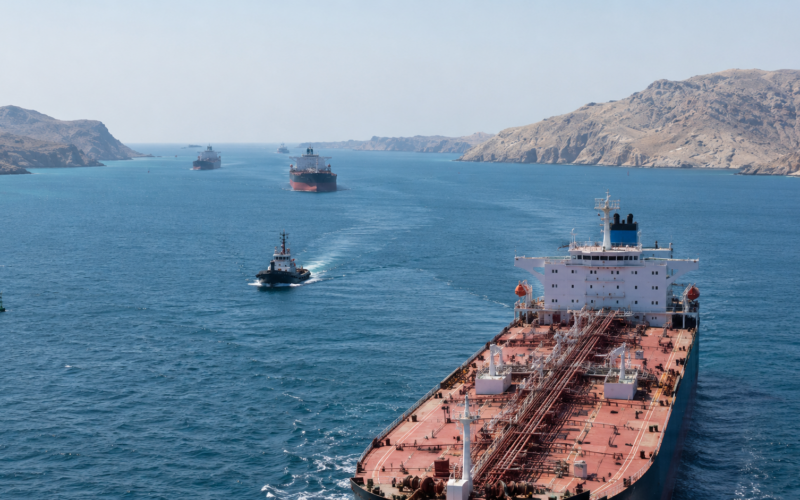
A proposed agreement between Iran and Oman could give Tehran operational control over commercial ships entering the Gulf through the Strait of Hormuz, potentially transforming the legal, security and economic framework governing the world’s most important energy shipping route.
Iranian officials said on August 5, 2026, that negotiations with Oman had reached fundamental understandings and were close to finalisation. The proposed arrangement would direct commercial vessels through Iranian territorial waters on both inbound and outbound journeys, although the scope of Iranian authority over departing ships remained unresolved.
No final agreement had been announced by the morning of August 6. The United States had not publicly accepted the reported terms, and regional officials cautioned that major disagreements remained over inspections, supervision, shipping fees and the meaning of operational control.
Iran is reportedly seeking charges equivalent to between 5% and 7% of the value of cargo carried through the Strait of Hormuz. Oman has discussed a lower figure of approximately 3%, while Washington has maintained that international shipping should pass through the waterway without tolls.
The negotiations are intended to support a broader settlement after five months of war involving Iran, the United States and Israel. President Donald Trump said discussions appeared to be progressing positively, but Iranian officials said no direct talks with the United States had taken place during the latest negotiating period.
The emerging proposal therefore represents a possible diplomatic breakthrough without yet constituting a completed peace or navigation agreement. Its final form could determine whether the Strait of Hormuz reopens as a predictable international waterway or becomes a route in which Iran gains formal authority to inspect, approve and charge vessels entering the Gulf.
What is actually proposed in the Iran and Oman Strait of Hormuz arrangement?
The reported proposal would change the routes used by commercial vessels entering and leaving the Gulf.
Iranian Deputy Foreign Minister for Legal and International Affairs Kazem Gharibabadi said the arrangement was being designed so that commercial ships would pass through Iranian territorial waters during both inbound and outbound journeys. Kazem Gharibabadi said Iran and Oman had reached fundamental understandings and were close to completing the process.
Iran and Oman are the two coastal states bordering the Strait of Hormuz. Both countries possess territorial waters in and around the narrow passage, while the established navigation system includes separated shipping lanes intended to reduce collision risks and maintain an orderly flow of traffic.
The International Maritime Organization adopted the existing traffic separation scheme after it was proposed by Iran and Oman in 1968. Any permanent change to routes, inspection procedures or maritime services would therefore require technical coordination as well as political agreement.
The most important unresolved issue is what Iranian control would mean in practice. Control could involve monitoring vessel identities and cargo, approving passage, providing navigational services, conducting inspections or requiring payment before a ship enters the Gulf.
Gulf governments are seeking limits on unilateral Iranian authority. Regional negotiators want inspections to be supervised by Gulf states and any payment system to remain voluntary rather than becoming a compulsory Iranian toll.
The difference between monitoring and permission is fundamental. A coordinated maritime management system could improve safety, while a system allowing Iran to decide which vessels may pass would give Tehran significant leverage over Gulf economies and international energy markets.
Why would Iranian control of inbound Gulf traffic mark a major strategic shift?
Before the 2026 conflict, commercial shipping generally passed through the Strait of Hormuz without paying Iran or seeking political approval from Tehran.
Iran has long argued that its position on the northern side of the strait gives it substantial security responsibilities and sovereign rights. Iran has also maintained that foreign military deployments and sanctions have threatened Iranian ports, vessels and national security.
The proposed arrangement could convert Iran’s wartime ability to disrupt shipping into recognised administrative authority. Tehran would move from imposing restrictions through military power towards participating in a formal system governing international passage.
Such an outcome would represent a strategic gain because Iran would influence the entry route used by tankers and cargo ships supplying Saudi Arabia, the United Arab Emirates, Qatar, Kuwait, Bahrain and Iraq.
The effect would extend beyond oil exports. Gulf states import food, machinery, vehicles, construction materials and consumer goods through ports located inside the waterway. Control over inbound traffic could therefore create leverage over the wider economic life of the region.
Washington entered the war seeking to weaken Iran’s military capabilities and restore unrestricted shipping. An agreement that formalised Iranian control could instead allow Tehran to present the conflict as having produced greater recognition of its regional authority.
The practical importance would depend on safeguards. Transparent traffic management conducted jointly with Oman and monitored internationally would be different from a system allowing Iran to delay, inspect or refuse vessels based on nationality, ownership, cargo or political relationships.
How do the proposed shipping fees conflict with existing international maritime law?
Iran is reportedly seeking a fee worth between 5% and 7% of the value of cargo carried through the Strait of Hormuz.
A charge calculated as a percentage of cargo value would be commercially significant. A tanker carrying crude oil worth tens of millions of dollars could face a payment running into several million dollars for one passage.
Oman has discussed a possible charge closer to 3%, while the United States continues opposing mandatory tolls. The gap is not merely a disagreement over price because the legal basis for charging ships remains disputed.
The United Nations Convention on the Law of the Sea provides ships and aircraft with a right of transit passage through straits used for international navigation. States bordering those straits may regulate navigation, safety, pollution and traffic separation, but they cannot simply obstruct transit passage.
International maritime law also distinguishes between tolls imposed solely for passage and charges collected for specific services. A coastal state may be able to recover costs for services provided to a vessel, but a compulsory payment based only on cargo value would face substantial legal objections.
Iran could describe the proposed charges as payment for security, navigation, inspection or administrative services. Other governments could argue that the system amounts to a toll on international passage and gives Iran powers inconsistent with established navigation rights.
Any final agreement would therefore need to define the service being supplied, the body collecting the money, the calculation method and the consequences when a ship refuses to pay.
The dispute could eventually involve the International Maritime Organization, flag states, shipping associations and insurers. A system accepted by Iran and Oman but rejected by major trading powers would not automatically restore confidence among commercial operators.
Why is Oman central to the agreement and why has Muscat not confirmed the reported terms?
Oman controls the southern side of the Strait of Hormuz and has positioned itself as a neutral diplomatic intermediary throughout the conflict.
The Omani government has held repeated discussions with Iran, the United States, Gulf governments and the International Maritime Organization. Oman also helped establish temporary corridors intended to move commercial vessels through the strait during periods of severe disruption.
Oman and Iran agreed in June to create a joint working group addressing future navigation administration, maritime services and associated costs. Both governments also reaffirmed that the strait should remain open and secure under applicable international law.
Oman’s publicly stated position has consistently emphasised freedom of navigation and passage without transit fees. That position does not fully align with reports that Oman is discussing a 3% charge or accepting Iranian control over inbound traffic.
The difference could reflect unfinished negotiations rather than an Omani policy reversal. Oman may be examining payments for specific services while rejecting a compulsory toll, or discussing Iranian involvement without accepting unrestricted Iranian authority.
Muscat must balance several interests. Oman wants to prevent renewed war, maintain constructive relations with Iran, protect Gulf trade and preserve its reputation as a neutral mediator trusted by Western and regional governments.
A final agreement that appears to surrender international navigation rights to Iran could damage that reputation. Oman is therefore likely to demand clear legal safeguards, shared administration and an arrangement that can be defended as compatible with international law.
How did the United States and Iran war turn the Strait of Hormuz into a bargaining tool?
The conflict began on February 28, 2026, when the United States and Israel launched military operations against Iran.
Iran responded through missile and drone attacks, restrictions on maritime passage and operations against vessels that Tehran considered hostile or unauthorised. Commercial shipping declined as attacks, naval deployments and insurance costs made the route increasingly dangerous.
The International Maritime Organization confirmed at least 46 attacks against international shipping around the Strait of Hormuz during the conflict. Seafarers were killed, vessels were damaged and shipping companies faced uncertainty over whether safe passage guarantees would be honoured.
An interim understanding reached in June was intended to stop major military operations and begin restoring shipping. Traffic increased, but the settlement did not resolve who would administer passage or whether Iran could impose permanent conditions.
The United States later prepared renewed attacks on Iranian infrastructure after accusing Tehran of failing to implement earlier commitments. President Donald Trump cancelled the planned operation on August 2 while diplomacy continued.
Iran has made reopening the strait conditional on broader security guarantees and compliance with the ceasefire framework. Tehran argues that it cannot be expected to provide unrestricted maritime security while its territory, infrastructure and vessels remain under threat.
The strait has therefore become the principal bargaining asset in the conflict. Iran’s ability to disrupt energy trade gives Tehran negotiating power that its conventional military and economic position might not otherwise provide.
Why are Saudi Arabia, Qatar and other Gulf states deeply exposed to the negotiations?
Gulf states require a stable Strait of Hormuz to export energy and maintain imports essential to their domestic economies.
Saudi Arabia and the United Arab Emirates possess pipelines that can bypass part of the strait, but those alternatives cannot replace the full volume of regional oil and petroleum products normally shipped through the waterway.
Qatar faces even greater exposure because most of its liquefied natural gas exports move by tanker through the Strait of Hormuz. Extended disruption can affect buyers across Asia and Europe that depend on Qatari gas for electricity generation and industrial demand.
Gulf governments are also concerned that renewed American attacks could trigger Iranian retaliation against oil fields, refineries, electricity grids, water infrastructure, ports and transport networks.
Iran conveyed warnings through high-level regional contacts that a new attack on Iranian infrastructure would produce strikes against United States assets and Gulf energy facilities. Saudi Arabia urged President Donald Trump to delay military action and return to negotiations.
The Gulf states therefore face a difficult choice. They do not want Iran controlling their principal maritime entrance, but they also want to avoid a renewed war that could damage the same ports and energy facilities the agreement is intended to protect.
Saudi Arabia, Qatar and Oman are pressing for a settlement that restrains both Washington and Tehran. Their objective is not necessarily to support Iranian authority but to prevent the regional economic destruction that could follow another cycle of attacks.
How could a new Hormuz system affect oil prices, liquefied natural gas and shipping insurance?
The Strait of Hormuz carried about 20.7 million barrels per day of crude oil and petroleum products during the final quarter of 2025.
Flows declined sharply during the first quarter of 2026 after the war began, illustrating how military risk can reduce traffic through the chokepoint even without a permanent physical closure.
A credible agreement could lower oil prices by reducing the probability of renewed attacks and allowing producers to restore exports. Shipping companies would be more willing to return when governments, insurers and crews believe passage is predictable.
A compulsory fee could offset some of those benefits. Oil and liquefied natural gas exporters would need to decide whether they absorb the charge, pass it to customers or attempt to use alternative routes.
Insurance premiums would depend on more than a diplomatic announcement. Insurers will examine whether attacks have stopped, whether vessels can transit without political discrimination and whether the inspection system creates delays or detention risks.
Shipping schedules could become less reliable if every vessel requires approval or inspection. Queues near the strait would create additional fuel costs and could expose ships to security threats while waiting.
Energy markets may initially respond positively to any reopening plan, but long-term confidence will depend on the legal and operational details. A waterway that is technically open but subject to uncertain Iranian permission would still carry a substantial geopolitical risk premium.
What must be resolved before commercial shipping can return to predictable operations?
Iran and Oman must first agree on the precise coordinates of the inbound and outbound routes.
The two governments must then define who manages vessel traffic, who conducts inspections and which information ships must provide before entering the strait.
Any fee system requires equal clarity. Negotiators must determine whether payments are mandatory, voluntary or limited to identifiable services such as escort, navigation support or emergency assistance.
The arrangement must also specify how military vessels, sanctioned ships, Israeli-linked cargoes and vessels serving United States forces will be treated. Those categories create the greatest risk of political disputes and selective enforcement.
International acceptance is another requirement. Shipping companies cannot rely only on promises from coastal governments when flag states, insurers and cargo owners believe the system violates navigation rights.
A monitoring mechanism may be needed to investigate delays, attacks or disputed inspections. The International Maritime Organization could provide technical expertise, but enforcement would ultimately depend on the political commitments of Iran, Oman, the United States and the Gulf states.
The wider ceasefire must also remain intact. A navigation agreement cannot provide lasting stability if missile strikes, drone attacks or threats against energy infrastructure resume elsewhere in the region.
The negotiations are close enough to influence oil prices and diplomatic calculations, but they remain too incomplete to describe the Strait of Hormuz as permanently reopened or placed under an agreed new administration.
What are the key takeaways from the proposed Iran and Oman Strait of Hormuz agreement?
- Iran and Oman are negotiating a new navigation arrangement that could route commercial ships through Iranian territorial waters on both inbound and outbound Gulf journeys, although the final structure and Iranian authority remain unresolved.
- Iranian Deputy Foreign Minister for Legal and International Affairs Kazem Gharibabadi said fundamental understandings had been reached, but no completed agreement had been publicly issued by Iran, Oman or the United States by August 6.
- Iran is reportedly seeking charges worth between 5% and 7% of cargo value, while Oman has discussed approximately 3% and the United States continues opposing compulsory tolls on international shipping.
- Oman’s published position emphasises freedom of navigation, international law and passage without transit fees, creating uncertainty over whether Muscat accepts the control and payment terms described by officials familiar with the negotiations.
- The Strait of Hormuz carried about 20.7 million barrels per day of oil and petroleum products before the 2026 conflict sharply reduced traffic and increased insurance, security and shipping costs.
- The International Maritime Organization confirmed at least 46 attacks on international shipping around the strait after the United States and Israel began military operations against Iran on February 28, 2026.
- Saudi Arabia, Qatar and other Gulf states want to prevent renewed American strikes because Iran has warned that another attack could trigger retaliation against regional oil fields, refineries, ports, electricity grids and water infrastructure.
- Commercial confidence will depend on agreed routes, transparent inspection rules, lawful service charges, international monitoring and a durable ceasefire rather than only a political announcement that the waterway has reopened.
Discover more from Business-News-Today.com
Subscribe to get the latest posts sent to your email.