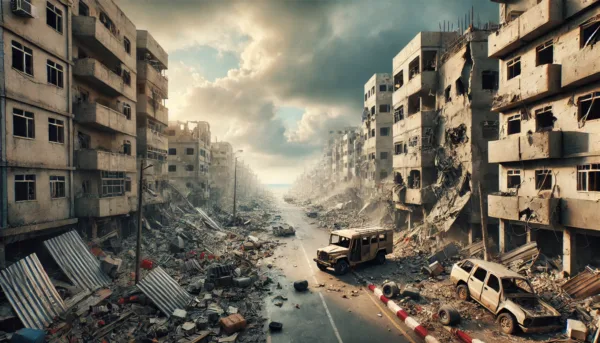





Iran launched a coordinated campaign of ballistic missiles and drones against Israel and all six member states of the Gulf Cooperation Council beginning on 28 February 2026, designating the operation as Operation True Promise IV. The Islamic Revolutionary Guard Corps and the Iranian Army initiated the campaign within hours of joint United States and Israeli strikes on Iranian territory that same day. The strikes marked the first occasion in history that Iran had simultaneously targeted all six Gulf Cooperation Council members, representing a fundamental shift in Tehran’s regional military posture.
The United States commenced strikes against Iran under Operation Epic Fury on 28 February 2026. Israel conducted its parallel campaign under the designation Operation Roaring Lion. United States President Donald Trump confirmed that United States forces had begun major combat operations in Iran with the objective of ensuring Iran could not develop a nuclear weapon and of eliminating what the administration described as imminent threats from the Iranian regime. Israeli Prime Minister Benjamin Netanyahu stated that Israel acted to remove an existential threat. Strikes targeted Iran’s nuclear facilities, military infrastructure, and government compounds across multiple cities including Tehran, Isfahan, Shiraz, Tabriz, Bushehr, Qom, and Karaj.
The conflict followed the collapse of a diplomatic process that had, until days before hostilities began, appeared to be approaching a resolution. Oman’s Foreign Minister Badr Al-Busaidi declared on 27 February 2026 that a breakthrough had been reached, with Iran reportedly agreeing to never stockpile enriched uranium, to full International Atomic Energy Agency verification, and to irreversibly downgrade its enriched uranium stockpile to the lowest feasible level. Iranian Foreign Minister Abbas Araghchi had stated on 25 February 2026 that a historic agreement was within reach. The United States and Israel launched their strikes the following day, one day before a scheduled resumption of talks.
Why Iran targeted all Gulf Cooperation Council states simultaneously for the first time in the modern era
Iran’s primary stated targets were United States military installations across the region. The Islamic Revolutionary Guard Corps reported strikes on Al Udeid Air Base in Qatar, Ali Al Salem Air Base in Kuwait, Al Dhafra Air Base in the United Arab Emirates, and the United States Navy Fifth Fleet headquarters at Naval Support Activity Bahrain. Iran also targeted Israeli military and civilian infrastructure in Tel Aviv and Haifa. However, Iranian strikes extended well beyond military sites, striking civilian airports, energy refineries, residential buildings, and maritime shipping routes throughout the Persian Gulf.
The United Arab Emirates sustained the highest volume of strikes in the opening phase, with its Ministry of Defense confirming engagement of 165 ballistic missiles, two cruise missiles, and 541 drones. Kuwait intercepted 97 ballistic missiles and 283 drones, while also absorbing strikes on Kuwait International Airport and residential buildings. Kuwait’s civil aviation authority confirmed that drones hit fuel storage facilities at Kuwait International Airport. A child died from injuries sustained when drone debris fell on a residential area in Kuwait. Four Kuwaiti soldiers and four civilians were killed. Bahrain sustained 32 missiles and 234 drones over the period to 18 March, with damage to the Bahrain Petroleum Company refinery in the Sitra area and a residential building in Manama’s Seef district.
Saudi Arabia, which had normalized diplomatic relations with Iran in 2023, was also targeted. Jordan reported 204 combined missiles and drones over the course of the campaign to 18 March. Qatar intercepted Iranian missiles aimed at Al Udeid Air Base, with missile debris falling on a food storage warehouse and causing fires. Oman, the least affected state, recorded 16 drone strikes resulting in limited infrastructure damage and no reported casualties.
How the US-Israeli air campaign degraded Iran’s ballistic missile launch capacity within the first three weeks
In Israel, Iran’s multilayered air defense system achieved a 92 percent interception success rate against incoming Iranian missiles across the initial salvos. Approximately 90 missiles were fired at Israel on the first day, declining to approximately 60 on the second. The single largest casualty event in Israel occurred on 1 March when a missile struck a residential neighborhood in Beit Shemesh, 18 miles southwest of Jerusalem, killing nine civilians. A missile also struck a building in Tel Aviv, killing one person and injuring dozens. At least 17 Israeli civilians had been killed and more than 4,000 injured as of mid-March.
United States and Israeli counter-strikes progressively degraded Iran’s missile launch infrastructure. Israeli officials stated that the Israel Defense Forces had destroyed or disabled more than 330 of an estimated 470 Iranian ballistic missile launchers. United States Central Command reported that ballistic missile launch rates declined by approximately 90 percent from their peak by the tenth day of the conflict. Iranian missile production was reported at zero according to Israeli intelligence estimates by mid-March, with United States and Israeli strikes also targeting Iran’s defense industrial base and setting back key defense programs by an estimated several years. By 24 March, Iran had conducted 79 waves of missile and drone strikes under Operation True Promise IV, with the frequency and scale of each wave declining substantially from the initial salvos.
What the disruption of the Strait of Hormuz means for global energy markets and Gulf state stability
Iran’s campaign substantially disrupted maritime transit through the Strait of Hormuz, through which approximately one-fifth of global oil supply passes. Shipping slowed to a near standstill at peak disruption, with 150 freight ships including large numbers of oil tankers stalled in the waterway. Iran also struck two oil tankers off the coast of Oman. On 18 March, Israel struck the South Pars natural gas field in the Persian Gulf and neighboring refineries inside Iran. Iran retaliated by attacking Qatar’s liquefied natural gas production facility, the largest in the world. President Trump stated he was unaware of the South Pars strike, pledged there would be no further Israeli attacks on Iranian oil infrastructure, and warned Iran against continuing strikes on Qatari energy assets. Oil prices rose in response to the combined disruptions.
United States casualties in the region reached at least 13 fatalities confirmed by United States Central Command. The Shuaiba port in Kuwait was the site of the first confirmed United States casualties. A refuelling aircraft crash in western Iraq on 13 March killed all six crew members. A friendly fire incident on 2 March resulted in a Kuwaiti F/A-18 shooting down three United States F-15E aircraft; all six crew survived. The United States Embassy in Kuwait was struck by an Iranian missile, prompting its closure. The United Kingdom initially reported strikes against British bases in Cyprus before subsequently clarifying no such strikes had occurred. A British Royal Air Force runway at the Akrotiri base in Cyprus was later struck by an Iranian drone.
How the 15-point US framework delivered through Pakistan reflects the state of ceasefire diplomacy as of late March 2026
President Trump stated on 24 March 2026 that the United States and Iran were in active negotiations and that Iranian interlocutors were communicating in good faith. Trump described Iran as having offered what he called a very significant prize related to energy flows through the Strait of Hormuz. The New York Times reported that the United States had transmitted a 15-point framework plan to Iran via Pakistan. Separately, Trump stated that Iran had agreed it would never develop a nuclear weapon, without providing further detail.
Iran’s Foreign Ministry denied that direct negotiations were taking place, while acknowledging that it was responding to messages through intermediaries. Pakistan, Turkey, Egypt, and Oman were confirmed as active intermediaries. Pakistan’s Prime Minister offered publicly to host talks, an offer Trump signaled interest in. Two regional sources indicated that Iran preferred to engage with Vice President JD Vance rather than Witkoff or Kushner, viewing Vance as more oriented toward concluding the conflict. Trump confirmed Vance, Rubio, and others were leading the United States negotiating effort.
Axios reported that the United States was waiting on a decision from Iranian authorities, possibly including the new Supreme Leader Mojtaba Khamenei, on whether to proceed with talks. The identity of the lead Iranian interlocutor remained unclear given the disruption to Iran’s leadership structure following the killing of Ayatollah Ali Khamenei in the initial United States and Israeli strikes. United States and Israeli officials were reported to be planning for an additional two to three weeks of military operations regardless of whether talks proceeded. One mediating country proposed a temporary ceasefire to enable detailed negotiations, but the Trump administration indicated it preferred to negotiate under continued military pressure to preserve leverage.
Iran’s Foreign Minister Araghchi stated at the Iranian foreign ministry’s final press conference of the Iranian calendar year that Iran was not seeking a ceasefire but that the war must end in a manner that ensures adversaries do not repeat such attacks. He confirmed Iran had entered prior diplomatic talks with open eyes and accused Washington of ultimately undermining the diplomatic process. The spokesperson Baghaei rejected European calls for Iran to halt hostilities, stating it was unreasonable to ask a country under attack to end a war it did not start.
Key takeaways on what Iran’s Operation True Promise IV means for the Gulf, Israel, and global energy security
- Iran launched Operation True Promise IV on 28 February 2026 in direct retaliation for joint United States and Israeli strikes on Iranian nuclear, military, and government facilities, marking the most expansive Iranian military offensive in the modern era.
- For the first time in history, Iran targeted all six Gulf Cooperation Council member states simultaneously, striking civilian infrastructure, energy facilities, and airports alongside United States military bases in Bahrain, Kuwait, Qatar, Saudi Arabia, the United Arab Emirates, and Oman.
- United States Central Command confirmed Iranian missile launch rates declined by approximately 90 percent from peak levels within ten days, attributed to United States and Israeli strikes that destroyed more than 330 of an estimated 470 Iranian ballistic missile launchers and reduced Iranian missile production to zero.
- Iran’s near-closure of the Strait of Hormuz and strikes on Qatar’s liquefied natural gas infrastructure triggered global oil price rises and stranded more than 150 tankers, with the United States, Pakistan, Turkey, Egypt, and Oman engaged in back-channel efforts to restore passage as of late March 2026.
- As of 24 March 2026, the United States transmitted a 15-point framework to Iran via Pakistan but both governments offered conflicting accounts of whether formal negotiations were underway, with United States and Israeli officials simultaneously planning for two to three more weeks of military operations.
Discover more from Business-News-Today.com
Subscribe to get the latest posts sent to your email.