

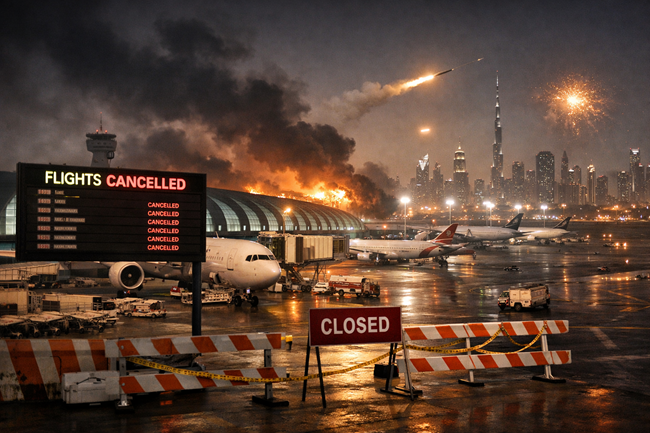
Dubai International Airport, the world’s busiest airport for international flights, suspended all flight operations on Saturday, February 28, 2026, after the United Arab Emirates, Kuwait, Bahrain, Qatar and Jordan became targets of Iranian retaliatory strikes following a coordinated military offensive launched by the United States and Israel against the Islamic Republic of Iran. The disruption to aviation, which resulted in the cancellation of more than 1,800 regional flights, ranks among the most severe interruptions to global commercial air travel since the COVID-19 pandemic grounded flights worldwide in 2020.
Dubai Airports confirmed in an official statement that all operations at Dubai International Airport and Dubai World Central, Al Maktoum International Airport, had been suspended until further notice. Passengers were urged not to travel to either facility and to contact their airlines directly for the latest updates. Dubai International Airport handles more than 1,000 flights per day and serves as the primary international hub for Emirates airline, one of the largest carriers by international passenger volume in the world. Disruptions to its operations carry cascading effects for global flight connectivity, particularly on long-haul routes linking Europe, Africa and South Asia to East Asia and Australasia.
Dubai Airports subsequently confirmed that one concourse at Dubai International Airport sustained minor damage in a related incident that was quickly contained. Four members of staff were injured and received prompt medical attention. The Dubai Media Office stated that most of the airport’s terminals had been cleared of passengers in advance, owing to contingency plans that had already been activated before the incident occurred. Debris from an intercepted Iranian drone caused a minor fire on the outer facade of the Burj Al Arab hotel. The Fairmont The Palm hotel on Dubai’s Palm Jumeirah island also sustained fire damage, causing four injuries, after being struck by debris from an intercepted Iranian missile.
How did United States and Israeli military operations against Iran on February 28, 2026 trigger the closure of Dubai International Airport and Gulf airspace?
The United States and Israel launched the coordinated military offensive, designated Operation Epic Fury by the United States Department of Defense and Operation Lion’s Roar by the Israeli military, in the early hours of Saturday, February 28, 2026. Targets included the Iranian capital Tehran, as well as the cities of Isfahan, Qom and Karaj. The Israeli Air Force stated that approximately 200 fighter jets struck around 500 military targets in western and central Iran, including air defense installations and ballistic missile launch systems. United States President Donald Trump confirmed the launch of operations in a public address delivered at 2:30 a.m., stating the objective was to defend the American people by eliminating what he characterised as imminent threats from the Iranian regime, with specific reference to Tehran’s nuclear programme.
United States President Trump and Israeli Prime Minister Benjamin Netanyahu both called, in separate statements, on the Iranian people to pursue what they described as an opportunity for self-governance. This offensive follows a previous round of coordinated United States and Israeli strikes in June 2025, which at that time targeted Iran’s stockpile of ballistic missiles. United States military planners had indicated to multiple news organisations that the February 28 campaign was planned to continue for several days, suggesting broader operational objectives than the June 2025 strikes.
What is known about the death of Iranian Supreme Leader Ayatollah Ali Khamenei in the United States and Israeli strikes on Iran?
Iranian Supreme Leader Ayatollah Ali Khamenei, who had led the Islamic Republic of Iran since 1989 following the death of the Republic’s founder Ayatollah Ruhollah Khomeini, was killed in the course of the February 28, 2026 strikes. Iranian state media confirmed his death on Saturday. Khamenei, who was 85 years old, held ultimate constitutional authority over Iran’s military, judicial and foreign policy apparatus under the framework of the Islamic Republic of Iran. His death represents the most significant leadership disruption in the four-and-a-half-decade history of the Islamic Republic.
United States President Trump publicly confirmed that Khamenei had been killed, describing him as one of the most evil people in history. Iran’s Islamic Revolutionary Guard Corps subsequently issued a public threat to launch what it described as the most ferocious offensive operation in the history of the armed forces of the Islamic Republic of Iran against Israel and United States military assets. The Islamic Republic of Iran’s Supreme National Security Council stated that the joint United States and Israeli attacks would begin what it described as a massive uprising against the world’s oppressors. The Iranian government issued a formal statement describing the strikes as a great crime that will never remain unanswered.
Which Gulf states were struck by Iranian retaliatory missiles and drones after the United States and Israel attacked Iran on February 28, 2026?
Iran confirmed retaliatory attacks on Bahrain, Kuwait, Qatar and the United Arab Emirates, all of which host United States military assets. The Islamic Revolutionary Guard Corps claimed through official channels that all Israeli and United States military targets across the Middle East had been struck by Iranian missiles, and declared that the retaliatory operation would continue relentlessly. The scope of Iranian retaliation extended beyond United States military installations and struck civilian infrastructure including airports, hotels and residential districts across multiple countries.
In the United Arab Emirates, the Ministry of Defence stated that air defence systems destroyed 132 Iranian missiles and intercepted 195 Iranian drones during the retaliatory barrage. Iranian Shahed-136 drones targeted the area proximate to the Burj Khalifa tower in Dubai, prompting an evacuation order and activation of the building’s emergency protocol. One person was killed and seven others were injured at Zayed International Airport in Abu Dhabi during a drone strike. A residential building on the outskirts of Doha, the capital of Qatar, was also struck. At Kuwait International Airport, a drone strike caused material damage to the passenger terminal building and left a number of airport employees with minor injuries. Abdullah al-Rajhi, spokesperson for the General Authority of Civil Aviation in the State of Kuwait, confirmed the incident. The Kuwaiti Ministry of Foreign Affairs stated that Kuwait maintains its right to defend itself.
In Bahrain, a missile attack targeted the headquarters of the United States Navy’s 5th Fleet in the capital city of Manama. The Bahraini government described the strike as a treacherous attack and a blatant violation of the Kingdom of Bahrain’s sovereignty and security. An Iranian Shahed drone subsequently struck a tower block located near the 5th Fleet headquarters, setting it ablaze. The Interior Ministry of Bahrain confirmed that civil defence teams were engaged in firefighting and rescue operations at multiple affected residential buildings in Manama.
In the Hashemite Kingdom of Jordan, air defence systems intercepted Iranian ballistic missiles over Jordanian territory, preventing major casualties or significant damage to civilian infrastructure.
Jordan’s foreign ministry stated that Iran had attacked Jordan without justification, adding that Jordan had exerted significant efforts to resolve the regional crisis peacefully. In Qatar, the Ministry of Defence stated that it had thwarted all attacks in accordance with a pre-approved security plan, intercepting all incoming missiles before they reached Qatari territory. Qatar’s Foreign Ministry stated that the targeting of Qatar by a neighbouring state could not be accepted under any justification or pretext. In the Syrian Arab Republic, debris from an Iranian ballistic missile struck a residential building in the city of Suwayda, killing at least four civilians.
United States Central Command issued a statement confirming that it suffered no casualties and that light damage to its facilities had not disrupted operations, and that it had neutralised several hundred Iranian drone and missile strikes.
What was the scale of aviation disruption caused by Iranian strikes on Dubai International Airport, Abu Dhabi and Kuwait International Airport on February 28, 2026?
The combined closure of airspace over the United Arab Emirates, Kuwait, Bahrain, Qatar, Israel, Iran, Iraq, Syria and Jordan resulted in the cancellation of more than 1,800 flights operated by major Middle Eastern airlines. Emirates airline, Qatar Airways and Etihad Airways, the three primary carriers operating at Dubai International Airport, Hamad International Airport in Doha and Zayed International Airport in Abu Dhabi respectively, together carry approximately 90,000 passengers per day through those hubs. The simultaneous suspension of all three airports removed a combined transit and origination capacity that is critical to intercontinental route networks.
At least 145 aircraft that had already departed for cities including Tel Aviv and Dubai were diverted to airports in Athens, Istanbul and Rome, according to flight tracking service FlightAware. Other aircraft returned to their points of origin. One aircraft spent nearly 15 hours airborne after departing Philadelphia, travelling as far as Spain before returning to its departure airport. Aviation data research firm Cirium recorded that of 3,422 scheduled flights across the region, 232 flights, or 6.7 percent of the total, were cancelled on Saturday, with the highest cancellation rates recorded for flights to Israel at 37.3 percent, followed by Jordan at 13.3 percent and Qatar at 10.1 percent.
Deutsche Lufthansa, British Airways, Air Arabia, flydubai, IndiGo, Air India, EgyptAir, Saudia and Qatar Airways all suspended or cancelled regional operations. Aviation analyst Henry Harteveldt, president of Atmosphere Research Group, stated that passengers should prepare for delays or cancellations for the next several days. He noted that the primary impact on airlines crossing the Middle East would involve rerouting flights south over Saudi Arabia, generating additional fuel costs, higher war-risk insurance premiums and broader operational inefficiency.
The clashes also disrupted maritime transit through the Strait of Hormuz, the waterway between the Persian Gulf and the Gulf of Oman through which a significant proportion of global oil supply transits daily.
How did the international community respond to the United States and Israeli strikes on Iran and Iranian retaliatory attacks on Gulf states on February 28, 2026?
The Board of Governors of the International Atomic Energy Agency announced it would convene a special emergency session at its headquarters in Vienna on Monday following a formal request from the Russian Federation. In a diplomatic note dated February 28, Russia’s Permanent Mission to the International Organizations in Vienna requested the session to address the military strikes against the territory of the Islamic Republic of Iran, specifically citing strikes against nuclear facilities under International Atomic Energy Agency safeguards. Russia characterised the strikes as a preplanned and unprovoked act of armed aggression.
The United Kingdom confirmed it was not involved in the strikes. British Prime Minister Keir Starmer issued a public statement at 10 Downing Street on Saturday. The United Kingdom’s Foreign Office updated its official travel advice to warn against all travel to Israel and Palestine, and urged British nationals in other Middle Eastern countries to immediately shelter in place. The European Union said it had pushed to resolve critical issues through diplomacy but had in place extensive sanctions in response to Iran’s actions, and stated it was working with European Union member nations to support bloc citizens in the Middle East.
Saudi Arabia strongly condemned the Iranian attacks on the United Arab Emirates, Bahrain, Qatar, Kuwait and Jordan, describing them as blatant Iranian aggression and a flagrant violation of those countries’ sovereignty. The Kingdom of Saudi Arabia confirmed it fully stands by the targeted nations and warned of dire consequences for continued breaches of international principles and sovereignty. Oman’s Foreign Minister Badr Albusaidi expressed dismay at the outbreak of violence, adding that military action was not Oman’s war. Jordan’s Foreign Minister said Iran had attacked Jordan without any justification. Lebanon’s Prime Minister Nawaf Salam urged restraint and said Lebanon must not be dragged into a wider regional war. Morocco’s Ministry of Foreign Affairs condemned the Iranian retaliatory strikes on Arab states and reaffirmed its solidarity with those nations.
United States President Trump spoke by telephone with the leaders of Saudi Arabia, Qatar, the United Arab Emirates, the United Kingdom, Kuwait and Turkey, as well as with NATO Secretary General Mark Rutte, according to White House Press Secretary Karoline Leavitt.
The United States Embassy in Abu Dhabi and the United States Consulate in Dubai issued shelter-in-place alerts for all staff and urged all United States citizens in the United Arab Emirates to find secure locations, maintain supplies of food, water and medications, and monitor local media for updates.
Key takeaways on what the United States and Israeli strikes on Iran, Iranian retaliation and Gulf airport closures mean for regional security, global aviation and international institutions
- Dubai International Airport, the world’s busiest international aviation hub, was shut indefinitely on February 28, 2026, after sustaining minor structural damage, with Abu Dhabi’s Zayed International Airport and Kuwait International Airport also struck by Iranian drones and missiles, resulting in fatalities, injuries and the cancellation of more than 1,800 regional flights.
- Iranian Supreme Leader Ayatollah Ali Khamenei was killed in United States and Israeli strikes on February 28, 2026, confirmed by Iranian state media; Iran’s Islamic Revolutionary Guard Corps subsequently threatened the most extensive retaliatory offensive in the Islamic Republic’s history.
- Iran confirmed retaliatory attacks on Bahrain, Kuwait, Qatar and the United Arab Emirates, striking civilian infrastructure including airports, hotels and residential buildings across multiple countries that host United States military assets; the United Arab Emirates Ministry of Defence stated it intercepted 195 Iranian drones and destroyed 132 Iranian missiles.
- The Board of Governors of the International Atomic Energy Agency will convene an emergency session in Vienna on Monday following a Russian Federation request citing strikes against nuclear facilities under International Atomic Energy Agency safeguards; Russia characterised the operation as a preplanned and unprovoked act of armed aggression.
- Disruption to the Strait of Hormuz, through which a critical share of global oil supply transits, combined with the shutdown of Dubai International Airport, Zayed International Airport and Hamad International Airport in Doha, has generated significant implications for global energy markets, international supply chains and intercontinental air travel connectivity.
Discover more from Business-News-Today.com
Subscribe to get the latest posts sent to your email.