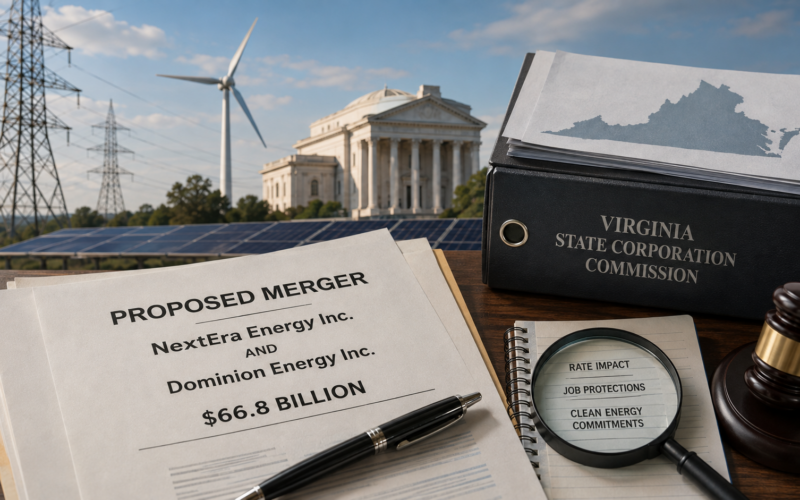
NextEra Energy Inc. (NYSE: NEE) and Dominion Energy Inc. (NYSE: D) now face the first Virginia governor in modern memory to formally insert herself as a party in a State Corporation Commission case, after Governor Abigail Spanberger announced on Thursday, 6 August 2026 that she would file to become an intervenor in the review of the companies’ proposed $66.8 billion all-stock combination. Spanberger, who took office in January 2026, announced the move in a Washington Post opinion piece and a Zoom briefing with reporters, framing the deal as too large and too consequential for the executive branch to observe from the sidelines. Her intervention does not transfer approval authority away from the SCC, which retains the sole power to approve, reject or modify the transaction. The immediate question for investors is not whether Spanberger can block the deal, but whether her involvement raises the probability of structural conditions on customer rates, job protections and clean-energy commitments that would blunt the accretion economics NextEra pitched to the market on 18 May 2026.
What did Governor Abigail Spanberger actually announce on 6 August 2026 and how is intervenor status different from executive approval
Spanberger said she would file paperwork to become a formal party to the SCC’s docketed review of NextEra’s proposed acquisition of Dominion. Intervenor status gives her administration the right to review the companies’ filings, submit interrogatories, cross-examine witnesses, argue for conditions and, once the SCC rules, pursue legal action if she believes the outcome fails to serve the public interest. It does not give her the power to approve, reject or rewrite the transaction. The governor was explicit on this point during her Thursday briefing, stating that the ability to approve or deny, or to impose new parameters, still lies with the SCC. What her intervention does supply is a state-executive megaphone inside the docket, along with legal standing to appeal.
Spanberger characterised her decision as unprecedented for a Virginia governor and justified it by referring to what she described as the equally unprecedented size and scope of the merger application. The commission is expected to rule on the deal in roughly six months, keeping the transaction on a review timetable consistent with the companies’ own second-half 2027 expected close.
How does the intervention change the risk-weighted approval picture for NextEra Energy and Dominion Energy
The bull case on the merger has always assumed that the SCC would ultimately approve the transaction, most likely with conditions, and that those conditions would be manageable inside NextEra’s guidance of nine percent-plus annual adjusted earnings per share growth through 2032. Spanberger’s intervention does not automatically invalidate that assumption, but it does raise the political cost of a clean approval, because any SCC order that appears to accept the companies’ proposed customer benefits at face value will now be scrutinised by an executive who has publicly stated that those benefits are not sufficient.
Her stated priorities cover three areas that speak directly to deal economics. The first is electric bill affordability, an area where NextEra and Dominion have already offered to fund $2.25 billion of Virginia customer bill credits recognised over the first 24 months post-close. The second is job protections, which addresses one of the most sensitive political dimensions of any large regulated utility acquisition, particularly where a Florida-headquartered acquirer takes control of a Virginia-domiciled target. The third is continued clean-energy investment, which aligns with NextEra’s own portfolio identity as the largest renewables and battery-storage developer in the United States, but which also creates political exposure if any post-close capital reallocation moves investment away from Virginia projects.
The exchange ratio remains fixed at 0.8138 NextEra shares plus a pro rata portion of $360 million in cash for each Dominion share, with existing NextEra shareholders retaining approximately 74.5 percent of the combined company. That structure protects NextEra shareholders from headline price risk on the Dominion side, but it does not protect them from the accretion arithmetic being pushed further out to the right if regulators or intervenors extract structural concessions.
Why does the intervention matter more for the data-centre thesis than for the immediate customer-bill argument
The strategic core of the NextEra-Dominion combination is not customer-bill management, which is a regulated cost pass-through, but the ability to serve the northern Virginia data-centre corridor, the largest data-centre market in the world. NextEra Chief Executive John Ketchum told investors on the deal call that the combined company was intended to become the go-to partner for large-load customers building artificial intelligence infrastructure. Dominion has publicly disclosed a data-centre pipeline that the combined company has framed at roughly 130 gigawatts across its regulated and unregulated footprints. This is the earnings vector that most differentiates the deal from a routine utility roll-up.
Spanberger’s July record already includes explicit calls for more oversight of data centres in Virginia, an increase in the share of transmission costs assigned to hyperscale customers and a rebalancing of the cost burden between data-centre load and residential ratepayers. The SCC itself, on 5 August 2026, ordered Dominion to develop a tariff that assigns more transmission costs to data centres. An intervening governor arguing for customer affordability while the commission simultaneously moves to reassign data-centre transmission cost creates a policy environment in which the future economics of serving hyperscale load could look materially different from the assumptions embedded in the pre-deal integrated resource planning.
That does not necessarily change the volume of data-centre load that NextEra and Dominion can serve. It does, however, alter the returns profile of that load, and therefore the discounted value that a combined utility can extract from being the sole regulated interconnection provider for artificial-intelligence infrastructure at scale.
What does the intervention imply for the special session risk and legislative overhang around the Virginia General Assembly
Spanberger has said she is considering all options, including calling a special session of the Virginia General Assembly, to make sure the SCC has adequate time and information to conduct the review. Republican State Senator David R. Suetterlein has publicly said that any such session would need to convene in August for legislative changes to take effect in time to influence the SCC’s review of the transaction. The governor has not yet issued a formal call for the special session, but by keeping the option live she preserves the ability to alter, mid-review, the statutory framework under which the SCC is evaluating the deal.
That is a lower-probability but higher-impact tail risk for the transaction. It is one thing for an intervenor to argue for tougher conditions inside an existing statutory framework. It is different in kind for the legislature to move the statutory perimeter of what the SCC must weigh, or of what the commission’s timetable looks like, while the review is running. Even a session that produces no legislation could function as a public forum that hardens political positions on the deal, particularly in an environment where lawmakers from both parties have already called for a more extensive review of the acquisition.
How does the political overlay interact with NextEra Energy’s history of failed utility acquisitions
NextEra Energy is not new to acquisition-approval risk. Its three previous attempts to acquire regulated utilities, Hawaiian Electric Industries, Oncor Electric Delivery and Duke Energy Corporation, all collapsed before completion. Each of those failures had different specific causes, but they share a common feature: state-level regulatory or political resistance to a Florida-based acquirer taking control of an out-of-state regulated utility. The Dominion transaction has been structured with a much larger set of customer commitments, including the $2.25 billion in bill credits, precisely because NextEra learned from those failures that a stronger customer offer at the outset would be needed to reach the finish line.
Spanberger’s stated position, that the current commitments are not sufficient and that her intervention is designed to secure more detail and stronger long-term benefits for Virginia, echoes the pattern that shaped the earlier failures. This does not mean the Dominion deal will fail. It does mean that the ceiling on what NextEra can concede without eroding the economics is now a live question, and that the transaction may need to absorb additional structural commitments before it clears the SCC.
Regulatory approvals in North Carolina and South Carolina, as well as clearances under the Hart-Scott-Rodino Act at the federal level, remain in parallel motion. The Virginia intervention does not by itself derail those processes, but a materially conditioned Virginia outcome would create both an anchor and a precedent for how the Carolinas approach their reviews.

Where does the market currently price the transaction and how does the intervention fit alongside recent NextEra Energy share performance
NextEra shares traded around $89 in the weeks before Spanberger’s announcement, roughly 10 to 12 percent below the mean Street price target of about $99 and approximately nine percent below the 52-week high of $98.75. That gap embedded some regulatory risk into the share price already, without pricing in a worst-case blocking scenario. Dominion shareholders receive a fixed-ratio consideration, so movements in the Dominion share price largely track the NextEra reference share alongside a deal-completion probability spread.
The July proxy filings from both companies confirmed that the special shareholder meetings will be held virtually on 3 September 2026 to approve the transaction, along with a NextEra charter amendment to increase authorised common shares from 3.2 billion to 5.0 billion. Shareholder approval remains a manageable step given the exchange ratio, cash consideration and premium already priced in. The regulatory path, and specifically the Virginia leg of it, now looks like the higher-variance component of the completion probability.
The intervention does not add a new binary approve-or-deny risk. It adds a wider distribution of possible conditions that could accompany an eventual approval. That is the specific reason why the stock reaction to Spanberger’s announcement is likely to be more muted than the headline framing suggests, and why the more relevant read-through is likely to be found in the specific interrogatories her administration files with the SCC over the coming weeks.
How should investors think about the intervention in the context of NextEra’s pro forma balance sheet and $37.9 billion goodwill
NextEra’s June 2026 pro forma disclosures indicated that acquisition accounting for the Dominion transaction would produce preliminary goodwill of $37,873 million on pro forma combined assets of $373,216 million, with pro forma basic earnings per share from continuing operations of $0.92 for the March 2026 quarter and $3.20 for full-year 2025 after including approximately $500 million of estimated merger-related costs and the $2.25 billion of planned customer bill credits recognised over 24 months.
That goodwill balance is a direct function of the price NextEra is paying and the fair-value step-ups on Dominion’s assets and debt. Any structural conditions imposed during the regulatory review that reduce the pro forma cash-generating capacity of the combined regulated utility footprint will pressure the recoverability of a portion of that goodwill over subsequent testing cycles. NextEra will not face a goodwill test at signing, but the size of the goodwill balance means that any material change to the operating case, whether through customer-bill concessions, mandated capital-allocation commitments in Virginia or restrictions on the transmission-cost allocation to data centres, feeds into a slower-burn accounting risk that runs alongside the immediate accretion story.
What has improved, what remains unresolved and what would strengthen or weaken the investment thesis
What has improved is the clarity of political risk. Investors now know explicitly that the Virginia executive branch will be inside the SCC docket arguing for stronger conditions, and no longer have to model the probability of that scenario as an uncertain forward risk.
What remains unresolved is the specific set of conditions Spanberger will formally request, the SCC’s willingness to adopt them, whether any Virginia General Assembly special session is convened, how the North Carolina Utilities Commission and the South Carolina Public Service Commission react to the Virginia intervention and precisely how NextEra and Dominion respond to the escalating customer-benefit expectation.
What would strengthen the thesis is a clear regulatory schedule out of the SCC, a Virginia settlement structure that ring-fences the accretion economics inside a defined customer-benefit envelope and evidence that the North Carolina and South Carolina reviews are not converging on a materially tougher condition set. What would weaken the thesis is a special session in August that reshapes the statutory review framework, a Virginia-specific condition on data-centre transmission cost allocation that materially compresses the combined utility’s earnings power on hyperscale load or a formal SCC hearing schedule that pushes the second-half 2027 targeted close further to the right.
What are the key numbers and forward catalysts investors should track as Virginia’s regulatory review of the NextEra-Dominion transaction proceeds
- Governor Abigail Spanberger announced on 6 August 2026 that she will file to formally intervene in the Virginia State Corporation Commission’s review of the proposed NextEra Energy acquisition of Dominion Energy, becoming the first Virginia governor to take that step in an SCC case.
- Intervenor status gives her administration the right to submit interrogatories, participate in hearings, argue for conditions and pursue legal action after the ruling, but does not transfer approval authority from the SCC.
- The $66.8 billion all-stock transaction announced on 18 May 2026 exchanges 0.8138 NextEra shares plus a pro rata portion of $360 million in cash for each Dominion Energy share, leaving existing NextEra shareholders with roughly 74.5 percent of the combined company.
- The companies have offered $2.25 billion of Virginia customer bill credits recognised over 24 months, and the governor’s stated position is that current commitments are not yet sufficient.
- The Virginia SCC is expected to rule on the transaction in roughly six months, in line with the companies’ second-half 2027 expected close.
- NextEra has three prior failed regulated-utility acquisition attempts on its record, involving Hawaiian Electric Industries, Oncor Electric Delivery and Duke Energy Corporation, each blocked at the state political or regulatory level.
- Pro forma preliminary goodwill of $37.9 billion would sit on a combined asset base of $373.2 billion, making any structural condition that reduces regulated cash generation a slow-burn goodwill risk alongside the immediate accretion story.
- Special shareholder meetings for both NextEra and Dominion are scheduled for 3 September 2026 to approve the merger and a NextEra charter amendment to increase authorised common shares from 3.2 billion to 5.0 billion.
- North Carolina Utilities Commission and South Carolina Public Service Commission reviews, plus Hart-Scott-Rodino federal antitrust review, remain in parallel motion alongside the SCC docket.
- The near-term signal for investors is the specific set of interrogatories and proposed conditions Spanberger’s administration files with the SCC and any move to convene a Virginia General Assembly special session in August 2026.
Discover more from Business-News-Today.com
Subscribe to get the latest posts sent to your email.