




Why are private equity firms like KKR doubling down on South Korean mid-cap manufacturers in 2025?
Global private equity firm KKR has made another high-profile bet on South Korea’s industrial backbone with the acquisition of Samhwa Co., Ltd., a premium cosmetics packaging manufacturer. The deal, valued at KRW 733 billion (approximately USD 528 million), underscores a growing institutional appetite for mid-cap Korean firms that combine advanced manufacturing with export scalability. This acquisition, which sees KKR take over Samhwa from fellow U.S. investment giant TPG, builds on a strategic pattern of investment into South Korea’s most globally competitive sectors—ranging from fashion and e-commerce to marine engineering and waste management.
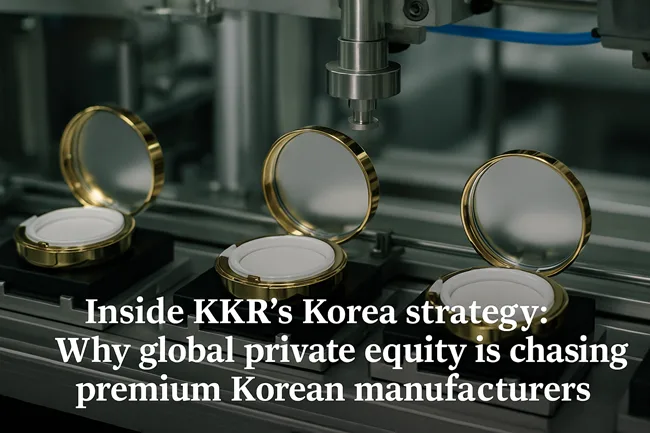
Samhwa, which was founded in 1977 as a mold developer, has grown into one of the top 10 global producers of cosmetic packaging. Known for its proprietary air-tight cushion compacts and airless pump designs, Samhwa supplies more than 300 brands across the globe, including leading K-Beauty and international luxury labels. The company offers fully integrated services—combining R&D, in-house mold manufacturing, high-speed assembly, and multi-region delivery networks—which aligns with KKR’s preference for platform-ready industrial businesses with defensible market share.
KKR’s investment in Samhwa is part of a wider strategy focused on scalable Korean mid-caps. In the past five years, the global private equity firm has accumulated a diverse portfolio of Korean assets, including MUSINSA, a digitally native fashion brand; HD Hyundai Marine Solution, a ship maintenance and parts company; Ecorbit, a circular economy-focused waste management provider; and LS Automotive, a Tier-1 automotive supplier. These moves reflect not only conviction in South Korea’s industrial innovation but also a recognition of the country’s rising role in global supply chains—especially in segments where precision, premiumization, and operational integration are key.
What makes South Korea’s mid-cap manufacturers so attractive to global private equity firms like KKR?
South Korea’s mid-cap manufacturing sector sits at a strategic sweet spot. These companies are large enough to have proven commercial models, mature supply chains, and international exposure—but small enough that private equity firms can unlock additional value through operational upgrades, digital transformation, and global expansion. Firms like KKR are increasingly identifying Korean mid-caps as under-capitalized innovators with untapped growth potential.
The macro backdrop is also supportive. South Korea consistently ranks among the world’s top 10 exporters and is home to advanced industrial capabilities in packaging, semiconductors, display tech, automotive parts, marine engineering, and more. Yet unlike the chaebols, mid-cap firms often lack the internal capital and global networks needed to scale internationally. This has created a pipeline of PE-ready opportunities—especially in areas aligned with consumer wellness, energy transition, and advanced manufacturing.
In Samhwa’s case, its premium packaging formats—particularly in airtight and airless pump systems—are in high demand across skincare, makeup, and hybrid cosmetic categories. These segments are seeing explosive global growth, particularly in Asia, the Middle East, and Europe, where consumers are drawn to formulations that require secure dispensing systems and aesthetically differentiated packaging. Institutional investors view this as a multi-year opportunity, especially as refillable and recyclable formats gain regulatory and commercial momentum.
KKR has shown a clear preference for such businesses. Its investment history in Korea reveals an emphasis on firms that operate with deep vertical integration, strong engineering capacity, and high-value exports. That makes mid-cap Korean manufacturers uniquely positioned for global capital.
How does Samhwa fit into KKR’s wider Korean investment thesis?
Samhwa is not an isolated bet—it’s part of a calculated strategy. KKR’s recent investments in South Korea suggest a focus on three pillars: operational excellence, export scale, and sectoral defensibility. These pillars are visible across its Korean portfolio.
MUSINSA, KKR’s e-commerce and fashion bet, is a millennial-facing platform with strong digital and DTC (direct-to-consumer) infrastructure. HD Hyundai Marine Solution—another KKR investment—provides ship repair and parts services for the global merchant fleet. That company’s 2024 IPO raised over USD 540 million and marked one of the largest listings in South Korea in recent years. Ecorbit, a waste management player, reflects KKR’s interest in sustainable infrastructure.
Samhwa adds to this mix by expanding KKR’s exposure to high-margin consumer industrials. It also positions KKR deeper inside the fast-growing K-Beauty ecosystem, where Korean contract manufacturers, formulators, and packaging providers are rapidly moving up the value chain. With in-house mold design, precision engineering, and strong export momentum, Samhwa offers exactly the kind of vertically integrated platform that KKR can globalize.
KKR’s strategy also appears to favor businesses that are already category leaders in Asia but have the capability to expand globally with the right capital and strategic support. Samhwa, which already supplies over 300 brands including global luxury names, fits this mold. The firm’s integrated production lines and in-house R&D allow for faster innovation cycles, which is critical in a beauty industry driven by seasonal launches, influencer-led trends, and custom packaging solutions.
How does the Samhwa transaction reflect institutional investor confidence in Korea’s premium exports?
TPG’s exit from Samhwa—just two years after its acquisition in 2023—also speaks volumes about the velocity of value creation in Korean industrials. During TPG’s tenure, Samhwa transitioned from a family-run business into a globally poised enterprise with professional governance, digitalized operations, and expanded product offerings. The company’s value uplift during this period suggests that institutional investors are now seeing faster-than-expected returns in Korea’s mid-cap industrials—particularly those serving high-growth export markets.
From an institutional sentiment perspective, Korea’s export-driven mid-cap segment is gaining visibility as a relatively low-risk, high-innovation play. These companies often serve diversified client bases across multiple geographies, have IP-led differentiation, and enjoy policy tailwinds from government-backed R&D and trade facilitation.
KKR’s willingness to double down on these companies through its Asia Fund IV and K-Series vehicles highlights a growing trend among large-cap private equity funds: the search for operationally mature but under-optimized businesses outside the traditional U.S. and Western European corridors. In a tightening global macro environment, Korea offers relative currency stability, a strong IP regime, and skilled labor—all factors that reduce investment friction.
What does this mean for South Korea’s position in the global M&A and private equity landscape?
South Korea is emerging as a core market for global private equity firms seeking scaleable industrial platforms with international upside. Its mid-cap sector is not only manufacturing-centric but increasingly tech-enabled, with strong R&D intensity and flexible production ecosystems. This makes Korean suppliers highly relevant in a world where brands seek agile, ESG-compliant, and design-forward manufacturing partners.
For South Korea, the growing volume of cross-border private equity interest also strengthens its position as a Tier 1 industrial hub. As global investors like KKR continue to pour capital into the country’s manufacturing, logistics, packaging, and e-commerce sectors, Korean suppliers are gaining access to new markets, upgraded digital infrastructure, and supply chain resilience.
Industry watchers believe that deals like Samhwa could spark further M&A and consolidation in adjacent sectors, such as sustainable packaging, functional ingredients, medical devices, and health-tech OEM manufacturing. Other potential ripple effects include secondary listings, vertical joint ventures, and greenfield expansions supported by foreign capital.
If Samhwa executes well under KKR’s guidance, it could become a benchmark case for how Korean packaging innovators scale globally with strategic capital and operational rigor. And if KKR continues its Korean buildout, it may soon be one of the most influential global investors shaping the future of South Korea’s industrial exports.
Discover more from Business-News-Today.com
Subscribe to get the latest posts sent to your email.


