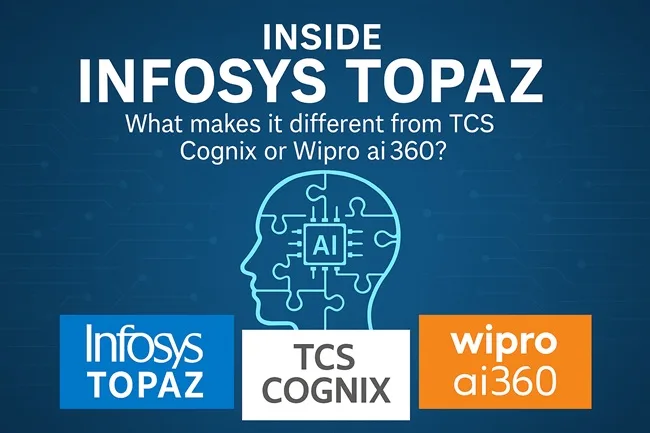
The Indian IT services industry is undergoing one of its most significant transformations in decades as global clients shift from large‑scale outsourcing and migration work toward artificial intelligence‑led business models. Firms such as Infosys Limited, Tata Consultancy Services and Wipro Limited have each introduced flagship platforms to capture this shift: Infosys Topaz, TCS Cognix and Wipro ai360. With clients demanding faster outcomes, higher automation, lower cost of delivery and more “human+AI” models, the platforms represent the next frontier in Indian IT strategy. The question now is not only which of these platforms is most advanced, but which can truly deliver enterprise‑scale adoption and shareholder value.
What is Infosys Topaz and how is it positioned as an AI‑first enterprise platform?
Infosys describes Topaz as an AI‑first set of services, solutions and platforms leveraging generative AI technologies. It claims over 12,000 AI assets, more than 150 pre‑trained AI models and more than ten accompanying AI platforms, overseen by AI‑first specialists and data strategists. According to the firm’s description, Topaz also incorporates a “responsible by design” approach that emphasises ethics, trust, privacy, security and regulatory compliance. Under the framework, the company’s applied‑AI methodology aims to build an AI‑first core that empowers enterprises to deliver cognitive solutions, accelerate value‑creation and drive new growth. Several client success stories cited include a food and beverages chain that used Topaz to connect disparate partner data signals and achieve over 95 % accuracy in consumer‑experience insights, and a British bank that transformed over 2,000 customer‑service processes to near‑real‑time operations instead of a week. The positioning therefore spans both growth opportunities (new business models) and efficiency gains (productivity at scale).
How does TCS Cognix compare in scope, design and target delivery model?
TCS’s Cognix platform is described as an AI‑driven human‑machine collaboration suite built to accelerate enterprise digital transformation. The platform uses the Machine First Delivery Model (MFDM™) framework to prioritise machines for routine tasks and humans for creative or strategic work. Cognix emphasises modular, scalable solutions across IT infrastructure, business processes and applications. TCS highlights benefits such as 90 % prediction accuracy in disruption forecasting, 100 % platform availability, and cost optimisation of over 20 % in selected operations. The emphasis for Cognix appears more on operational resilience, IT and infrastructure delivery, service desk automation, device‑workspace management and hybrid environment orchestration. While AI forms a component of Cognix, its core differentiator seems to be the layering of AI and automation over managed services and digital operations rather than explicitly packaging a full stack “enterprise AI transformation” platform.
What is Wipro ai360 and how does it differ in emphasis and investment?
Wipro’s ai360 is positioned as an AI‑first innovation ecosystem that embeds AI across tools, platforms and processes throughout the enterprise and within client‑facing services. Wipro has disclosed a US$1 billion investment in generative AI and related use cases under the ai360 umbrella, covering training, go‑to‑market and partner initiatives. In the telecom domain, Wipro’s TelcoAI360 platform illustrates a directed use‑case approach: network‑operations optimisation, predictive analytics in IoT and edge, and 5G service‑assurance. The focus of ai360 thus appears to favour domain‑specific models and workflow optimisation. The emphasis is less on building a broad horizontal AI‑platform and more on verticalised, specialised applications, especially in telecommunications and manufacturing contexts.
What are the key differentiators that help Topaz stand out (or not)?
When comparing the three platforms, several differentiators for Topaz emerge. Firstly, the depth of asset‑library and model reuse appears higher in the case of Topaz: the public figure of over 12,000 AI assets and 150+ pre‑trained models suggests scale of reuse and internal repository strength. By contrast, while TCS and Wipro publish platform metrics, they are less explicit on library size of reusable AI assets. Secondly, Topaz’s focus on enterprise “AI agents” capable of performing autonomous tasks across functions suggests a move beyond automation or advisory models into “agentic AI” territory. Thirdly, the explicit verticalisation and domain‑specific packaging of Topaz—across financial services, manufacturing and retail—indicates a deliberate move to align with industry workflows rather than just horizontal infrastructure. Fourthly, Infosys’s emphasis on “Responsible by Design” governance and ethical frameworks may provide an edge especially in regulated industries requiring compliance and trust. However, it is important to recognise that TCS’s infrastructure‑and‑operations strength remains formidable and Wipro’s domain‑specific focus may lead to faster wins in narrower verticals. Ultimately, the differentiator will rest on execution, client outcomes and the shift from pilot programmes to recurring revenue.
What key metrics can help investors evaluate if Indian IT’s AI platforms are truly creating value?
Investors and enterprise buyers looking to evaluate the success of these platforms should shift their focus beyond announcements to measurable outcomes. Key performance indicators will include the percentage of revenue derived from platform services versus traditional services, margin expansion on AI‑led projects, number and value of AI agents or independent modules deployed, time‑to‑value from pilot to production, client retention and expansion rates associated with AI engagements, reduction in operating cost or uplift in productivity delivered via AI agents, adoption rate of platform modules in verticals (such as how many financial‑services clients have adopted Topaz modules), and the emergence of recurring revenue or subscription‑based delivery models derived from these platforms. For example, Infosys reported over 200 enterprise AI agents as part of Topaz in collaboration with a cloud partner, signalling movement beyond experimentation. Monitoring such metrics provides clarity on whether platforms are moving from concept to value creation.
What execution challenges and competitive risks could slow down Indian IT’s AI platform race in 2025?
The race to enterprise AI platforms is fraught with execution challenges. Talent remains the most immediate bottleneck: scaling AI delivery requires not only coders but data scientists, model engineers, domain specialists and infrastructure architects. Indian IT firms must compete not only with each other but with global tech firms and well‑funded startups for this talent pool. Client‑side adoption hurdles also persist as many enterprises grapple with data readiness, governance frameworks, model‑validation, integration complexity and aligning AI outcomes with business strategy. The infrastructure intensity of platform bets raises fixed‑cost risks: if large data centres, GPU racks and cloud intake are built ahead of demand ramp, utilisation could lag and margins could compress. Competition is intensifying too—if all major Indian IT firms deliver broadly similar platforms, differentiation may shrink and margin premiums may erode. Finally, macro factors—such as currency volatility, visa‑policy restrictions, slowing global tech budgets and regulatory uncertainty in AI ethics—remain wild‑cards that could prolong the ramp‑up phase.
Which Indian IT platform is most likely to deliver enterprise‑scale AI value and why?
The platform competition in Indian IT is real and vigorously underway. Infosys Topaz appears to have a broad architectural ambition, combining a large asset library, agent‑based AI, vertical‑industry focus and governance emphasis. TCS Cognix brings deep managed‑services and infrastructure strength while Wipro ai360 offers domain‑specific potential with substantial investment. For investors and enterprise buyers, the winning platform will be the one that converts announcements into revenue growth, demonstrates margin uplift, and scales production‑level AI deployments rather than pilots. On that basis, Topaz currently holds the strategic edge—but execution is everything. At this stage of the cycle, a cautious stance remains appropriate: scale will lag, and the gap between promise and delivery still exists. Indian IT firms are not just riding the AI wave—they are building the next platform wave. Whether Topaz, Cognix or ai360 becomes the dominant engine will hinge on value capture, not just value creation.
Discover more from Business-News-Today.com
Subscribe to get the latest posts sent to your email.